Herbal Pet Supplement Quality: Herbs, Standards and Testing
Herbal pet supplement quality, explained for buyers: plant part, HPLC standardisation, documented adulteration, batch tests and honest evidence grades for pets.
Herbal pet supplement quality comes down to four checks: the right plant part, a named marker measured by HPLC, batch tests for identity, heavy metals and microbes, and honest evidence. Ask for the Certificate of Analysis (CoA). Published tests have found turmeric coloured with lead chromate and boswellia extracts short of their boswellic acids.
This page is the buyer-side reference for our Ayurveda for Pets series. For herb-by-herb guidance written for pet parents, AyurPet’s Ayurveda for Pets hub is the main consumer guide. AyurPet is a sister brand of TrueSource. For the research and safety side, read IndoFolk Wellness’s veterinary Ayurveda research hub.
Key facts
- Plant part: ashwagandha (Withania somnifera) is traditionally a root herb; turmeric (Curcuma longa) is the rhizome; boswellia (Boswellia serrata) is the oleo-gum resin; Triphala is the fruit of three trees.
- Standardised to 5% withanolides means tested withanolide markers make up at least 5% of the extract’s weight. The method (ideally HPLC) must be named.
- Lead in turmeric: 51 of 356 turmeric samples from India, Pakistan, Sri Lanka and Nepal had detectable lead above 2 µg/g (Forsyth et al. 2024).
- Evidence grades used here: A = controlled trials in dogs or cats; B = smaller or open studies in dogs or cats; C = other animals; D = human studies only; E = lab work or traditional use only.
What decides herbal pet supplement quality?
Herbal pet supplement quality is decided by identity, strength and purity, and each needs a test result, not a promise. Identity means the right species and plant part. Strength means how much of a named marker is present, by which method. Purity covers heavy metals, pesticide residues and microbes. The WHO publishes the reference methods in Quality control methods for herbal materials.
Pet products add one more question: does the label stay within the law? In the UK, a product presented as acting against disease in animals counts as a veterinary medicine and needs a marketing authorisation (Veterinary Medicines Directorate). That is why careful brands say “supports” and give evidence, rather than promise outcomes. The National Animal Supplement Council’s NASC Quality Seal requires member companies to pass an independent quality audit and keep an adverse event reporting system.
Which plant part and evidence grade go with each herb?
Each herb has a traditional plant part, a main marker to test and at least one documented quality problem. The table adds the evidence grade for dogs and cats.
| Herb (Latin name) | Part used | Marker to ask for | Documented quality problem | Evidence in dogs and cats |
|---|---|---|---|---|
| Ashwagandha (Withania somnifera) | Root | Withanolides, by HPLC | Root material mixed with leaf and stem (Dutta and Gupta 2026) | A: one small placebo-controlled trial of root extract in 20 older dogs (Bharani et al. 2024) |
| Turmeric (Curcuma longa) | Rhizome | Curcuminoids, by HPLC | Lead chromate added for colour (Forsyth et al. 2019); synthetic curcumin (You et al. 2022) | A, mixtures only: 42 dogs fed curcuminoids with collagen and green tea (Comblain et al. 2017) |
| Boswellia (Boswellia serrata) | Oleo-gum resin | KBA and AKBA, by HPLC | Citric acid added to pass titration tests (Püski et al. 2024) | B: open study in 29 dogs, no control group (Reichling et al. 2004) |
| Triphala (amalaki, bibhitaki, haritaki) | Fruits of Emblica officinalis, Terminalia bellerica and Terminalia chebula (Peterson et al. 2017) | Ask which marker, and the ratio of the three fruits | Heavy metals, as with any Ayurvedic preparation (Saper et al. 2008) | D: human research only; a PubMed search on 18 Nov 2026 found no dog study |
What does “standardised to 5% withanolides” mean?
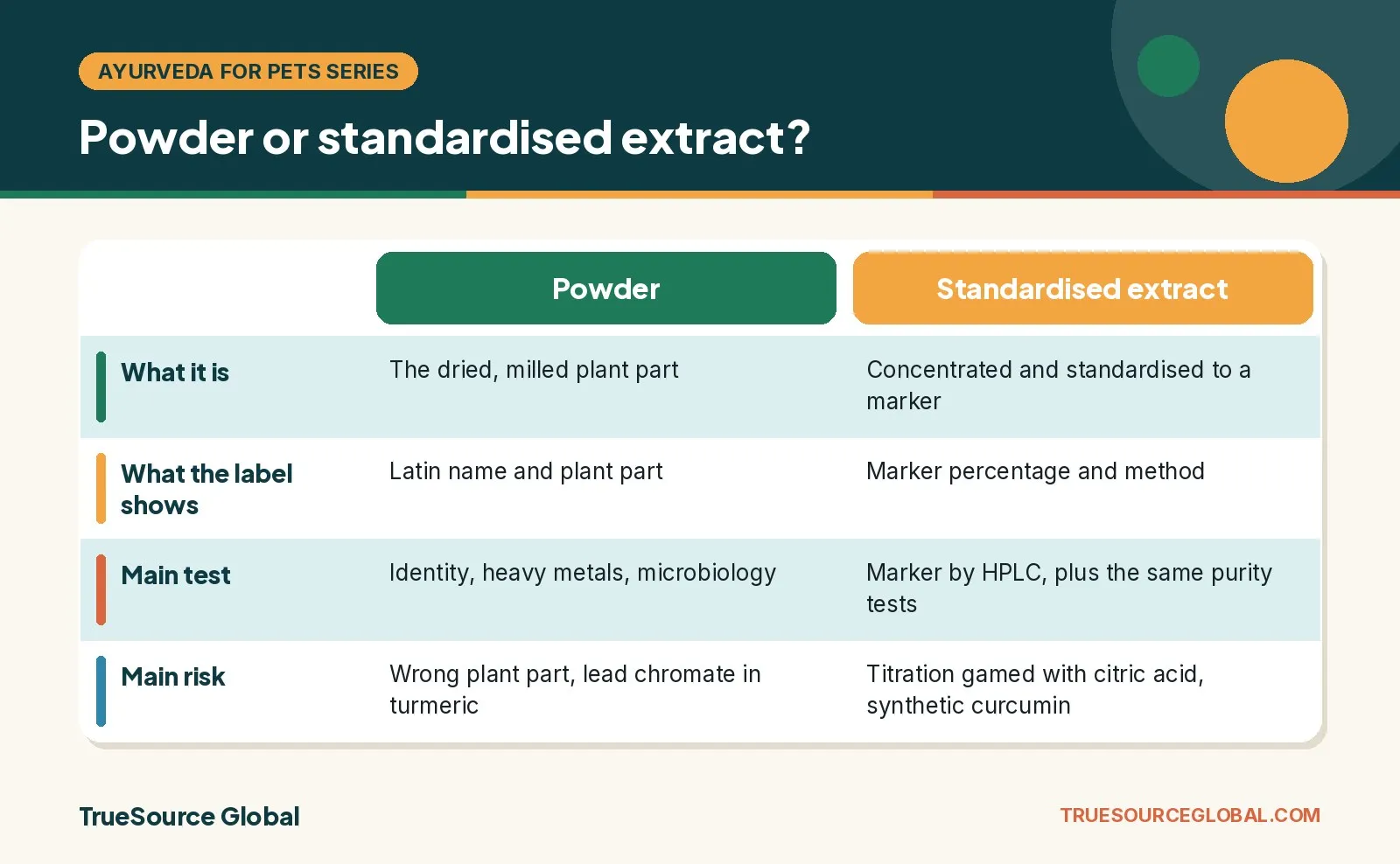
It means the named withanolide markers add up to at least 5% of the extract’s weight, and the number is only useful with the method beside it. A powder is the dried, milled plant part; an extract is concentrated and standardised to a marker. The label should say which one it contains.
Method matters because cheaper tests can be gamed. When researchers tested 14 commercial boswellia extracts, only two met the criteria for KBA and AKBA measured by HPLC. Ten contained 6 to 11% citric acid, which is not a natural part of the resin and raises the result of a titration test for total boswellic acids (Püski et al. 2024). A similar story applies to turmeric: in a study combining HPLC with carbon-14 testing, only 4 of 14 turmeric supplements supported their authentic label claims, with synthetic curcumin found in others (You et al. 2022).
So ask three questions about any standardised herb: which marker, which method, and is there a carrier such as maltodextrin in the percentage. Our herbal extract guide for EU buyers and ashwagandha comparison cover these specifications in more depth.
Which adulteration problems are documented?
Three are well documented for these herbs: lead chromate in turmeric, leaf in ashwagandha root, and undeclared additives in boswellia. In Bangladesh, researchers found lead chromate pigment being added to turmeric during polishing in 7 of the 9 major producing districts, with turmeric powder reaching 1,152 µg/g lead (Forsyth et al. 2019). A 2024 follow-up found lead above 1,000 µg/g in turmeric from Patna in India and from Karachi and Peshawar in Pakistan (Forsyth et al. 2024).
Metals are a wider issue too. Of 193 Ayurvedic medicines bought online and analysed, 20.7% contained detectable lead, mercury or arsenic, and 75% of those products claimed Good Manufacturing Practices (Saper et al. 2008). A GMP logo is not a test result.
Which tests should a Certificate of Analysis show?
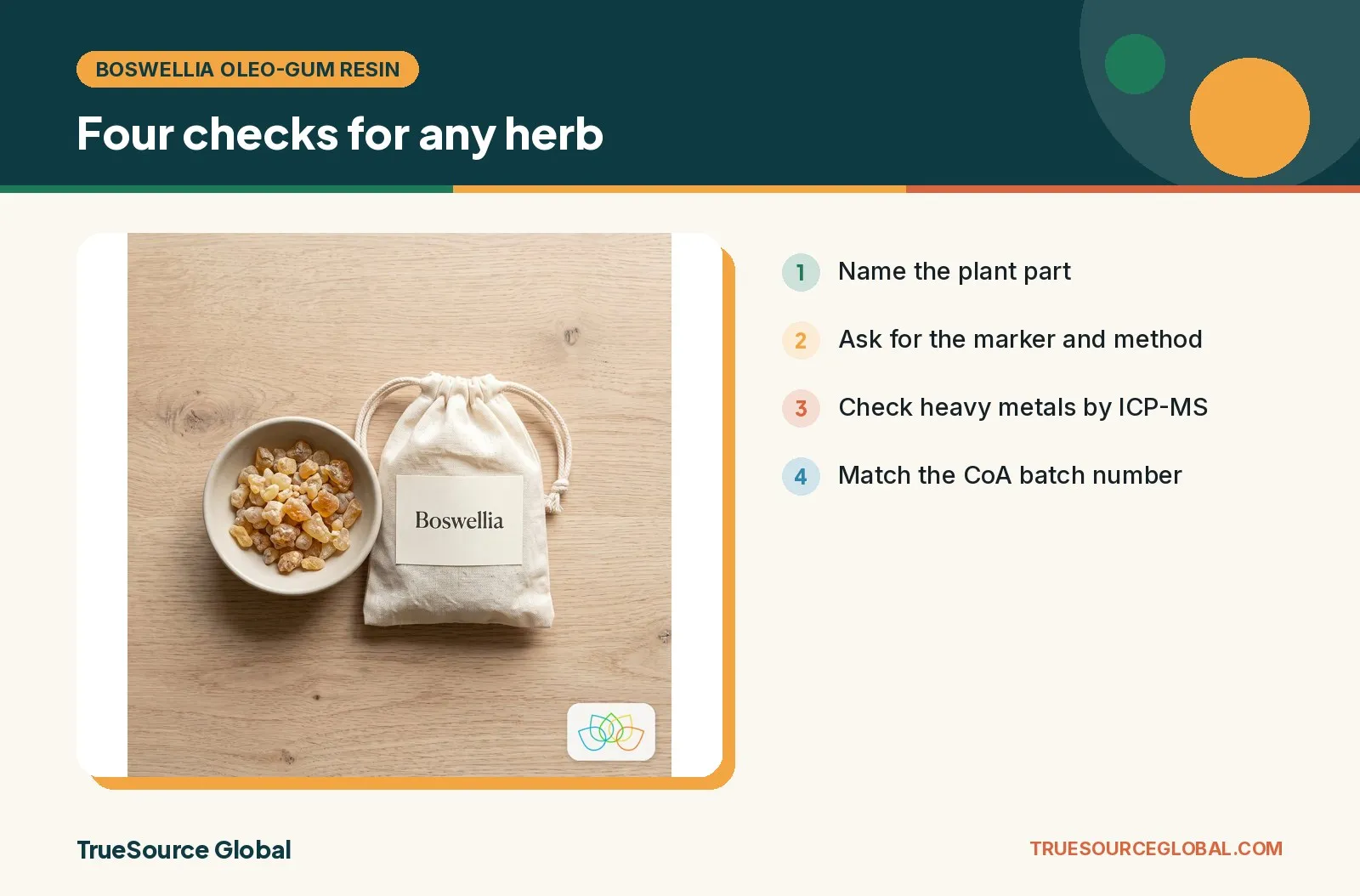
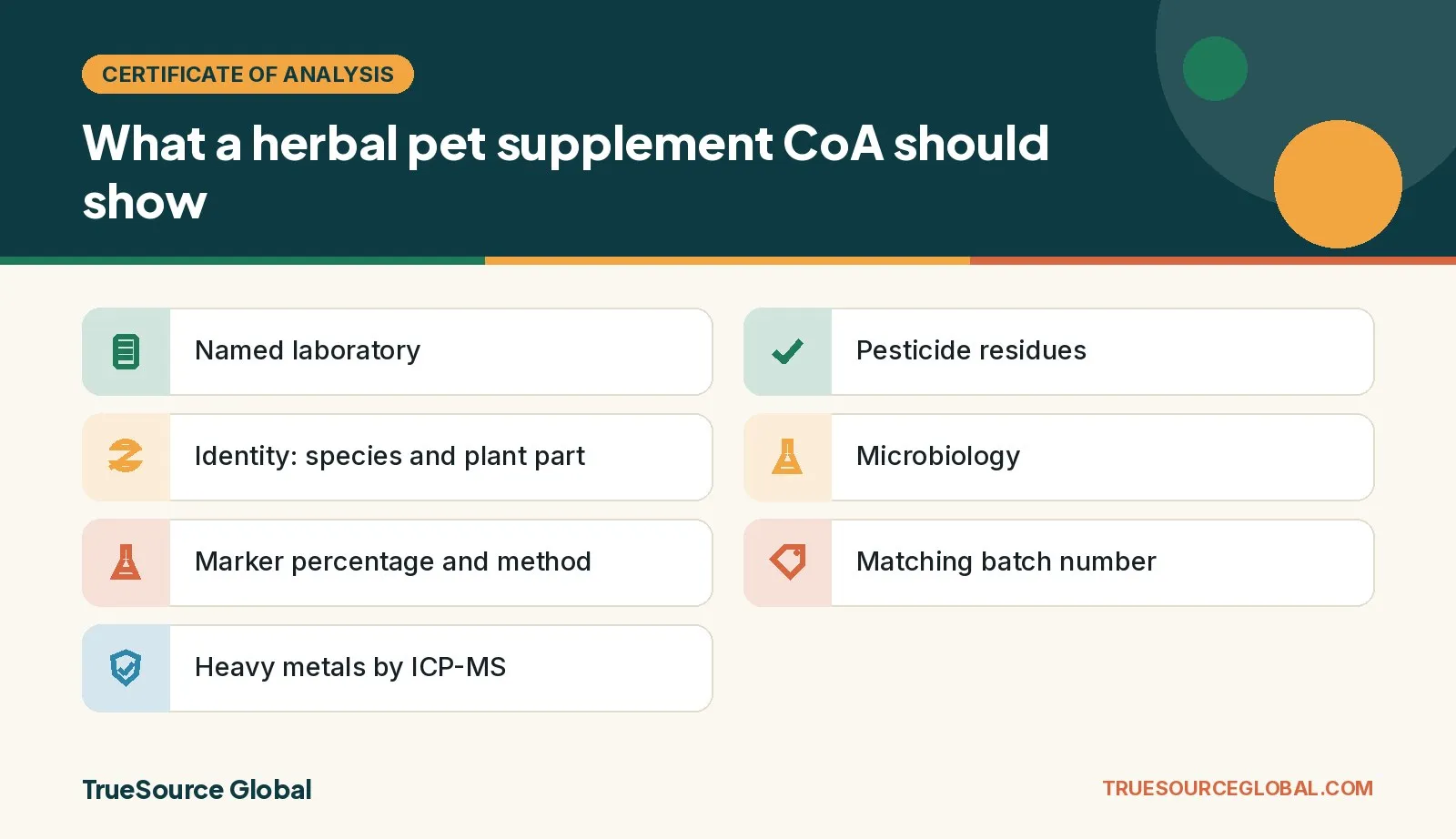
A CoA should come from a named laboratory, carry the same batch number as the product and cover identity, strength and purity. Use this list with any brand or supplier:
- Identity: species and plant part confirmed, for example by HPTLC fingerprint against a reference.
- Strength: the marker percentage and the method (HPLC for withanolides, curcuminoids, KBA and AKBA).
- Heavy metals: lead, arsenic, cadmium and mercury, usually by ICP-MS.
- Pesticide residues: against the limits of the market you sell in.
- Microbiology: total plate count, yeast and mould, and pathogens such as Salmonella and E. coli.
- Batch match: the CoA batch number matches the pack, and the report is recent.
How strong is the evidence for these herbs in dogs and cats?
The evidence is thin and uneven. Grade A here means at least one controlled trial in dogs, not proof that a herb works.
- Ashwagandha (A): a randomised, double-blind, placebo-controlled trial in 20 healthy dogs aged 8 or older found lower serum cortisol after 60 days of root extract (Bharani et al. 2024). The study was small and short.
- Turmeric (A, mixtures only): in 42 dogs with osteoarthritis, a diet with curcuminoids, hydrolysed collagen and green tea extract lowered vets’ scores for pain on manipulation over three months, but force plate and biomarker results did not differ (Comblain et al. 2017). The trial cannot separate turmeric from the other ingredients.
- Boswellia (B): an open study gave a resin extract to 29 dogs with joint and spinal disease for six weeks and reported fewer signs, with brief diarrhoea or wind in 5 dogs (Reichling et al. 2004). There was no control group. A controlled crossover trial in 17 dogs tested boswellia only in combination with UC-II collagen (Stabile et al. 2024).
- Triphala (D): the research summarised by Peterson et al. (2017) is in people and the lab. It is traditionally used for digestion, but that is not evidence for pets.
Cats are not small dogs.
- Cat livers have a very low capacity for glucuronidation, a main route for clearing many compounds, compared with dog livers (van Beusekom et al. 2014). Never give a cat a product or amount chosen for a dog.
- Concentrated tea tree oil caused serious signs, including tremors and unsteadiness, in 337 dogs and 106 cats reported to ASPCA Animal Poison Control, with younger, lighter cats most at risk (Khan et al. 2014).
- Onion, garlic and chives can damage red blood cells, and cats are more susceptible than dogs (ASPCA).
- IndoFolk Wellness’s feline safety reference on Ayurvedic herbs and cats lists herbs and oils to use with caution or avoid in cats.
Which medicines and warning signs should you raise with a vet?
Raise every medicine your pet takes, and especially anti-inflammatory painkillers (NSAIDs), anticoagulants and antiplatelet medicines. The Merck Veterinary Manual notes that turmeric may increase the risk of bleeding when combined with NSAIDs, and that boswellia may inhibit platelet aggregation. IndoFolk Wellness’s herb-drug interaction table for dogs and cats lists more medicine classes to raise. For amounts, ask your vet for an amount for your pet’s weight and health. Never scale down a human dose.
When to see a vet: before starting any herbal product if your pet is pregnant, very young, elderly, on medicine or has a long-term condition, and straight away if you see vomiting, diarrhoea, lethargy or unsteadiness after starting one.
What is coming next in the TrueSource series?
Each guide will be linked here once it is live:
- 20 Nov 2026: Ashwagandha root vs leaf extract in pet products: what to check
- 22 Nov 2026: Turmeric supplement lead testing for pet products: curcumin standardisation and CoA checks
- 24 Nov 2026: Liquid drops, chews, powder or oil: choosing a herbal supplement format for pets
- 26 Nov 2026: How to read a herbal pet supplement label: Latin names, plant part and extract ratios
- 28 Nov 2026: Heavy metals in herbal pet supplements: testing and questions to ask a brand
- 30 Nov 2026: Herbal yak chews: what turmeric and ashwagandha chews can and cannot carry
How can a pet brand source herbs to this standard?
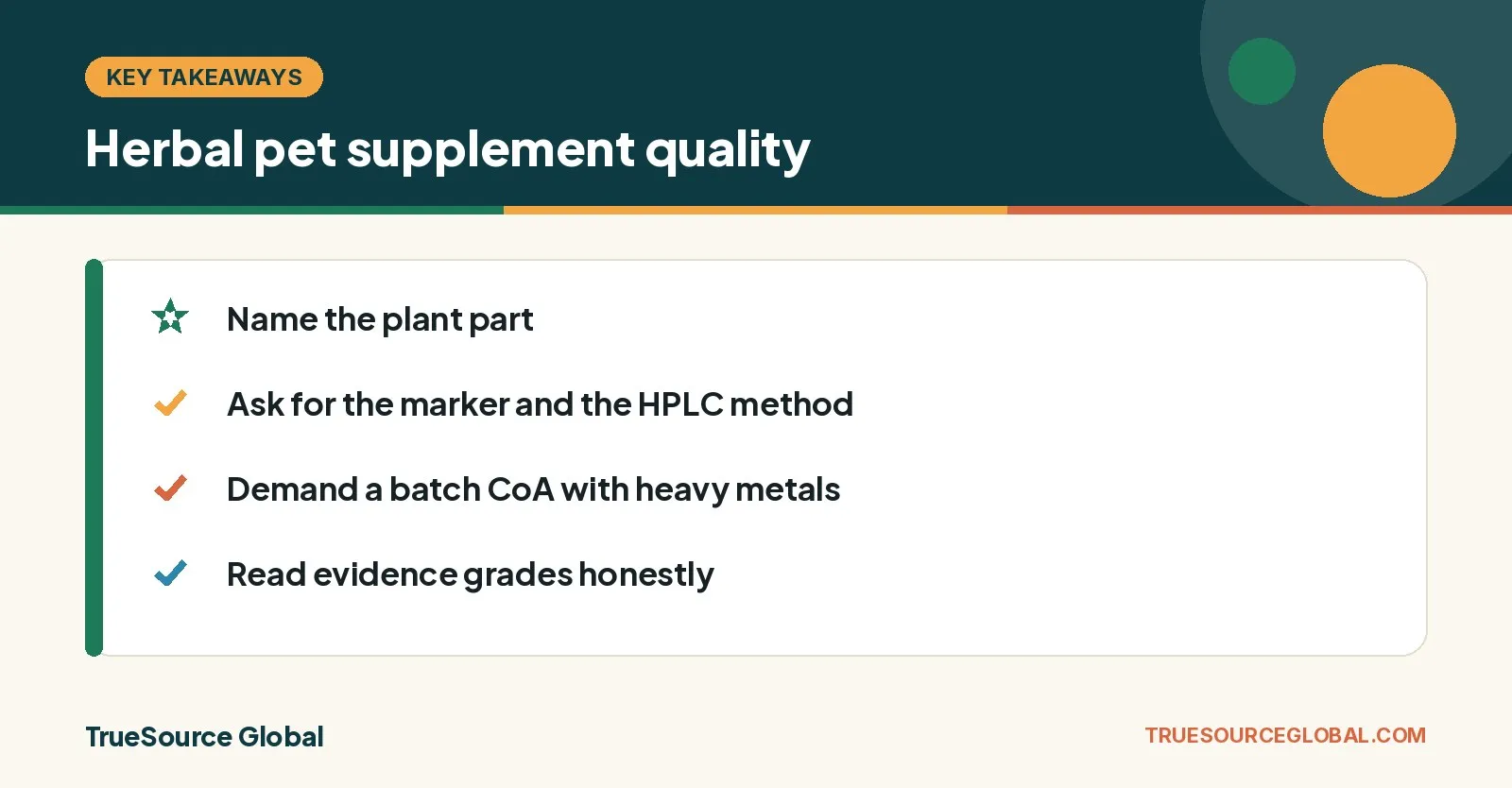
Write the four checks into your specification before you compare prices. We source Ayurvedic herbs such as ashwagandha, turmeric, boswellia and Triphala through GMP-certified partner facilities, including AYUSH GMP for Ayurvedic products, with third-party lab Certificates of Analysis that include heavy metals and microbiology. Most pet products start at 100 units. See our pet wellness page, quality and documentation page and the full Ayurvedic herbs range. Request a pet product quote and we’ll reply within 12 hours, or book a call.
Frequently asked questions
How can I tell if a herbal pet supplement is good quality?
Check that the label names the herb by its Latin name and plant part, and that any standardisation names a marker and a method, such as withanolides by HPLC. Then ask the brand for a batch Certificate of Analysis from a named laboratory covering identity, heavy metals and microbiology. A brand that cannot show these is asking you to trust it without evidence.
What does standardised to 5% withanolides mean?
It means the extract was tested and the named withanolide markers make up at least 5% of its weight. The figure only means something with the test method attached, because results from HPLC and from cruder methods are not comparable. Plain root powder usually carries no such guarantee.
Are herbal supplements for dogs tested for heavy metals?
Not automatically. A good brand tests each batch for lead, arsenic, cadmium and mercury, usually by ICP-MS, and can show you the report. This matters because studies have found lead chromate added to turmeric and detectable metals in about one in five Ayurvedic medicines bought online.
Is there good evidence that Ayurvedic herbs work in dogs?
It varies by herb. Ashwagandha root extract has a small placebo-controlled trial in older dogs (grade A), boswellia has an open study without a control group (grade B), and Triphala has human research only (grade D). Be wary of any product claim stronger than the evidence, and ask your vet before you start.
Can I give my cat a herbal supplement made for dogs?
Not without asking your vet. Cats clear many compounds through glucuronidation far more slowly than dogs, so an amount chosen for a dog can be wrong for a cat. Products with essential oils such as tea tree, or with garlic or onion, should not be given to cats.
Sources
- Bharani et al. (2024): Ashwagandha root extract in healthy geriatric dogs, randomised double-blind placebo-controlled study, Veterinary Medicine and Science
- Comblain et al. (2017): Diet with curcuminoids extract, hydrolysed collagen and green tea extract in dogs with osteoarthritis, BMC Veterinary Research
- Reichling et al. (2004): Dietary support with Boswellia resin in canine joint and spinal disease, open multicentre study
- Stabile et al. (2024): UC-II and Boswellia serrata supplement in dogs, randomised placebo-controlled crossover study, PLoS One
- Peterson, Denniston and Chopra (2017): Therapeutic uses of Triphala in Ayurvedic medicine
- Dutta and Gupta (2026): Plant part-specific differences in ashwagandha, root and leaf evidence, Food Science and Nutrition
- Püski et al. (2024): Detection of citric acid adulteration in Boswellia extracts, Journal of Dietary Supplements
- You et al. (2022): Labelling accuracy and economically motivated adulteration of turmeric supplements, Food Chemistry
- Forsyth et al. (2019): Lead chromate pigments added to turmeric in Bangladesh, Environmental Research
- Forsyth et al. (2024): Evidence of turmeric adulteration with lead chromate across South Asia, Science of the Total Environment
- Saper et al. (2008): Lead, mercury and arsenic in US- and Indian-manufactured Ayurvedic medicines sold online, JAMA
- WHO: Quality control methods for herbal materials (2011)
- Merck Veterinary Manual: Common botanical products in veterinary medicine
- van Beusekom, Fink-Gremmels and Schrickx (2014): Glucuronidation capacity of the feline liver compared with dogs
- Khan, McLean and Slater (2014): Concentrated tea tree oil toxicosis in dogs and cats, 443 cases, JAVMA
- ASPCA Animal Poison Control: People foods to avoid feeding your pets
- Veterinary Medicines Directorate: Legal requirements for placing a veterinary medicine on the market
- NASC: Quality Seal requirements
Ready to source this from India?
Tell us the product, volume and market. We'll reply within 12 hours with a quote, MOQ and sample plan, with no obligation.