Ashwagandha Manufacturers in India for US Buyers: How to Choose (and Who We'd Pick)
Ashwagandha manufacturers in India for US buyers compared: root vs root and leaf, powder vs HPLC extract, testing, documents and FDA import steps.
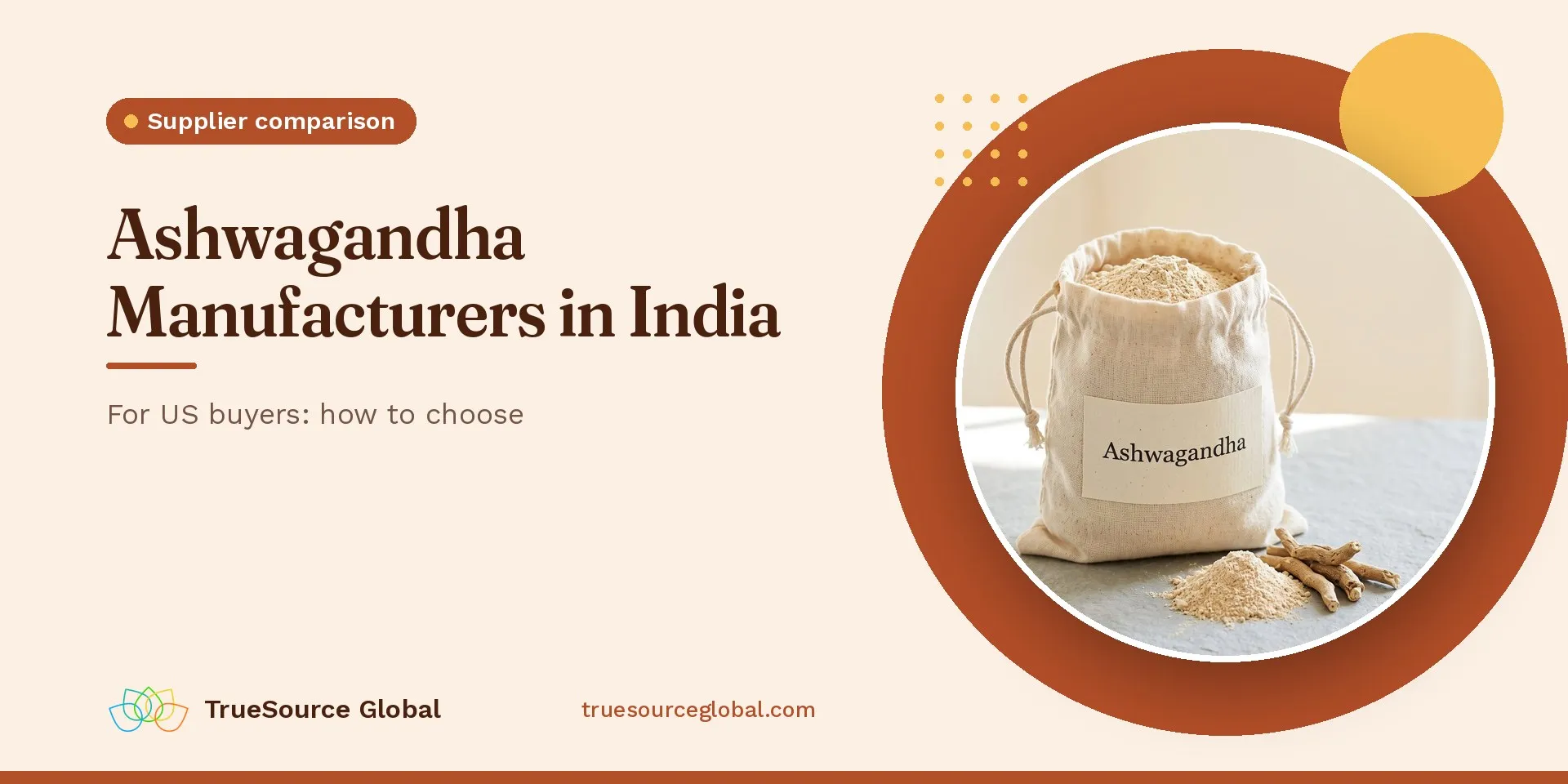
The best ashwagandha manufacturers in India for US buyers are the ones that can tell you, in writing, which part of the plant they use, how the extract is standardised (withanolides by HPLC) and which batch tests sit on the Certificate of Analysis, then back it with FDA facility registration for your importer. Our shortlist is TrueSource Global, Ixoreal Biomed (KSM-66), Arjuna Natural (Shoden), Botanic Healthcare, Starwest Botanicals as a US-stocked option, and B2B marketplaces. Which fits depends on whether you need root powder, a standard extract or a branded ingredient.
TrueSource Global publishes this guide and has put itself first, so judge the alternatives for yourself.
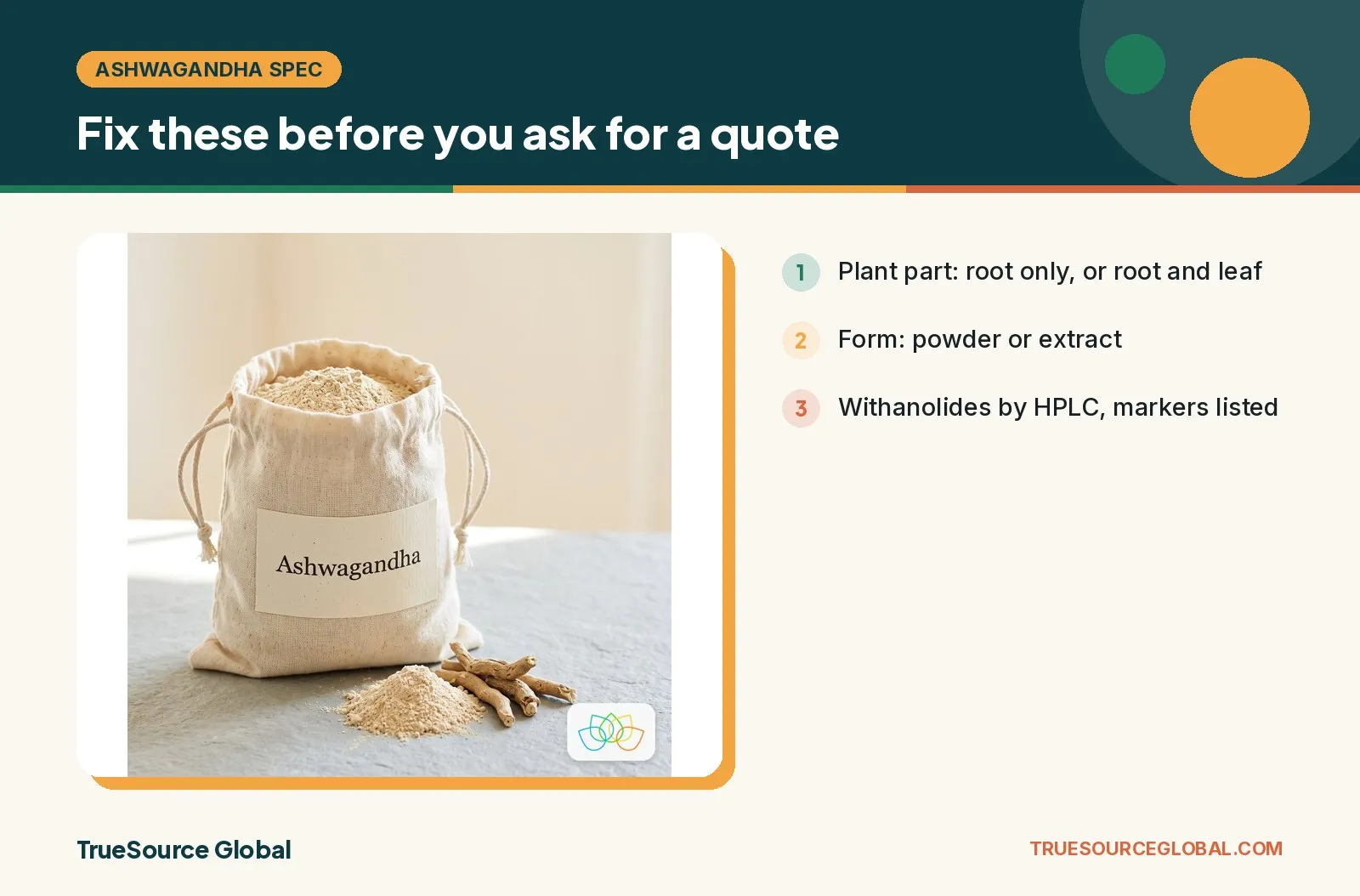
What should you specify before you contact an ashwagandha supplier?
Buyers who ask for “ashwagandha” get back three different products. Fix these four points first.
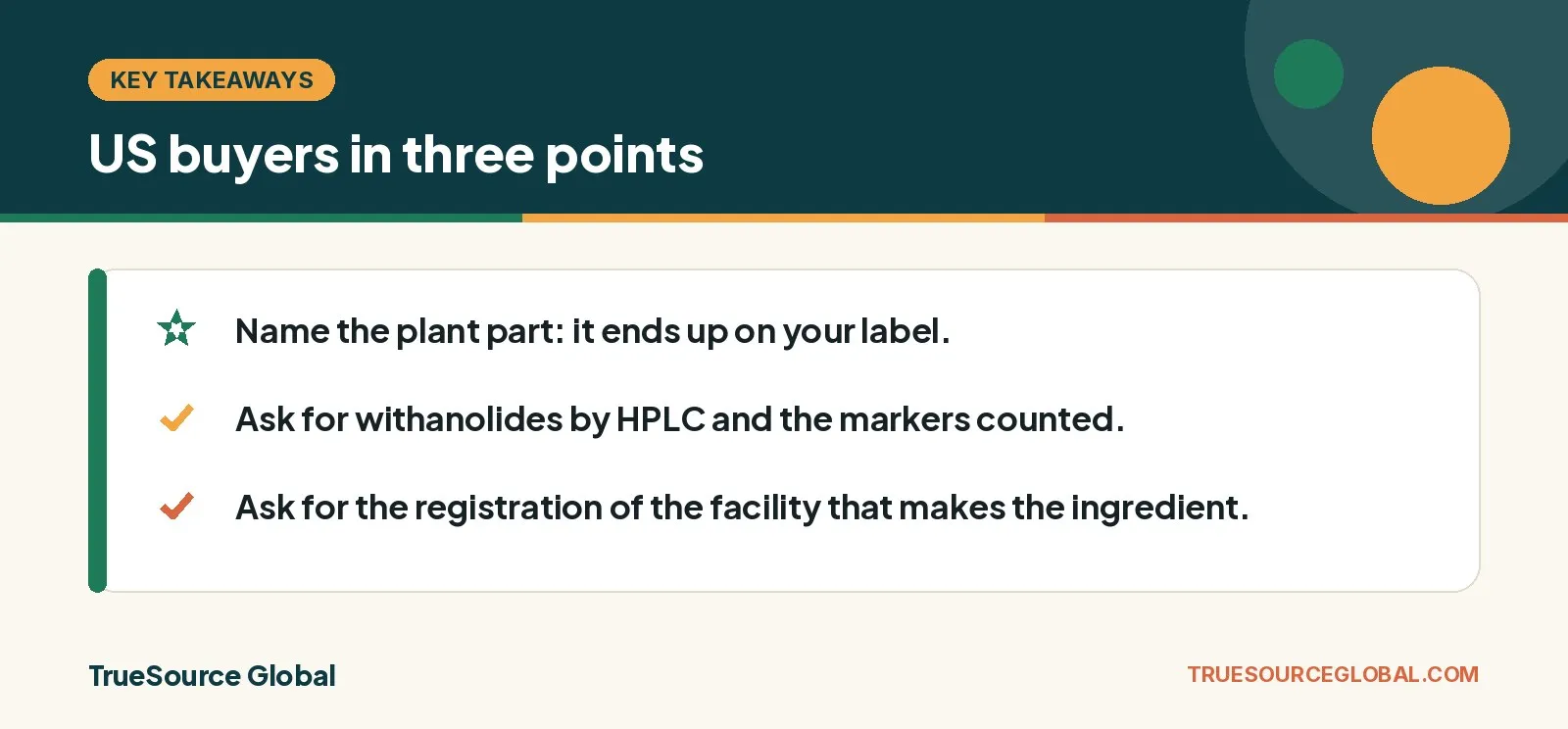
1. Plant part: root only, or root and leaf. Ashwagandha (Withania somnifera) is traded mainly as root, though some extracts combine root and leaf. A US supplement label must name the plant part under 21 CFR 101.4(h), so this choice ends up on your pack. Ask for identity testing (HPTLC or microscopy). For pet products, our ashwagandha root vs leaf extract guide explains why a withanolide figure alone cannot confirm the plant part.
2. Form: powder or extract. Root powder is dried, milled root, usually sold by mesh size and moisture. An extract is concentrated and standardised to a stated withanolide percentage. They are priced very differently.
3. Standardisation method. Ask for withanolides “by HPLC” and the list of markers counted. Figures from other methods are not comparable. Ask whether the percentage includes any carrier, such as maltodextrin.
4. Tests on every batch. The CoA should cover identity, the withanolide assay (for extracts), heavy metals (lead, arsenic, cadmium, mercury, usually by ICP-MS), pesticide residues, microbiology, moisture and, where relevant, residual solvents. It should come from a named, accredited laboratory.
If your range includes pets, AyurPet’s guide to ashwagandha for anxious dogs shows how this herb is explained to pet parents.
How did we compare ashwagandha manufacturers?
| Criterion | What we looked for |
|---|---|
| Product range | Root powder, standard extracts, branded extracts, finished formats |
| Specification clarity | Plant part, withanolide method and percentage stated on the supplier’s own site |
| Testing and documents | Stated tests, certifications and CoA practice |
| US readiness | Support for FDA facility registration, Prior Notice and FSVP |
| Minimums and pilot runs | Published MOQ, or willingness to run a small first order |
| Accountability | One contact who answers for the batch, in English, on time |
We used only what each company publishes on its own website.
Who are the main ashwagandha manufacturers and suppliers to compare?
1. TrueSource Global. We are the B2B sourcing and export brand of IndoFolk Wellness Private Limited, New Delhi. We source ashwagandha as powder, extract and capsules from 200+ partners, alongside turmeric, shilajit and moringa in our Ayurvedic herbs and supplements range. Partner facilities include GMP, ISO and US FDA-registered sites, with third-party CoAs covering heavy metals and microbiology. Most products start at 500 units per SKU, with pilots from 100 to 250 units. Samples dispatch in 5 to 7 working days and quotes take 12 hours. The limits: we don’t own factories, we sell no branded, patented extract (for a named ingredient, look at KSM-66 or Shoden), and we’re a newer export brand, so ask for references. Our private label team can make finished goods.
2. Ixoreal Biomed (KSM-66). The maker of KSM-66, a branded extract, with addresses in Hyderabad, India and Los Angeles. It describes KSM-66 as a root-only, full-spectrum extract made “without using alcohol or any other chemical solvent”, shows certification logos including USDA Organic, NSF GMP and ISO 22000, and lists heavy metal, pesticide, microbiological and aflatoxin testing. MOQ and withanolide specification are not published on the pages we checked, and brand-name use on your pack follows the brand owner’s terms.
3. Arjuna Natural (Shoden). An Indian extract maker in Kochi, Kerala. Its Shoden page describes a root and leaf extract standardised to 35% withanolide glycosides “measured by HPLC”, plus a root-only version, Shoden-R. MOQ is not published, and the core extract includes leaf, which your US label must declare.
4. Botanic Healthcare. An Indian extract maker based in Hyderabad. Its ashwagandha page describes a full-spectrum extract profiled for six named withanolides, and states GMP, ISO, HACCP and FSSAI certifications. Percentage, method, plant part and MOQ are not stated on that page, so confirm them in writing.
5. Starwest Botanicals (US-stocked). A US herb supplier in Sacramento, California, listing India as the origin of its organic ashwagandha root powder. Its commercial programme quotes orders “from 50 pounds to full containers” and states QAI organic processor, SQF and kosher certification, with in-house testing. US stock means no import, Prior Notice or FSVP work, but you buy from an intermediary, so unit costs are typically higher.
6. B2B marketplaces (IndiaMART, Alibaba). A fast way to see prices, but many sellers are traders, not manufacturers, and plant part, method and CoA are often unclear. Use our supplier vetting checklist.
How do these options compare side by side?
| Option | Forms | Plant part stated | Standardisation stated | MOQ published | US import support |
|---|---|---|---|---|---|
| TrueSource Global | Powder, extract, capsules | Set in your specification | Set in your specification | Yes (500 units; pilots 100 to 250) | Yes |
| Ixoreal (KSM-66) | Branded extract | Root only | Not on pages checked | No | Ask |
| Arjuna Natural (Shoden) | Branded extract | Root and leaf; root-only version | 35% withanolide glycosides, HPLC | No | Ask |
| Botanic Healthcare | Extract | Not on page checked | Six markers named, % not stated | No | Ask |
| Starwest Botanicals | Organic powder, cut root | Root | Not stated for powder | Yes (50 lb commercial) | Not needed (US stock) |
| B2B marketplaces | Varies | Varies | Varies | Varies | Rarely |
Why would we choose TrueSource Global for US buyers?
Because the hard part of a US ashwagandha order is rarely the herb. It is getting batch two to match the sample, and giving your importer the documents it needs. We start from your specification (plant part, mesh or extract ratio, withanolide percentage and method, test limits) and supply the facility and batch details your importer needs for Prior Notice and FSVP. A pilot run of 100 to 250 units lets you test both first. See our international buyers page and quality and documentation page.
What do I need to import ashwagandha from India into the USA?
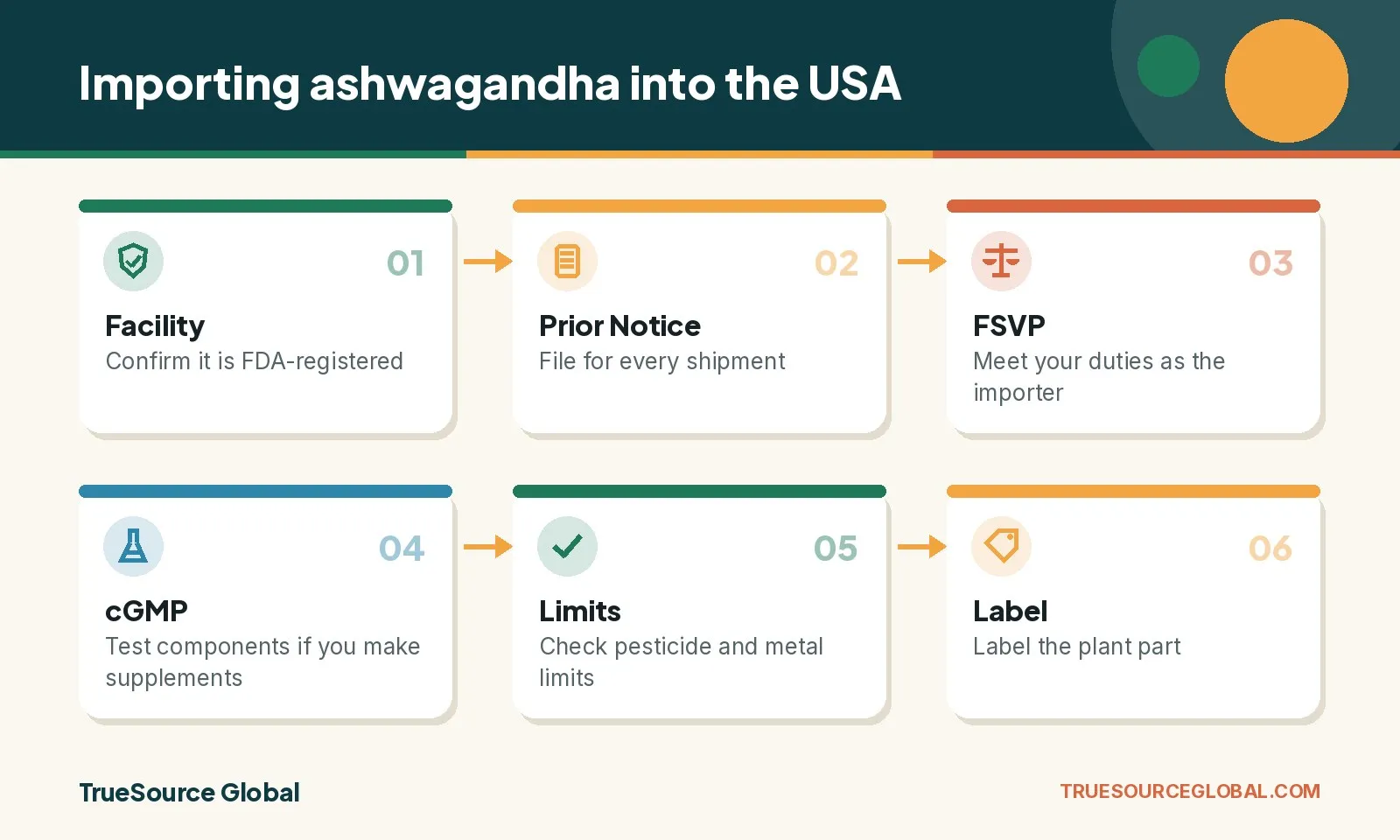
- Confirm the facility is FDA-registered. Ask for the registration of the facility that makes the ingredient (FDA food facility registration).
- File Prior Notice for every shipment before it arrives (21 CFR Part 1 Subpart I).
- Meet FSVP duties as the importer (21 CFR Part 1 Subpart L); for dietary supplement components, see 21 CFR 1.511.
- If you make supplements, test components under cGMP. 21 CFR 111 and 111.75 require you to confirm identity and verify the supplier’s CoA.
- Check pesticide and metal limits. The EPA sets tolerances in 40 CFR 180 and the FDA enforces them on imports (FDA: Pesticides). See FDA: Lead in Food and Foodwares, and check Proposition 65 warning duties if you sell in California.
- Label the plant part and follow supplement labelling rules (21 CFR 101.4(h), FDA Dietary Supplement Labeling Guide). Check permitted claims before writing pack copy. If you sell as organic, look up the supplier in the USDA Organic Integrity Database and see the Strengthening Organic Enforcement rule.
Pet products such as ashwagandha chews are regulated as animal food, not supplements, so confirm the rules with your customs broker. For the Indian side of the paperwork, see our export documents checklist, and our Ayurvedic ingredients supplier comparison covers other herbs.
Which questions should I ask before the first order?
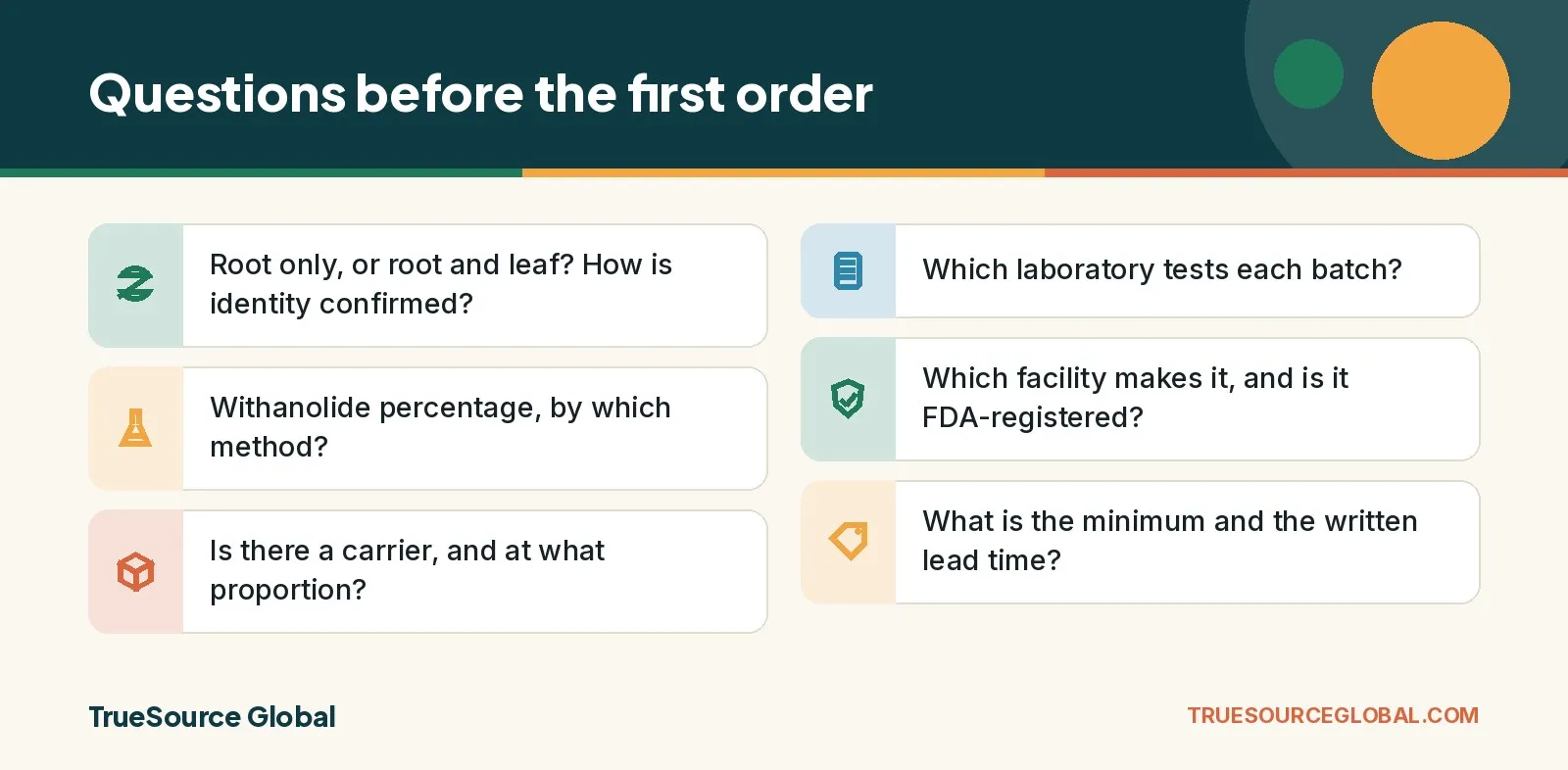
- Is this root only, or root and leaf? How do you confirm identity?
- What is the withanolide percentage, by which method, and which markers are counted?
- Is there a carrier in the extract, and at what proportion?
- Which laboratory tests each batch, and does the CoA cover heavy metals, pesticides and microbiology?
- Which facility makes the product, and is it FDA-registered?
- What is the minimum in kilograms or units, and the written lead time?
Sourcing ashwagandha for a pet product? Our herbal pet supplement quality guide covers the same checks for dogs and cats, with evidence grades.
Request an ashwagandha quote
Send us your specification (plant part, form, withanolide percentage and method, volumes) and we’ll quote within 12 hours. Request an ashwagandha quote, see how it works, or book a call to talk through your specification.
Frequently asked questions
Who is the best ashwagandha manufacturer in India for US buyers?
It depends on what you are buying. For root powder or standard extracts with low minimums, pilot runs and help with US import documents, we'd pick TrueSource Global; for a branded, clinically studied extract, Ixoreal Biomed (KSM-66) and Arjuna Natural (Shoden) are the established names. TrueSource Global publishes this guide and has put itself first, so request samples and CoAs from several suppliers and judge for yourself.
Should I buy ashwagandha root only, or root and leaf?
Decide this first, because it changes the specification, the price and the label. US dietary supplement labels must name the part of the plant used (21 CFR 101.4(h)), so a root and leaf extract has to say so. Many US brands specify root only; whichever you choose, write it into the specification and ask for identity testing that confirms it.
What does 5% withanolides by HPLC mean?
It means the extract has been tested by high-performance liquid chromatography and the named withanolide markers add up to at least 5% of its weight. Figures from gravimetric or other methods are not directly comparable with HPLC figures, so always ask which method the CoA uses and which markers it counts. Plain root powder is usually sold without a withanolide guarantee, or with a low one.
Do I need FDA approval to import ashwagandha from India?
No. The FDA does not approve dietary supplement ingredients or suppliers. The facility that makes or packs the ingredient must be registered with the FDA, each shipment needs Prior Notice, and the US importer must meet Foreign Supplier Verification Program duties, or the cGMP rules in 21 CFR 111 if it manufactures supplements with the ingredient.
What is the minimum order for ashwagandha from India?
Most large extract makers do not publish a minimum, so ask in writing. At TrueSource Global, most products start at 500 units per SKU, with pilot runs from 100 to 250 units at a slightly higher unit cost; custom formulations need higher minimums. For bulk powder or extract in drums, ask us for the minimum in kilograms with your quote.
Sources
- eCFR: 21 CFR 101.4, food labelling and designation of ingredients (part of plant, 101.4(h))
- FDA: Dietary Supplement Labeling Guide
- FDA: Registration of Food Facilities and Other Submissions
- eCFR: 21 CFR Part 1 Subpart I, Prior Notice of Imported Food
- eCFR: 21 CFR Part 1 Subpart L, Foreign Supplier Verification Programs
- eCFR: 21 CFR 1.511, FSVP for dietary supplements and components
- eCFR: 21 CFR Part 111, cGMP for Dietary Supplements
- eCFR: 21 CFR 111.75, testing components
- FDA: Pesticides
- eCFR: 40 CFR Part 180, pesticide tolerances
- FDA: Lead in Food and Foodwares
- USDA AMS: Strengthening Organic Enforcement
- USDA Organic Integrity Database
- California OEHHA: Proposition 65
- KSM-66 Ashwagandha (Ixoreal): home
- KSM-66 Ashwagandha (Ixoreal): what is KSM-66
- KSM-66 Ashwagandha (Ixoreal): quality control
- Arjuna Natural: Shoden ashwagandha
- Botanic Healthcare: Ashwagandha extract
- Starwest Botanicals: Ashwagandha root powder, organic
- Starwest Botanicals: Commercial ingredient programme
Ready to source this from India?
Tell us the product, volume and market. We'll reply within 12 hours with a quote, MOQ and sample plan, with no obligation.