Ashwagandha Root vs Leaf Extract in Pet Products: What to Check
Ashwagandha root vs leaf extract in pet products: withanolide markers, KSM-66 and root powder, leaf adulteration, HPTLC tests and India's 2026 root-only rule.
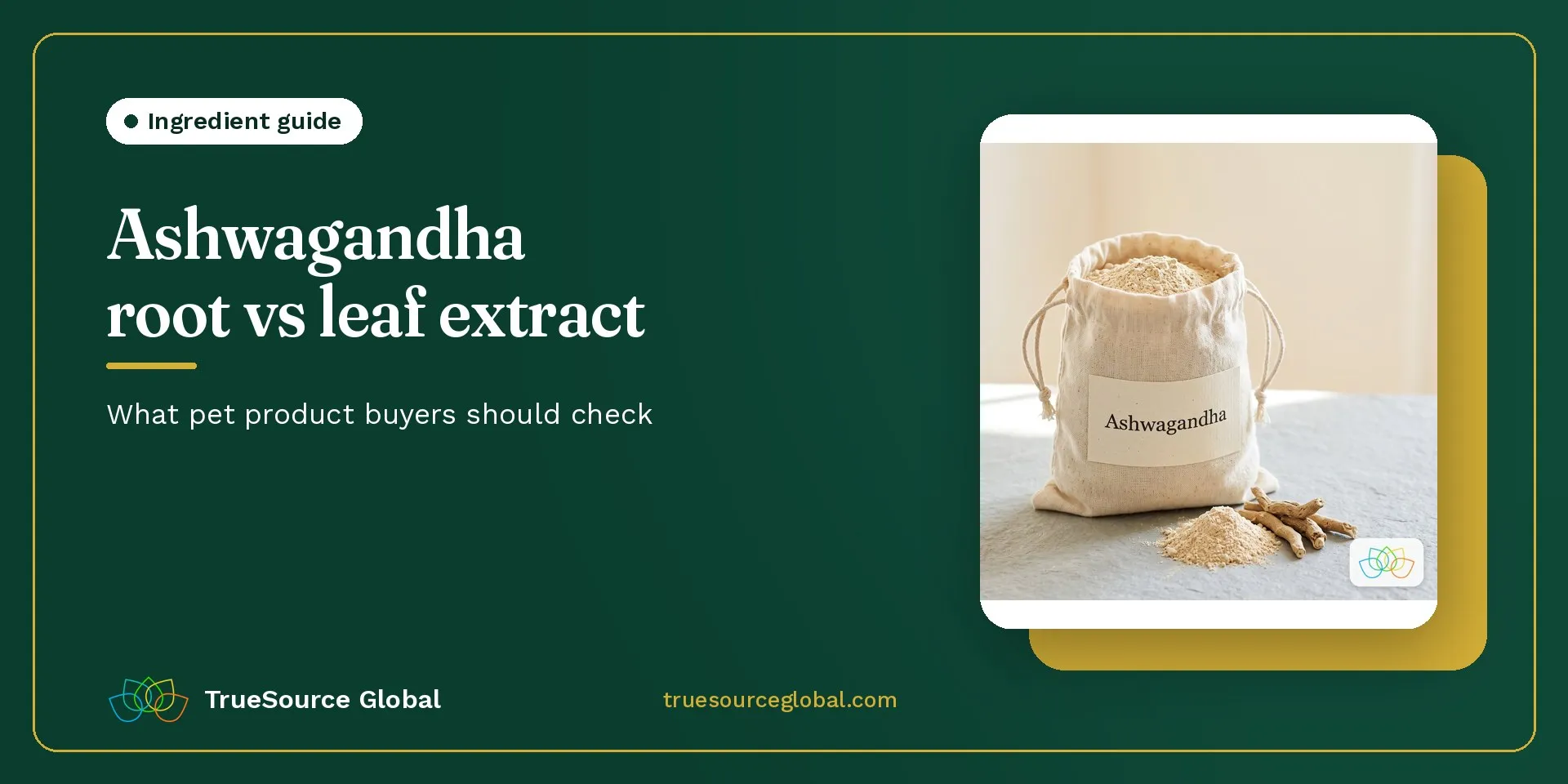
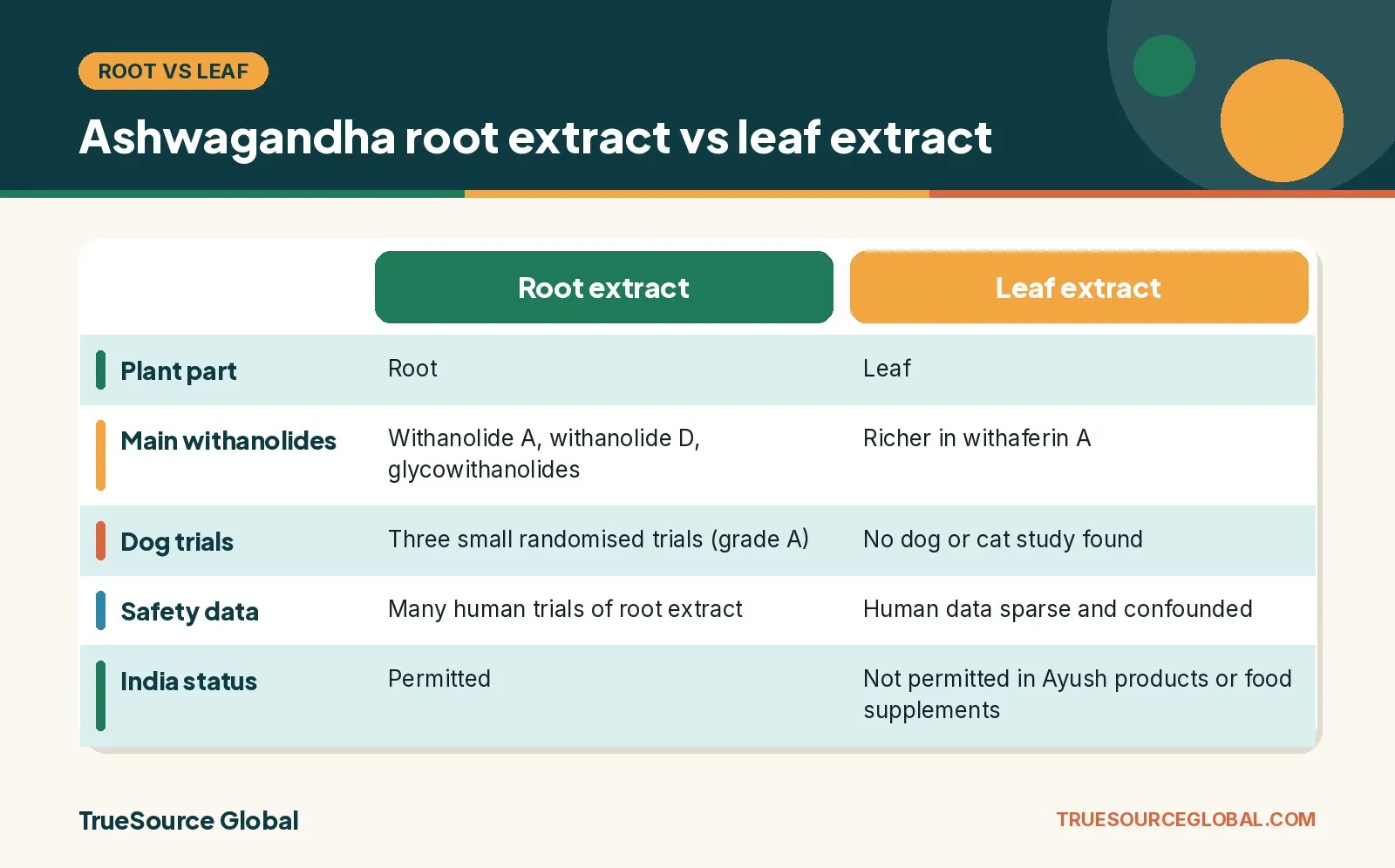
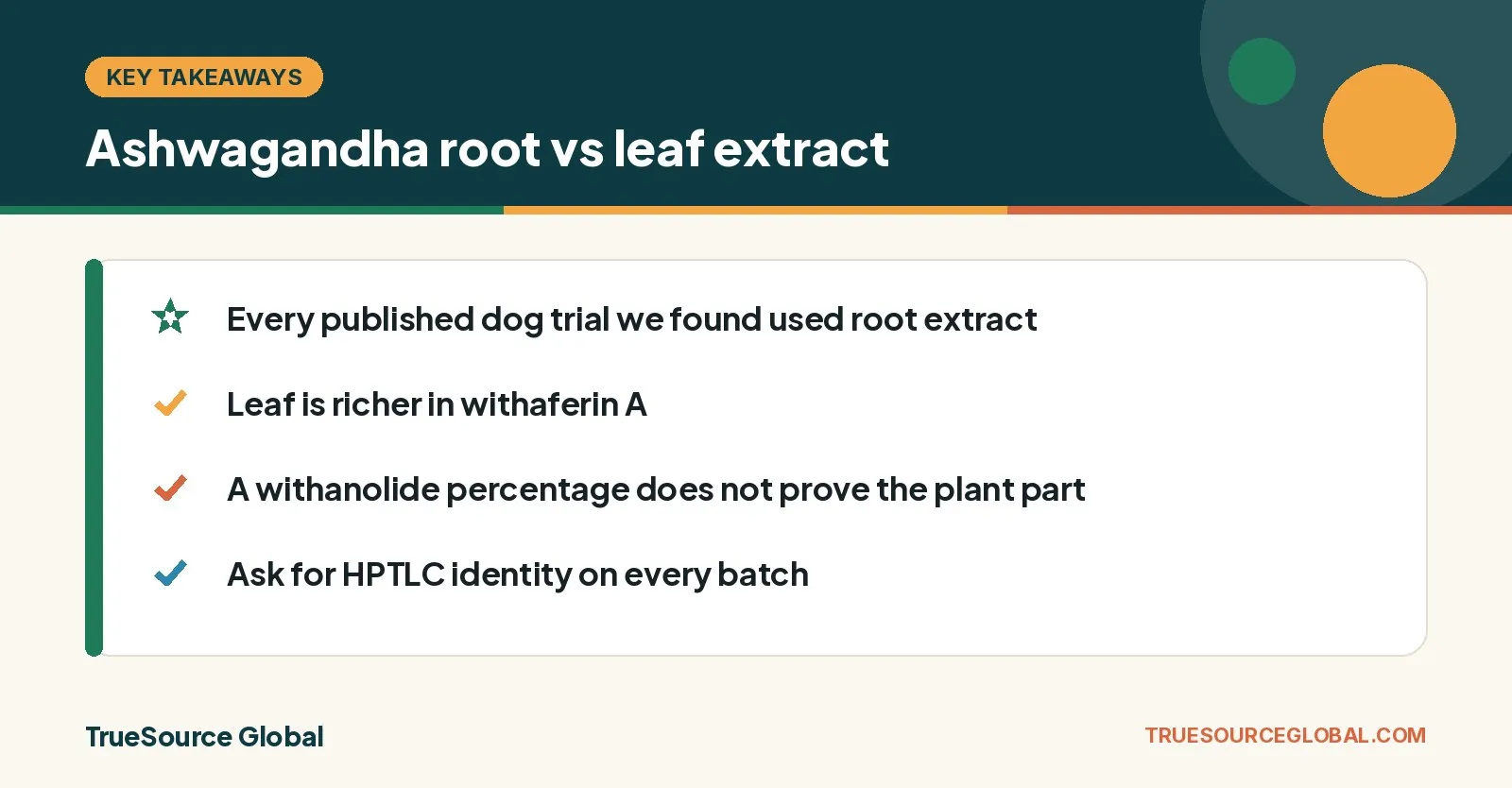
Ashwagandha root and leaf extract are not interchangeable. Root is the traditional Ayurvedic part, and all three dog trials we found used a root extract. Leaf is richer in withaferin A, has little safety data and, since April 2026, is not permitted in India’s Ayush products or food supplements. Ask for root only, confirmed by HPTLC.
This guide is the buyer side of one herb in our Ayurveda for Pets series. For what ashwagandha is and what the dog studies measured, read AyurPet’s ashwagandha guide for dogs. AyurPet is a sister brand of TrueSource. The wider checks for any herb are in our herbal pet supplement quality guide.
Key facts
- Name and part: ashwagandha is Withania somnifera. India’s Ministry of Ayush describes the root as the part widely used in Ayush systems (Ministry of Ayush, 15 Apr 2026).
- Chemistry: root is dominated by withanolide A, withanolide D and glycowithanolides; leaf is richer in withaferin A (Dutta and Gupta 2026).
- “Standardised to 5% withanolides” means named withanolide markers make up at least 5% of the extract’s weight. It does not prove the plant part, because withanolides occur throughout the plant (BAPP).
- Evidence grades: A = controlled trials in dogs or cats; B = smaller or open studies in dogs or cats; C = other animals; D = human studies only; E = lab work or traditional use only. Root extract is grade A in dogs (three small trials). Leaf has no dog or cat study.
Ashwagandha root vs leaf extract: what is the difference?
The difference is chemistry and evidence, not just price. A 2026 regulatory review found that root is dominated by withanolide A, withanolide D and glycowithanolides, while leaf is richer in withaferin A and related reactive withanolides (Dutta and Gupta 2026). It found many human trials of root extract, while human data for leaf are “sparse and confounded”.
Leaf costs less than root, which is why it turns up where it should not. The Botanical Adulterants Prevention Program has published a bulletin on root powders and root extracts with undeclared leaf and stem added. Declared blends are a different matter: at least one established extract openly uses both parts and is labelled as such (NutraIngredients 2019).
| Ingredient | What it is | Typical label marker | Evidence in dogs and cats | India status (Apr 2026) |
|---|---|---|---|---|
| Root powder | Dried, milled root | Usually none | E: traditional use; no dog trial of plain powder found | Permitted |
| Root extract | Root concentrated and standardised | Total withanolides, for example over 5% for KSM-66 (Bharani et al. 2024) | A: three small randomised dog trials, all root extract | Permitted |
| Root and leaf extract | Both parts, declared | Withanolide glycosides, for example 35% by HPLC for Shoden (Arjuna Natural) | D: human trials only, for example 60 adults given Shoden (Lopresti et al. 2019); no dog or cat study found | Leaf not permitted in Ayush products or food supplements |
| Leaf extract | Leaf only | Varies; ask which markers | E: mainly lab and preclinical work (Dutta and Gupta 2026) | Not permitted in Ayush products or food supplements |
What does a withanolide percentage on a label tell you?
A withanolide percentage tells you how much of the named markers the lab found, by its method. It does not tell you which part of the plant they came from. Withanolides are present throughout the plant and may be more concentrated in the leaves, so a test of withanolides alone can miss added leaf (NutraIngredients 2019).
Percentages from different products are often not comparable. KSM-66 is described by its maker as a root-only extract made without alcohol or other chemical solvents (Ixoreal), and the dog trials that used it describe it as containing more than 5% total withanolides. Shoden is a root and leaf extract standardised to 35% withanolide glycosides by HPLC, with a separate root-only version, Shoden-R (Arjuna Natural). Those two figures count different markers, so 35% is not “seven times” 5%.
Plain root powder is a third thing again: dried, milled root, usually with no withanolide guarantee. A pet product label should say which of the three it contains. Our ashwagandha supplier comparison covers specifications for each form.
Which plant part did the dog studies use?
Every published dog trial we found used root extract. A PubMed search on 20 Nov 2026 found no dog or cat study of ashwagandha leaf.
- Kaur et al. (2022): 24 dogs with signs of stress, randomised and placebo-controlled, given a standardised root extract at 15 mg/kg once daily for 4 weeks. Urine cortisol to creatinine ratio and fear and anxiety scores were measured, and no adverse events were reported (FAO AGRIS).
- Bharani et al. (2024): 20 healthy dogs aged 8 or older, double-blind and placebo-controlled, given KSM-66 root extract at 15 mg/kg once daily for 60 days. The extract was a gift from its manufacturer (PMC).
- Bharani et al. (2025): 12 healthy older Beagles, six per group, given the same extract and amount for two months (Frontiers in Veterinary Science).
That is grade A only in the narrow sense that controlled dog trials exist. They are small, short and tied to root extracts, two of them to one branded extract. The 15 mg/kg figure is what the researchers used, not a recommendation. Ask your vet for an amount for your pet’s weight and health.
How do labs detect leaf in ashwagandha root?
Labs detect leaf with fingerprinting methods that look at the whole pattern of compounds, not one total. A validated HPTLC method separates withaferin A, withanone, withanolide A and three phenolic acids in root, stem and leaf samples (Tomar et al. 2019). Researchers have also told roots and leaves of three varieties apart with near-infrared fingerprinting (Khan et al. 2023), though that is a research method rather than a routine batch test.
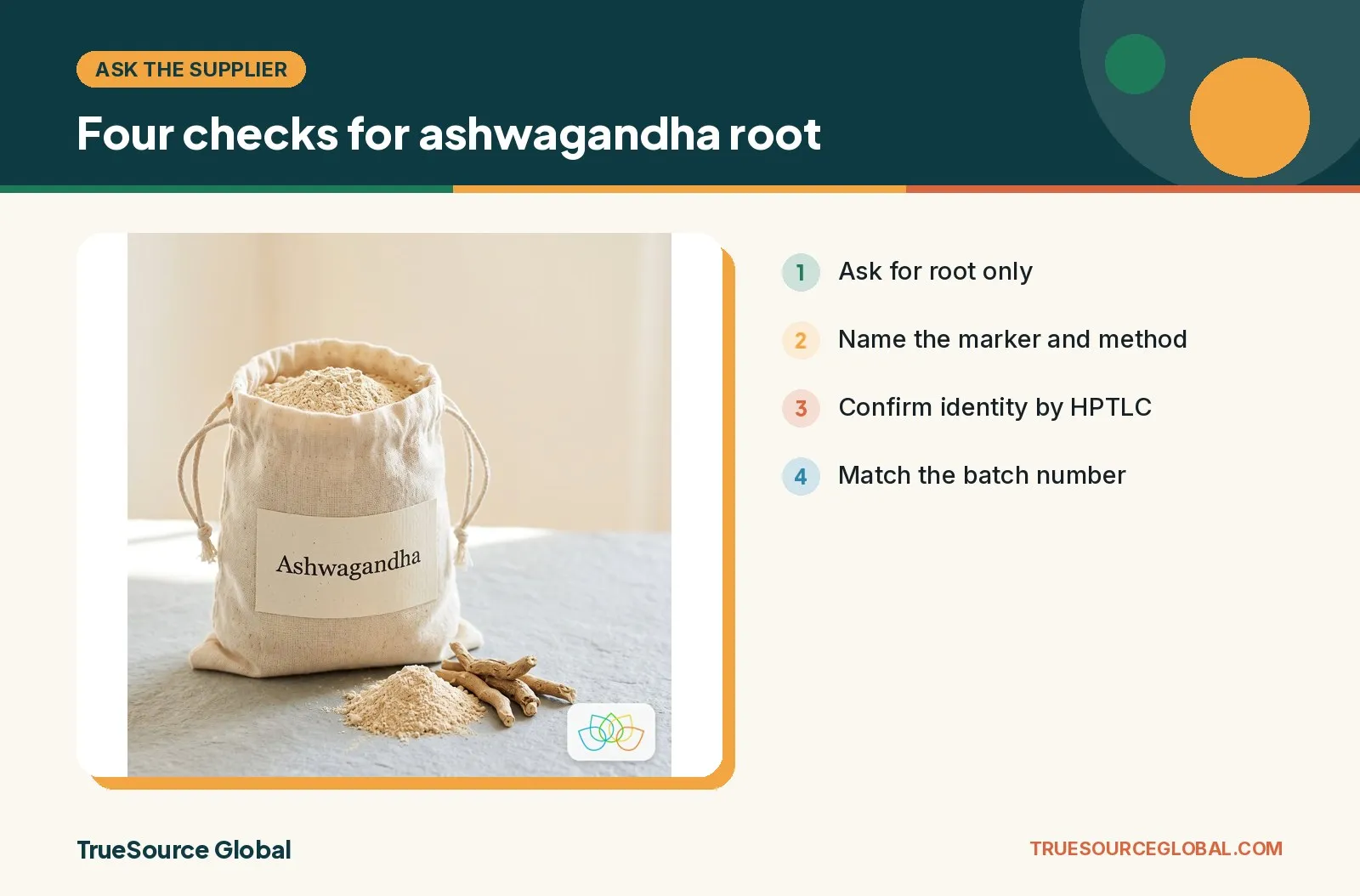
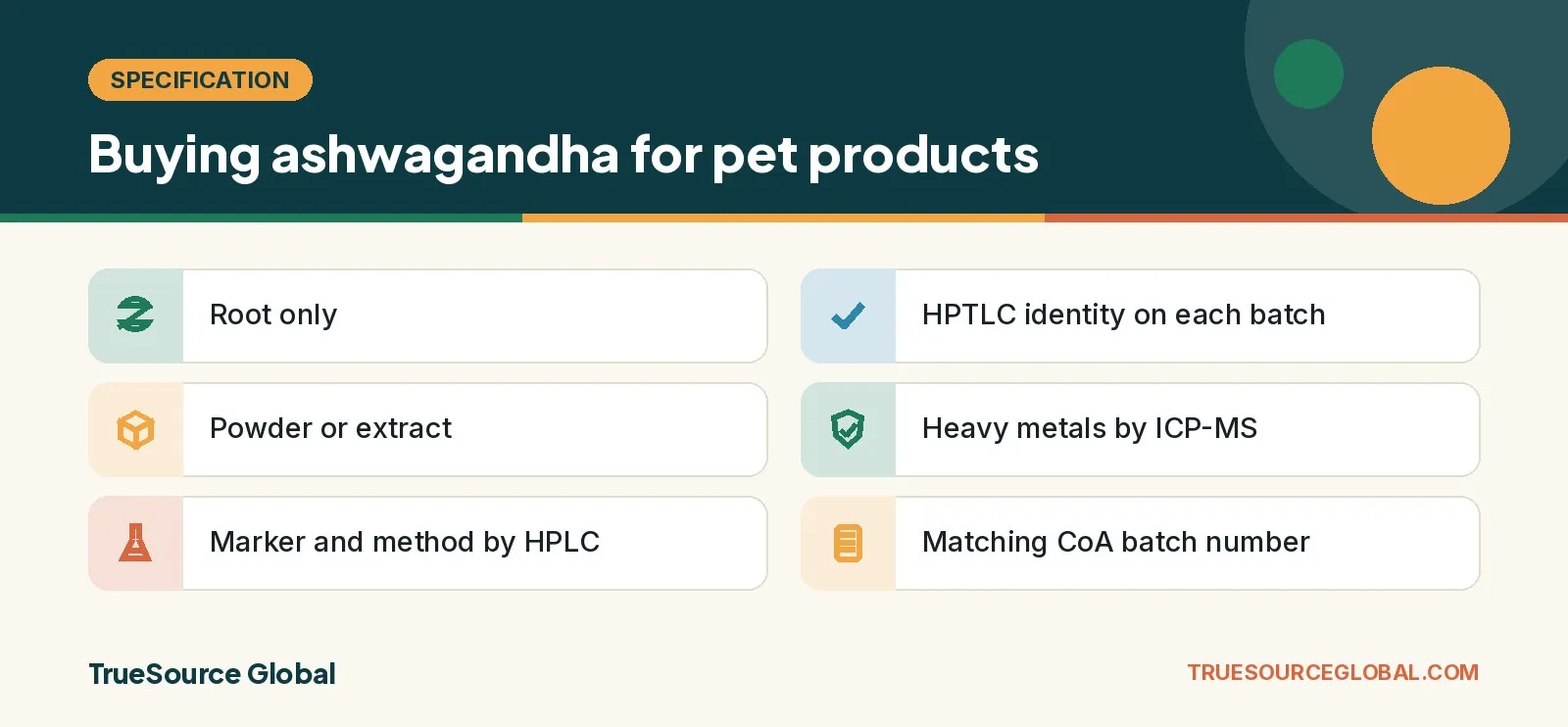
Use this list when you specify or buy ashwagandha for a pet product:
- Plant part: “root only” written into the specification and on the label.
- Form: powder or extract, and for an extract, the extraction solvent.
- Marker and method: which withanolides are counted, and by HPLC.
- Identity: an HPTLC fingerprint against a root reference, on each batch.
- Purity: heavy metals by ICP-MS, pesticide residues and microbiology.
- Batch match: the Certificate of Analysis (CoA) batch number matches the pack.
What do India’s 2026 rules say about ashwagandha leaf?
India now allows only the root. On 15 April 2026 the Ministry of Ayush directed manufacturers to use only ashwagandha roots, prohibited leaves in any form in Ayush drugs and products, and required the plant part on the label under Rule 161 of the Drugs Rules, 1945. It cited possible safety concerns for leaf “due to higher concentrations of reactive withanolides, particularly Withaferin-A”. A day later, FSSAI advised that leaf is not permitted in health supplements and nutraceuticals (FSSAI and Ministry of Ayush, Apr 2026).
Neither notice names pet products, but the Ayush letter notes that some manufacturers were still using leaf, so get root-only confirmed in writing.
Is ashwagandha suitable for cats?
There is no cat evidence to go on. A PubMed search on 20 Nov 2026 found no controlled study of ashwagandha supplements in cats.
Cats are not small dogs.
- Cat livers have a very low capacity for glucuronidation, a main route for clearing many compounds, compared with dog livers (van Beusekom et al. 2014). Never give a cat a product or amount chosen for a dog.
- Check the whole ingredient list. Concentrated tea tree oil caused signs such as drooling, lethargy, unsteadiness and tremors in 106 cats and 337 dogs reported to ASPCA Animal Poison Control (Khan et al. 2014), and onion and garlic can damage cats’ red blood cells (ASPCA).
- IndoFolk Wellness’s feline herb safety reference covers other herbs and oils.
Which medicines and warning signs should you raise with a vet?
Tell your vet about every medicine your pet takes before starting ashwagandha. In people, ashwagandha may interact with medicines for diabetes and high blood pressure, immunosuppressants, sedatives, anti-seizure medicines and thyroid hormone, and rare cases of liver injury have been reported (NCCIH). That is human evidence (grade D), so use it as a list of questions for your vet, not a verdict for pets.
When to see a vet: before starting if your pet is pregnant, young, elderly, on medicine or has a long-term condition, and straight away if you notice vomiting, diarrhoea, unusual sleepiness or yellowing of the gums or eyes.
How can a pet brand specify ashwagandha root?
Write “root only”, the form, the marker and method, and an HPTLC identity test into the specification before you compare prices. We source ashwagandha through GMP-certified partner facilities, including AYUSH GMP for Ayurvedic products, with third-party lab Certificates of Analysis that include heavy metals and microbiology. Most pet products start at 100 units, and samples dispatch in 5 to 7 working days. See our pet wellness page, quality and documentation page and Ayurvedic herbs range. Request an ashwagandha quote and we’ll reply within 12 hours, or book a call.
Frequently asked questions
Is ashwagandha leaf extract as good as root extract for dogs?
There is no evidence that it is. The three randomised dog trials we found all used root extract, and we found no dog or cat study of leaf. Leaf also has a different chemistry, richer in withaferin A, and far less safety data.
What is the difference between KSM-66 and ashwagandha root powder?
Root powder is dried, milled root, usually sold without a withanolide guarantee. KSM-66 is a branded root-only extract; the two dog trials that used it describe it as containing more than 5% total withanolides. An extract and a powder are different ingredients and should be labelled as such.
Does a high withanolide percentage mean better ashwagandha?
Not on its own. Withanolides occur in every part of the plant and leaf can carry more of some of them, so undeclared leaf can raise the figure. Ask which markers were counted, by which method, and for an identity test such as HPTLC that confirms the plant part.
Can I give my cat an ashwagandha product made for dogs?
Not without your vet's advice. A PubMed search on 20 Nov 2026 found no controlled study of ashwagandha supplements in cats, and cats clear many compounds more slowly than dogs. Never give a cat an amount chosen for a dog.
Is ashwagandha leaf banned in India?
In Ayush medicines and in food supplements, yes. A Ministry of Ayush letter of 15 April 2026 prohibits leaf in Ayush drugs and products, and an FSSAI advisory of 16 April 2026 says leaf is not permitted in health supplements and nutraceuticals. Neither notice names pet products.
Sources
- FSSAI advisory on non-use of ashwagandha leaves in food products (16 Apr 2026), with Ministry of Ayush letter T-13020/4/2022-DCC-Part(2) (15 Apr 2026)
- Dutta and Gupta (2026): Plant part-specific differences in ashwagandha, root and leaf evidence for safety and regulation, Food Science and Nutrition
- Kaur et al. (2022): Standardised ashwagandha root extract in domestic dogs, randomised controlled trial, Journal of Veterinary Behavior (FAO AGRIS record)
- Bharani et al. (2024): Ashwagandha root extract in healthy geriatric dogs, randomised double-blind placebo-controlled study, Veterinary Medicine and Science
- Bharani et al. (2025): Ashwagandha root extract and gut parameters in geriatric Beagles, Frontiers in Veterinary Science
- ABC-AHP-NCNPR Botanical Adulterants Prevention Program: Ashwagandha root and root extract bulletin
- NutraIngredients (2019): BAPP ashwagandha bulletin on roots adulterated with leaves
- Tomar, Beuerle and Sircar (2019): Validated HPTLC method for withanolides and phenolic acids in root, stem and leaf of Withania somnifera, Journal of Chromatography B
- Khan et al. (2023): FT-NIR metabolic fingerprinting to authenticate turmeric, Ocimum and Withania somnifera, Journal of Pharmaceutical Analysis
- Lopresti et al. (2019): Standardised ashwagandha extract (Shoden) in stressed adults, randomised double-blind placebo-controlled study, Medicine
- Ixoreal: What is KSM-66
- Arjuna Natural: Shoden ashwagandha
- NCCIH: Ashwagandha
- van Beusekom, Fink-Gremmels and Schrickx (2014): Glucuronidation capacity of the feline liver compared with dogs
- Khan, McLean and Slater (2014): Concentrated tea tree oil toxicosis in dogs and cats, 443 cases, JAVMA
- ASPCA Animal Poison Control: People foods to avoid feeding your pets
Ready to source this from India?
Tell us the product, volume and market. We'll reply within 12 hours with a quote, MOQ and sample plan, with no obligation.