Turmeric Supplement Lead Testing for Pet Products: 2026 Guide
Turmeric supplement lead testing for pet products in 2026: what 95% curcuminoids means, lead chromate, EU and Prop 65 lead limits, and how to read a CoA.
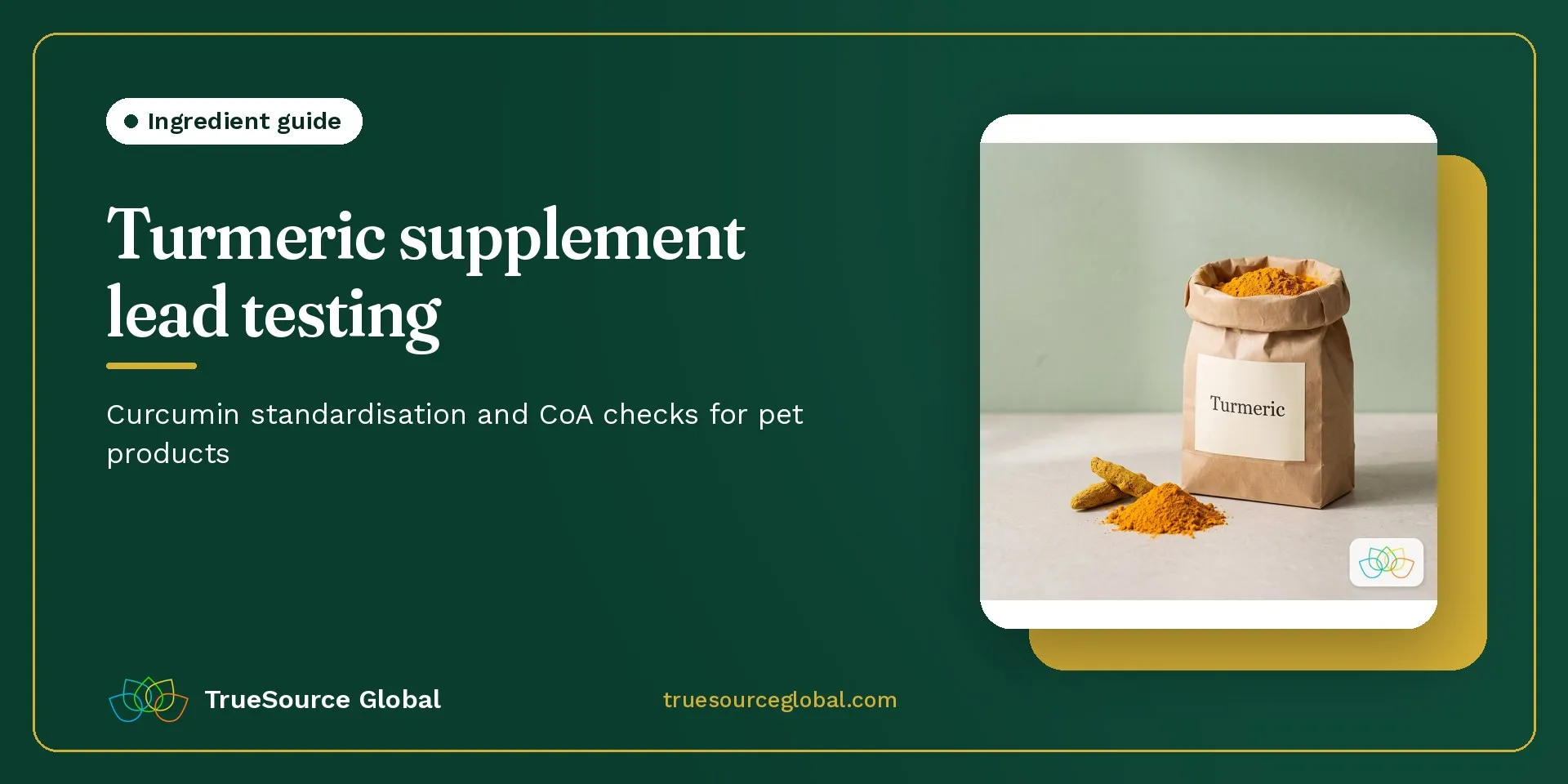
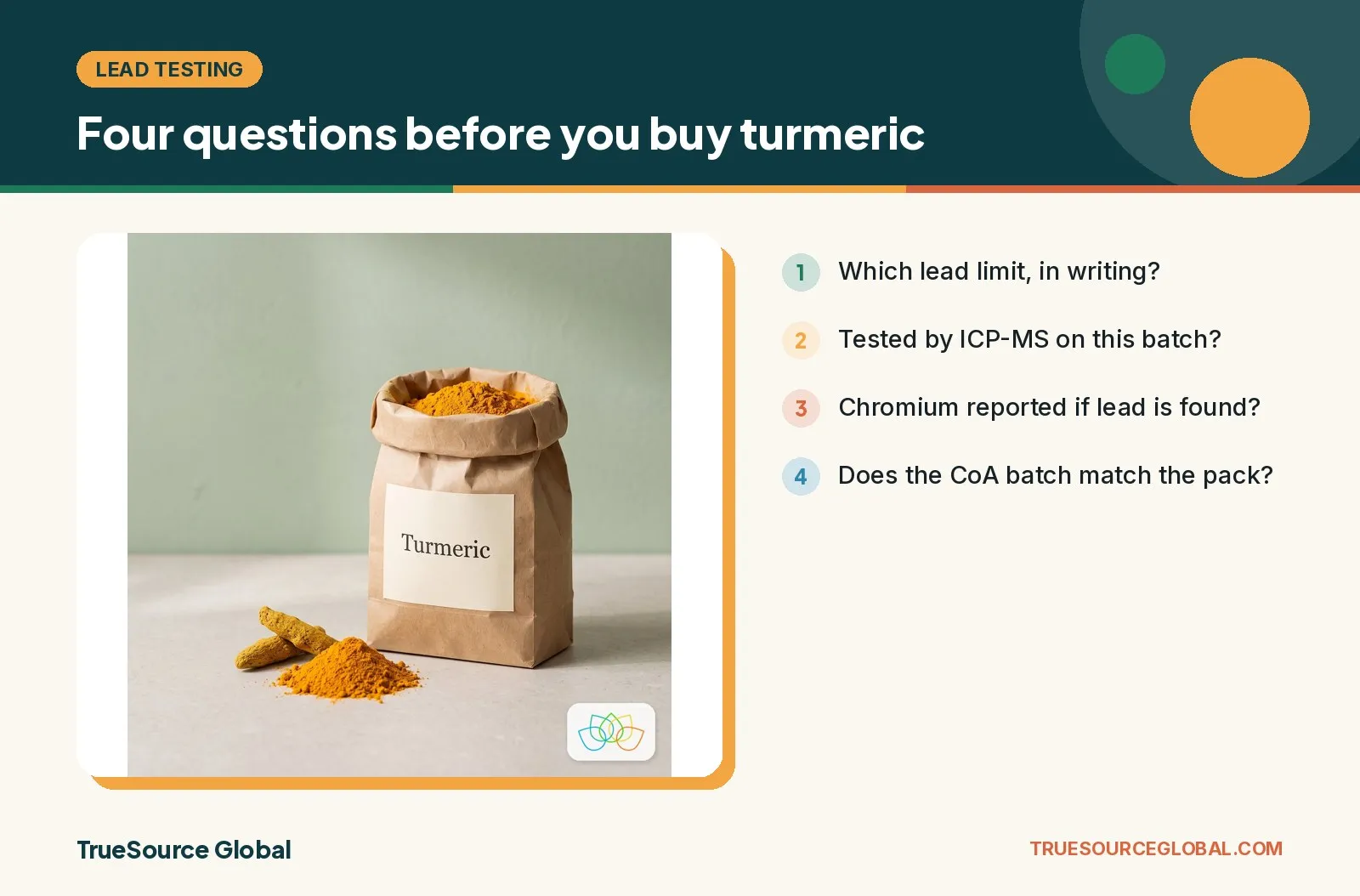
Turmeric supplement lead testing means testing every batch for lead, ideally by ICP-MS, against a limit agreed in writing. Turmeric has a documented history of lead chromate adulteration. Ask for each curcuminoid by HPLC, a curcumin share near the natural ratio, chromium when lead is found, and a Certificate of Analysis (CoA) whose batch number matches the pack.
This guide is the buyer side of one herb in our Ayurveda for Pets series. For what turmeric is and what the dog studies looked at, read AyurPet’s turmeric page. AyurPet is a sister brand of TrueSource. The checks that apply to any herb are in our herbal pet supplement quality guide.
Key facts
- Name and part: turmeric is the rhizome of Curcuma longa. It contains about 3 to 5% curcuminoids, of which curcumin is about 77%, demethoxycurcumin 17% and bisdemethoxycurcumin 3 to 6% (Kotha and Luthria 2019).
- “95% curcuminoids” means those three compounds make up at least 95% of the extract’s weight. Nine batches of a feed-grade turmeric extract assessed by EFSA averaged 96.68% curcuminoids, 77.02% of it curcumin (EFSA 2020).
- Lead chromate: 51 of 356 turmeric samples from four South Asian countries had detectable lead above 2 µg/g; at 18 µg/g or more, lead and chromium were present in a near 1:1 ratio, suggesting lead chromate (Forsyth et al. 2024).
- Evidence grades: A = controlled trials in dogs or cats; B = smaller or open studies in dogs or cats; C = other animals; D = human studies only; E = lab work or traditional use only. Turmeric is grade A in dogs only for a mixture with other ingredients. In cats, the controlled study we found measured tolerance, not benefit.
Why does turmeric need lead testing?
Turmeric needs lead testing because lead chromate, a bright yellow pigment, has been added to it to improve its colour. In Bangladesh, researchers found evidence of lead chromate pigment in 7 of the 9 major turmeric-producing districts, with turmeric powder reaching 1,152 µg/g lead (Forsyth et al. 2019). A 2024 follow-up found lead above 1,000 µg/g in turmeric from Patna in India and from Karachi and Peshawar in Pakistan (Forsyth et al. 2024).
The problem has reached Western shelves. All 32 turmeric samples bought around Boston contained some lead, with a range of 0.03 to 99.50 ppm; the two highest were the only samples imported from Bangladesh (Cowell et al. 2017). FDA’s Import Alert 99-42, which lets officials detain foods over heavy metals, lists turmeric products among them. It also notes that where no limit is set, FDA judges toxic elements case by case.
Lead matters for pets too. In veterinary medicine, lead poisoning is most common in dogs, cattle and companion birds, and acute signs in dogs and cats include loss of appetite, behaviour changes, unsteadiness, tremors and seizures (Merck Veterinary Manual).
Which lead limits apply to turmeric pet products in 2026?
No single lead limit covers turmeric pet products, so buyers pick a reference and write it into the specification. The table converts each limit into micrograms of lead per gram (1 mg/kg is 1 µg/g), so you can compare them. Limits checked on 22 Nov 2026.
| Rule | What it covers | Lead limit | Per gram of product |
|---|---|---|---|
| EU Regulation 2023/915 (EUR-Lex) | Dried root and rhizome spices, including turmeric | 1.50 mg/kg | 1.5 µg |
| EU Regulation 2023/915 | Food supplements for people | 3.0 mg/kg | 3 µg |
| EU Directive 2002/32/EC (EUR-Lex) | Complementary animal feed, at 12% moisture | 10 mg/kg | 10 µg |
| EU food additive specification, as cited by EFSA 2020 | Turmeric extract assessed as a feed additive | below 10 mg/kg | under 10 µg |
| California Prop 65 (27 CCR § 25805) | People’s exposure, reproductive harm | 0.5 µg a day | 0.5 µg, if 1 g is eaten a day |
| US FDA (Import Alert 99-42) | Foods with no set limit | Case by case | None set |
| Worst samples, South Asia (Forsyth et al. 2024) | Market turmeric | Above 1,000 µg/g | Over 1,000 µg |
A note on Prop 65. It is a California law about people’s exposure, not a pet safety standard. Its safe harbour figures for lead are 0.5 µg a day for reproductive harm and 15 µg a day by mouth for cancer (27 CCR § 25705). Because these are daily doses, divide 0.5 µg by the grams eaten a day to get a per-gram figure, and take legal advice on warnings.
What does “95% curcuminoids” mean?
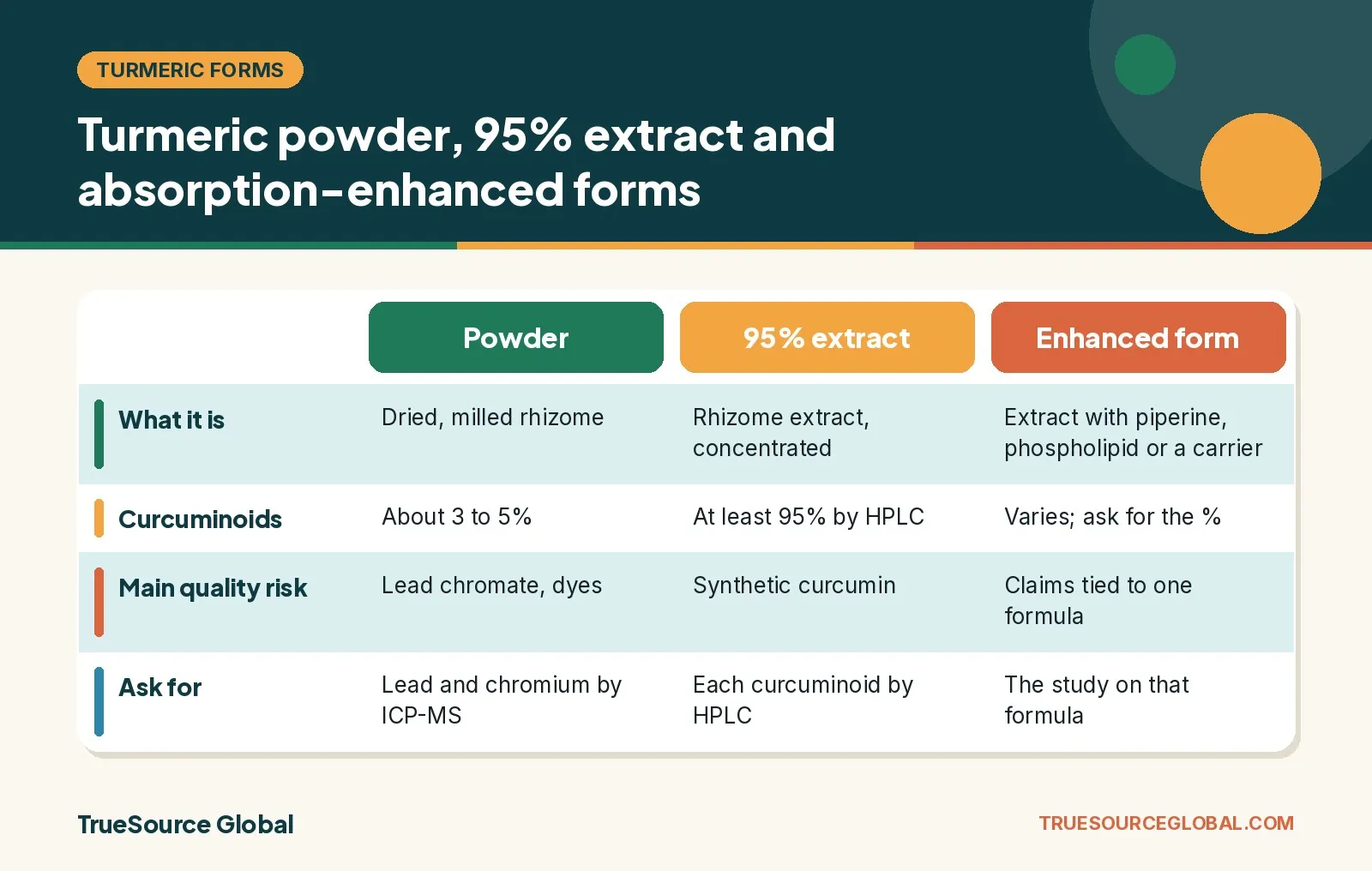
It means curcumin, demethoxycurcumin and bisdemethoxycurcumin together make up at least 95% of the extract’s weight. That is a purity figure, not a quality guarantee. Plain rhizome powder has about 3 to 5% curcuminoids (Kotha and Luthria 2019), so a 95% extract is a different ingredient and should be labelled as one.
The ratio inside the 95% matters as much as the total. In natural extracts curcumin is about three quarters of the curcuminoids, and a high curcumin-to-curcuminoids share has been used as a sign of synthetic curcumin. In a study pairing HPLC with carbon-14 testing, which shows how much of the carbon is biobased, only 4 of 14 turmeric supplements supported their authentic label claims (You et al. 2022).
Quick UV and other spectroscopic methods suit screening but often need HPLC to confirm them (Kotha and Luthria 2019), so ask for each curcuminoid by HPLC, not a single total.
Do absorption-enhanced forms change what you should check?
They add one check: whether the evidence belongs to that exact formula. Curcumin is poorly absorbed, so makers combine it with piperine from black pepper, phospholipids or carriers such as cyclodextrin. In 24 Beagles, three of these forms (a cyclodextrin complex, a solid dispersion and a phospholipid complex) gave relative bioavailability of about 196% to 272% of plain curcumin (Song et al. 2022). That is a blood-level study in one breed (grade B for absorption) and says nothing about benefit.
Treat “x times better absorbed” as claims tied to one formula. Ask for the study on that formula, in the species you sell to, and the curcuminoid percentage of the finished blend, which varies. Absorption also cuts both ways: piperine can inhibit the enzyme CYP3A4 and the transporter P-glycoprotein, which raises the absorption of some medicines (Tripathi et al. 2025).
What should a turmeric Certificate of Analysis show?
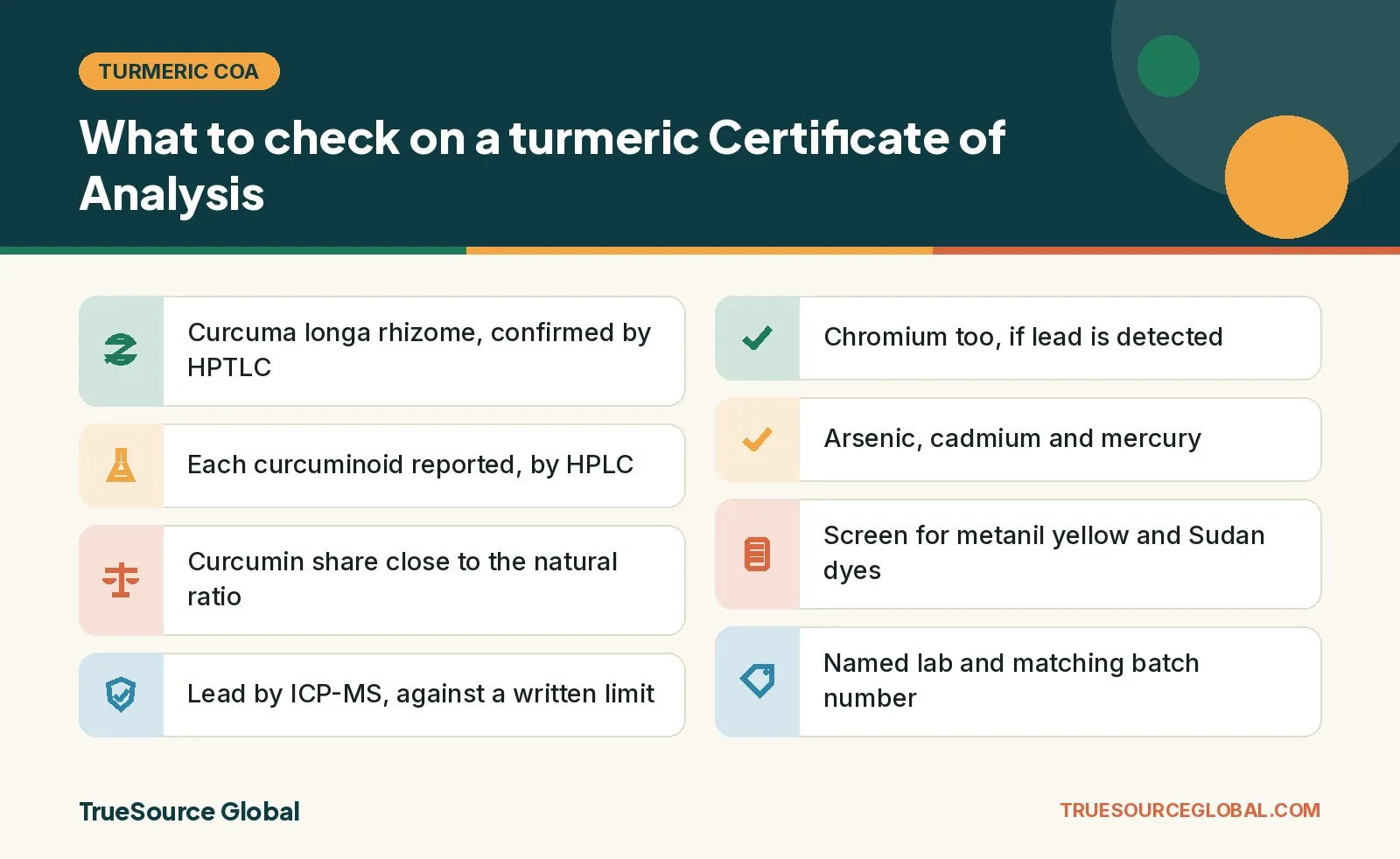
A turmeric CoA should come from a named laboratory, match the batch number on the pack and cover identity, strength and contaminants. Use this list with any supplier or brand:
- Identity: Curcuma longa rhizome, confirmed by HPTLC fingerprint.
- Strength: each curcuminoid reported, by HPLC.
- Ratio: curcumin share close to the natural ratio; ask about carbon-14 testing if it is far higher.
- Lead: by ICP-MS, against a written limit from the table above.
- Chromium: chromium too, if lead is detected. A lead to chromium ratio near 1:1 suggests lead chromate (Forsyth et al. 2024).
- Other metals: arsenic, cadmium and mercury.
- Dyes: a screen for metanil yellow and Sudan dyes, known turmeric adulterants with published detection methods (Kotha and Luthria 2019).
- Batch: named lab and matching batch number, with a recent test date.
How strong is the evidence for turmeric in dogs and cats?
It is thin. In dogs, the controlled trial we use is of a mixture: in 42 dogs with osteoarthritis, a diet with curcuminoids, hydrolysed collagen and green tea extract lowered vets’ scores for pain on manipulation over three months, but force plate and biomarker results did not differ (Comblain et al. 2017). That is grade A for the mixture only; it cannot separate turmeric from the other ingredients.
In cats, a controlled four-month feeding study in healthy adults found no effects of clinical concern at up to 1,040 ppm total curcuminoids in the diet (Raynaud et al. 2026). It measured tolerance, not benefit, and was run and funded by a pet food maker.
Dosage: EFSA’s figures below are safe feed concentrations for turmeric used as a flavouring, worked out from a rat study, not amounts to give. Ask your vet for an amount for your pet’s weight and health.
Cats are not small dogs.
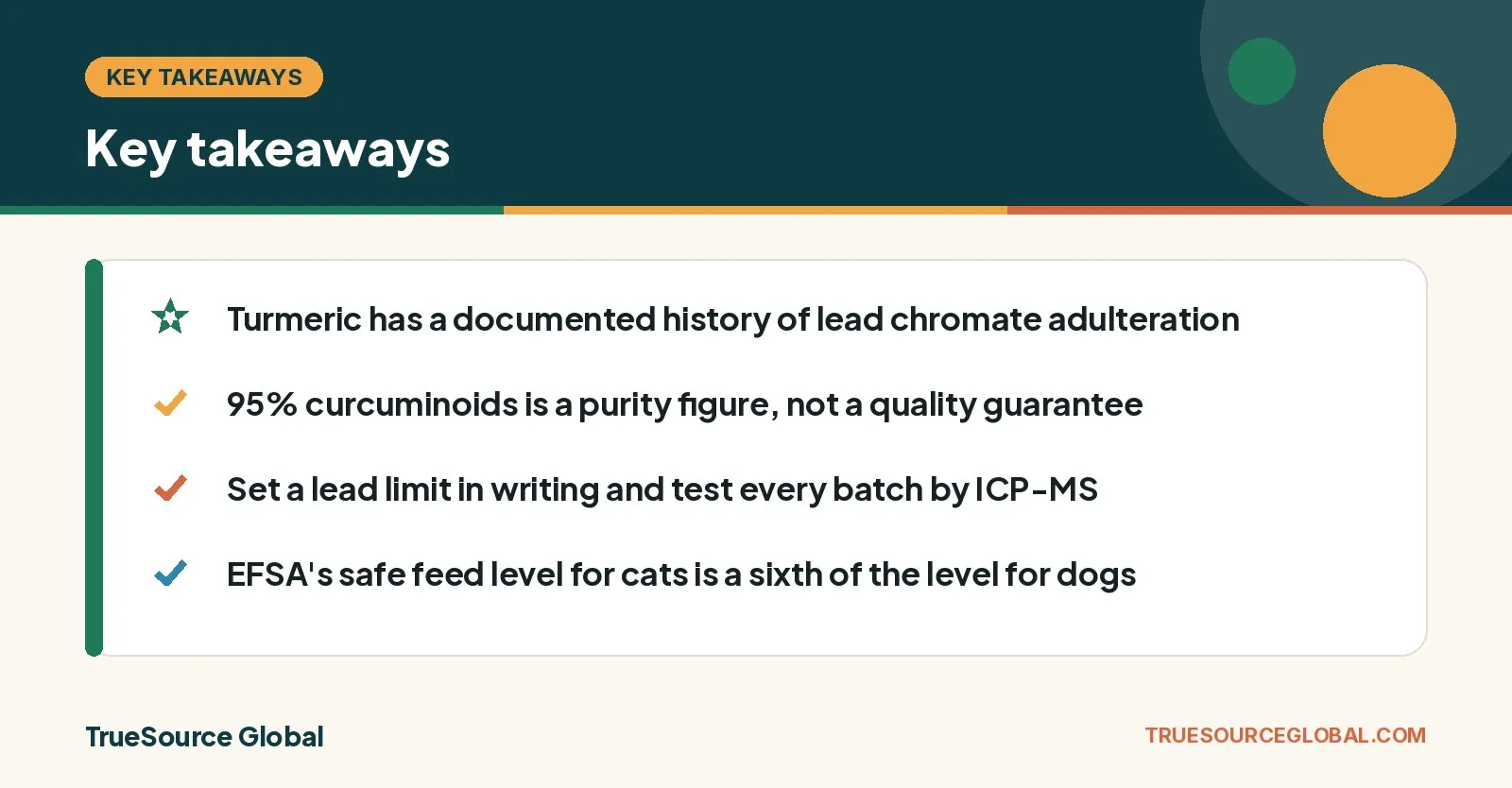
- EFSA set the maximum safe level of turmeric extract in complete feed at 22 mg/kg for cats against 132 mg/kg for dogs, adding an extra safety factor for cats because of their “unusually low capacity for glucuronidation” (EFSA 2020; van Beusekom et al. 2014). EFSA’s safe feed level for cats is a sixth of the level for dogs. Never give a cat a product or amount chosen for a dog.
- Check the whole ingredient list. Concentrated tea tree oil caused signs such as tremors and unsteadiness in 106 cats and 337 dogs reported to ASPCA Animal Poison Control (Khan et al. 2014), and onion and garlic can damage cats’ red blood cells (ASPCA).
Which medicines and warning signs should you raise with a vet?
Raise every medicine, and especially anti-inflammatory painkillers (NSAIDs) and anticoagulants. The Merck Veterinary Manual notes that turmeric may increase the risk of bleeding with NSAIDs. In people, highly bioavailable curcumin formulations have been linked to liver harm (NCCIH); that is grade D evidence, so use it as a question for your vet. IndoFolk Wellness’s herb-drug interaction table for dogs and cats covers more medicine classes.
When to see a vet: before starting if your pet is pregnant, young, elderly, on medicine or has a long-term condition, and straight away if you see vomiting, diarrhoea, loss of appetite, unsteadiness or tremors.
How can a pet brand source turmeric to this standard?
Write the lead limit, the curcuminoid method and the CoA list into the specification before you compare prices. We source turmeric powder and curcumin extract and turmeric yak cheese chews through GMP-certified partner facilities, including AYUSH GMP for Ayurvedic products, with third-party lab Certificates of Analysis that include heavy metals and microbiology. Most pet products start at 100 units, and samples dispatch in 5 to 7 working days. For other herbs, see our ashwagandha root vs leaf extract guide, our pet wellness page and quality and documentation page. Request a turmeric quote and we’ll reply within 12 hours, or book a call.
Frequently asked questions
Is there lead in turmeric supplements?
Some turmeric has been found with high lead. In a 2024 study, 51 of 356 turmeric samples from India, Pakistan, Sri Lanka and Nepal had detectable lead above 2 µg/g, and some exceeded 1,000 µg/g. A batch test by ICP-MS against a written limit is the only way to know what a given product contains.
What does 95% curcuminoids mean on a turmeric label?
It means curcumin, demethoxycurcumin and bisdemethoxycurcumin together make up at least 95% of the extract's weight, measured by HPLC. It is a purity figure, not a quality guarantee. Synthetic curcumin can also reach a high percentage, so ask for each curcuminoid separately.
What is a safe lead level for a turmeric pet supplement?
No single figure covers every market. The EU caps lead at 1.50 mg/kg in dried root and rhizome spices, 3.0 mg/kg in food supplements and 10 mg/kg in complementary animal feed. Agree your own limit with the supplier in writing, test every batch against it, and ask your vet about the product itself.
Does Prop 65 apply to pet supplements?
Proposition 65 is a California law about people's exposure to listed chemicals, not a pet safety standard. Its safe harbour figure for lead is 0.5 µg a day for reproductive harm. Take legal advice on whether a product sold in California needs a warning.
Can I give my cat a turmeric supplement made for dogs?
Not without your vet's advice. In its 2020 opinion, EFSA set the safe level of turmeric extract in cat feed at 22 mg/kg, against 132 mg/kg for dogs, because cats clear curcuminoid metabolites slowly. An amount chosen for a dog can be wrong for a cat.
Sources
- Kotha and Luthria (2019): Curcumin, biological, pharmaceutical, nutraceutical and analytical aspects, Molecules
- EFSA FEEDAP Panel (2020): Safety and efficacy of turmeric extract, oil, oleoresin and tincture as feed additives for all animal species, EFSA Journal
- Forsyth et al. (2024): Evidence of turmeric adulteration with lead chromate across South Asia, Science of the Total Environment
- Forsyth et al. (2019): Lead chromate pigments added to turmeric in Bangladesh, Environmental Research
- Cowell et al. (2017): Ground turmeric as a source of lead exposure in the United States, Public Health Reports
- You et al. (2022): Labelling accuracy and economically motivated adulteration of turmeric supplements, Food Chemistry
- Song et al. (2022): Pharmacokinetics in Beagle dogs of curcumin cyclodextrin, solid dispersion and phospholipid complex, Molecules
- Comblain et al. (2017): Diet with curcuminoids extract, hydrolysed collagen and green tea extract in dogs with osteoarthritis, BMC Veterinary Research
- Raynaud et al. (2026): A tolerance study of turmeric extract in healthy adult cats, Animals
- Commission Regulation (EU) 2023/915 on maximum levels for certain contaminants in food
- Directive 2002/32/EC on undesirable substances in animal feed (consolidated text)
- Cal. Code Regs. tit. 27, § 25805: Proposition 65 maximum allowable dose levels (reproductive toxicity)
- Cal. Code Regs. tit. 27, § 25705: Proposition 65 no significant risk levels (cancer)
- FDA Import Alert 99-42: Detention without physical examination of foods due to heavy metal contamination
- Merck Veterinary Manual: Lead poisoning in animals
- Merck Veterinary Manual: Common botanical products in veterinary medicine
- NCCIH: Turmeric
- Tripathi et al. (2025): Piperine as a bioenhancer, drug absorption and interactions, Pharmaceutical Research
- van Beusekom, Fink-Gremmels and Schrickx (2014): Glucuronidation capacity of the feline liver compared with dogs
- Khan, McLean and Slater (2014): Concentrated tea tree oil toxicosis in dogs and cats, 443 cases, JAVMA
- ASPCA Animal Poison Control: People foods to avoid feeding your pets
Ready to source this from India?
Tell us the product, volume and market. We'll reply within 12 hours with a quote, MOQ and sample plan, with no obligation.