Ordering Small Quantities from India: Samples, Parcels and Returns Under India's Official Export Rules
How to order samples from India: post vs courier vs cargo, what your supplier files, a sample checklist, your import duties and returns, as of 21 Nov 2026.
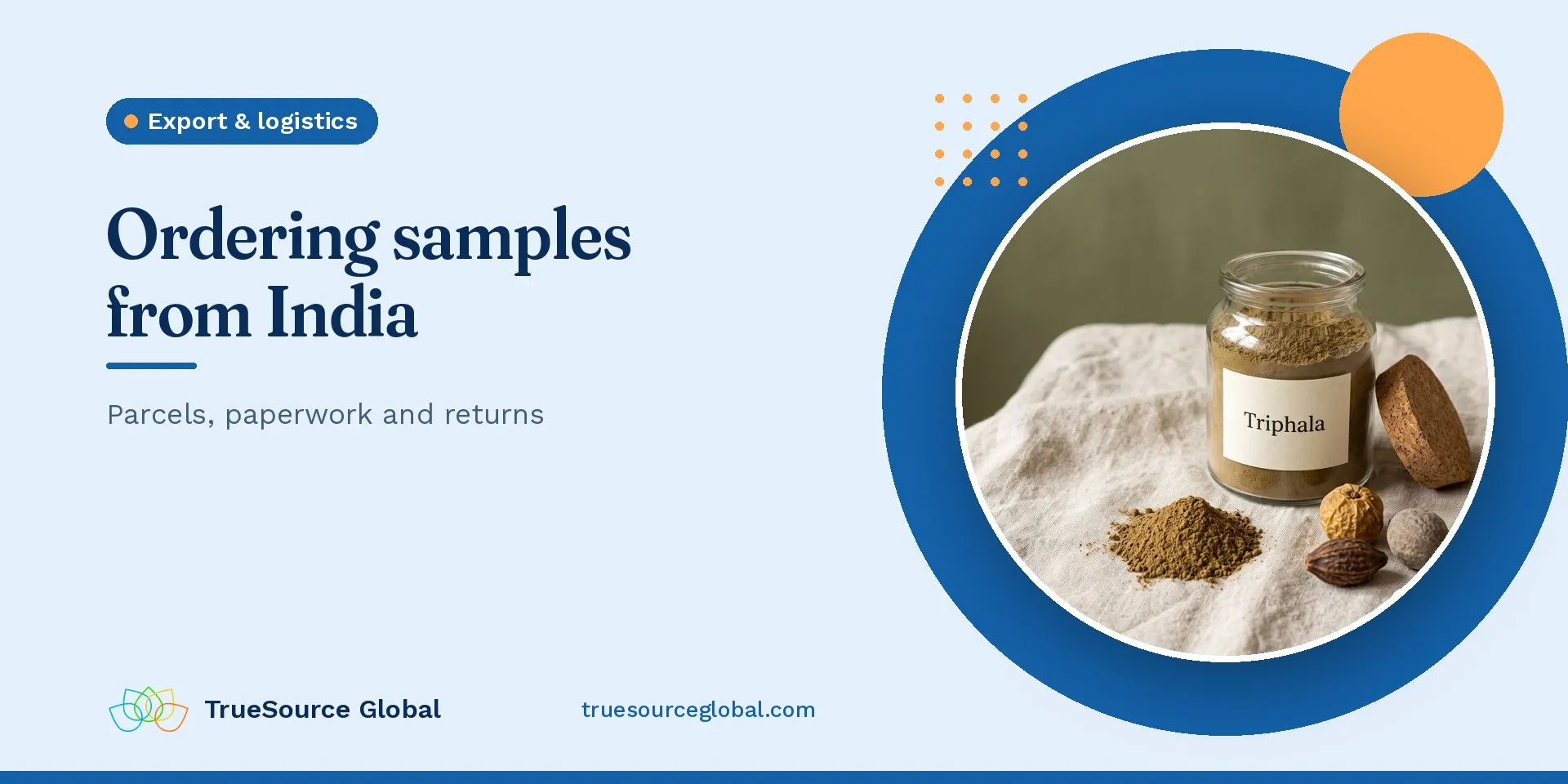
To order samples from India, agree the route first: India Post for light parcels, courier for speed and door-to-door tracking, and air or sea cargo for pallets. Your supplier files the Indian export entry; you handle your own customs and duty. Before it ships, ask for a Certificate of Analysis (CoA), an invoice marked as samples with a value for customs, and the HS code.
This guide reads the sample and small-parcel pages of the Indian government’s guide for sellers, the Directorate General of Foreign Trade’s E-Commerce Exports Handbook for MSMEs, from the buyer’s side. The handbook dates from the Foreign Trade Policy 2023 launch, so we rechecked each rule. Everything below is as of 21 Nov 2026, and where a rule has changed we say so. It is not legal advice: check with your customs broker. DGFT has not reviewed or endorsed this guide or TrueSource.
Which route should a sample or small order take?
The handbook describes two routes for small exports: India Post, booked at a Dak Ghar Niryat Kendra (post office export centre), and authorised couriers. Anything bigger goes as ordinary cargo.
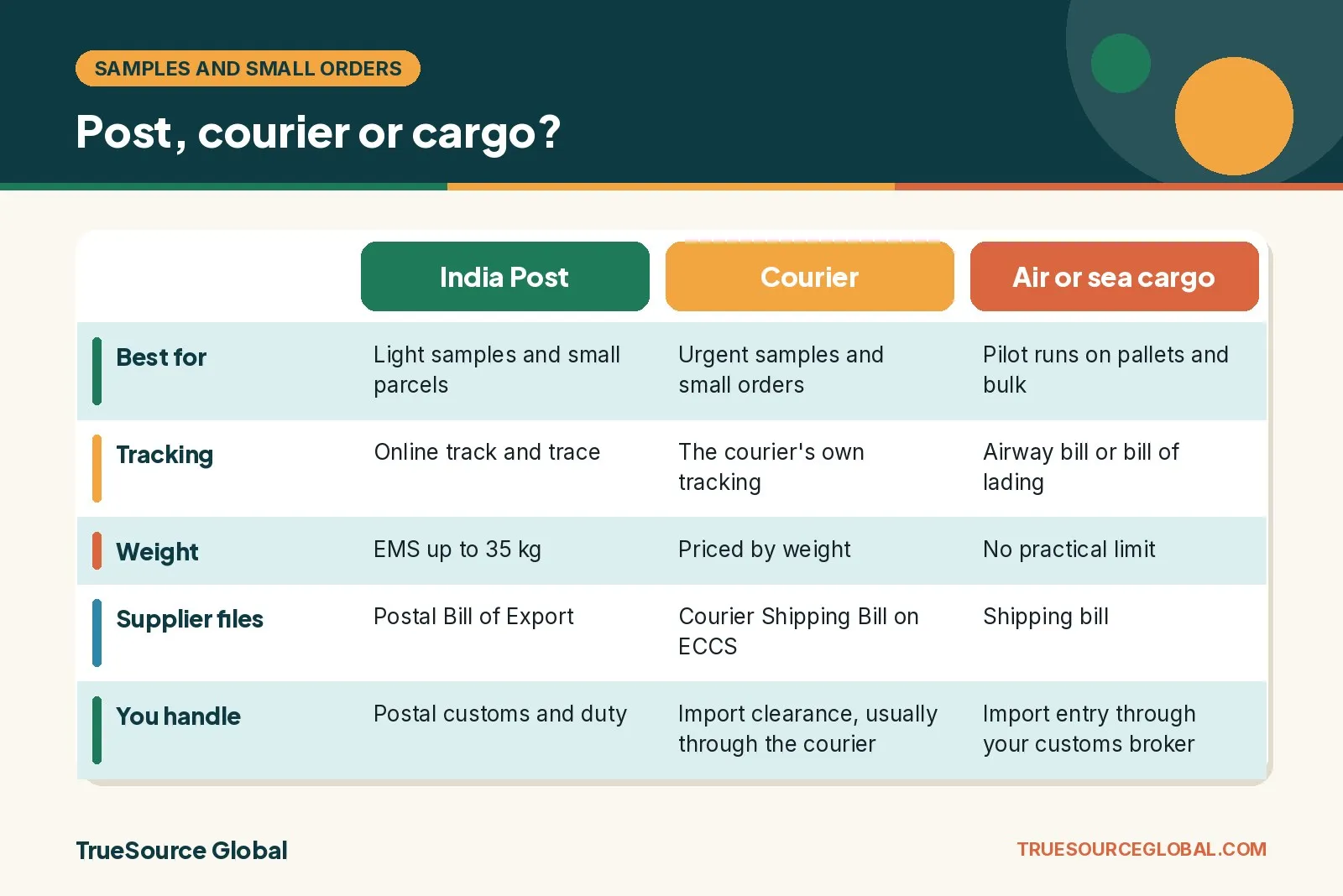
| India Post | Courier | Air or sea cargo | |
|---|---|---|---|
| Best for | Light samples and small parcels | Urgent samples and small orders | Pilot runs on pallets and bulk |
| Speed | Depends on the service and your country | Express, door to door | Slowest to arrange; sea is slowest |
| Tracking | Online track and trace on EMS, air parcels and the tracked packet (ITPS) | The courier’s own tracking | Airway bill or bill of lading |
| Weight | EMS up to 35 kg or your country’s lower limit (India Post); air parcels 20 kg and ITPS 2 kg in the handbook | Priced by weight | No practical limit |
| Supplier files in India | Postal Bill of Export online (PBE-III for e-commerce, PBE-IV for other exports), then books the parcel at the export centre | The authorised courier files a Courier Shipping Bill on ECCS using the supplier’s IEC, GSTIN, AD code and HSN code | Shipping bill, through a customs broker |
| You handle | Your country’s postal customs and duty | Import clearance, usually through the courier; confirm who pays duty | Import entry through your customs broker |
Source: DGFT E-Commerce Exports Handbook for MSMEs, pages 11 to 14, checked against India Post and the official sources linked below.
A free sample still needs paperwork. The handbook names CSB-IV for samples or goods of no commercial value under ₹50,000 and CSB-V for commercial shipments. We could not find the ₹50,000 figure on a current official page, so treat it as the handbook’s figure and check with your courier.
What has changed since the handbook?
| Topic | Handbook (2023) | As of 21 Nov 2026 |
|---|---|---|
| Courier value cap | CSB-V up to ₹10 lakh | Cap removed from 1 Apr 2026 (CBIC Circular 17/2026) |
| Registered Small Packet | Up to 2 kg, 200+ countries | Discontinued from 1 Jan 2026 (PIB) |
| Tracked packet (ITPS) | 40+ countries | 135 countries (PIB, Jan 2026) |
| Post to the US | Not covered | Resumed 15 Oct 2025, with US duties collected in India at booking (PIB) |
| Courier returns | Courier Bill of Entry for re-import | Risk-based checks and a returns module in ECCS (PIB) |
| Export council membership (RCMC) | Not covered | Not needed up to ₹3 lakh FOB per consignment from 15 Sep 2026 (DGFT Notification 36/2026-27) |
| Who exports | The seller | An Exporter-on-Record may export other firms’ goods from 5 Aug 2026 (DGFT Notification 27/2026-27) |
The last row matters for samples: the company on your invoice may not be the factory, so ask who made the batch.
What should you ask your supplier for?
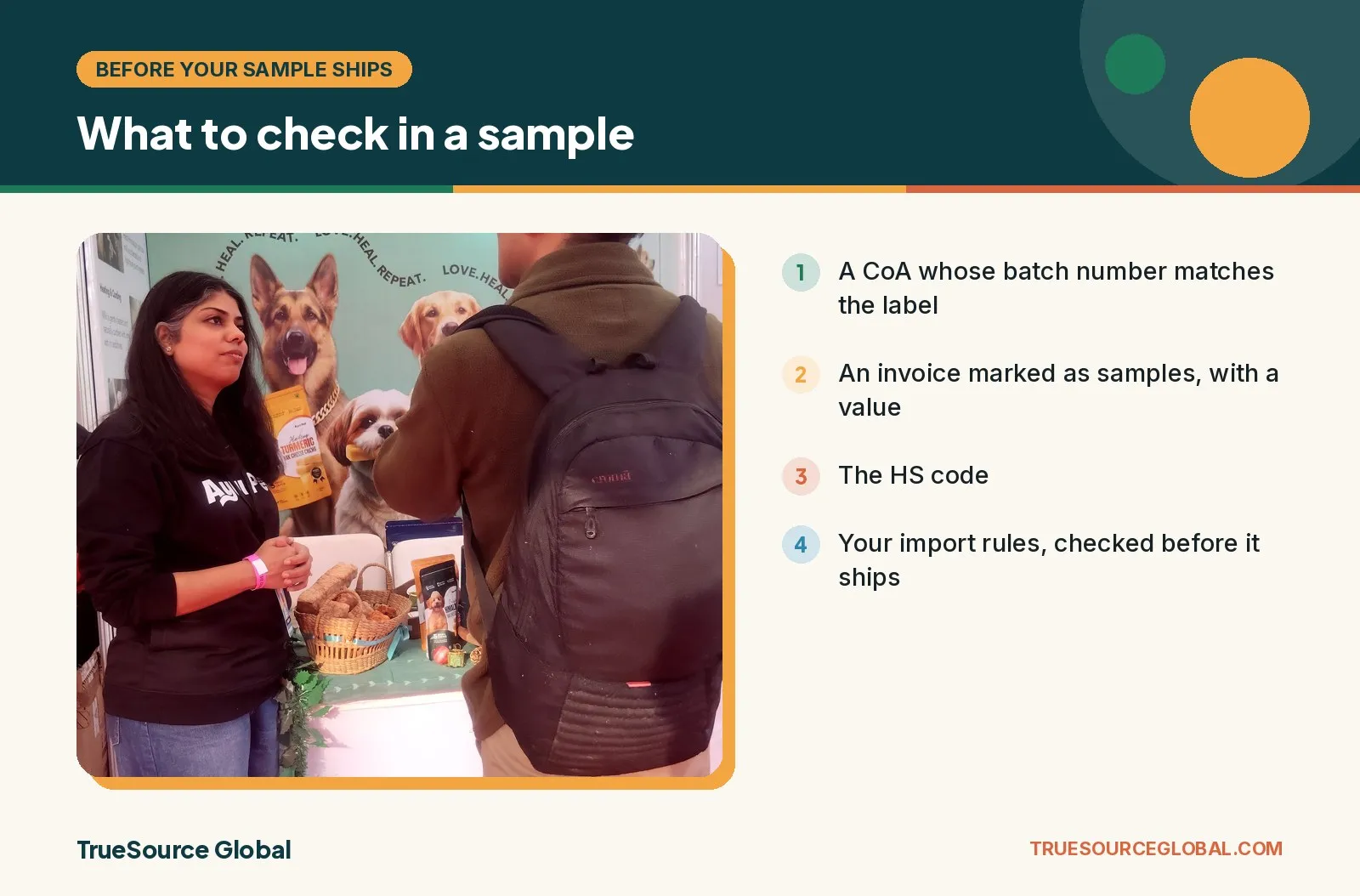
A sample should tell you what the bulk order will be. Ask for these before it ships.
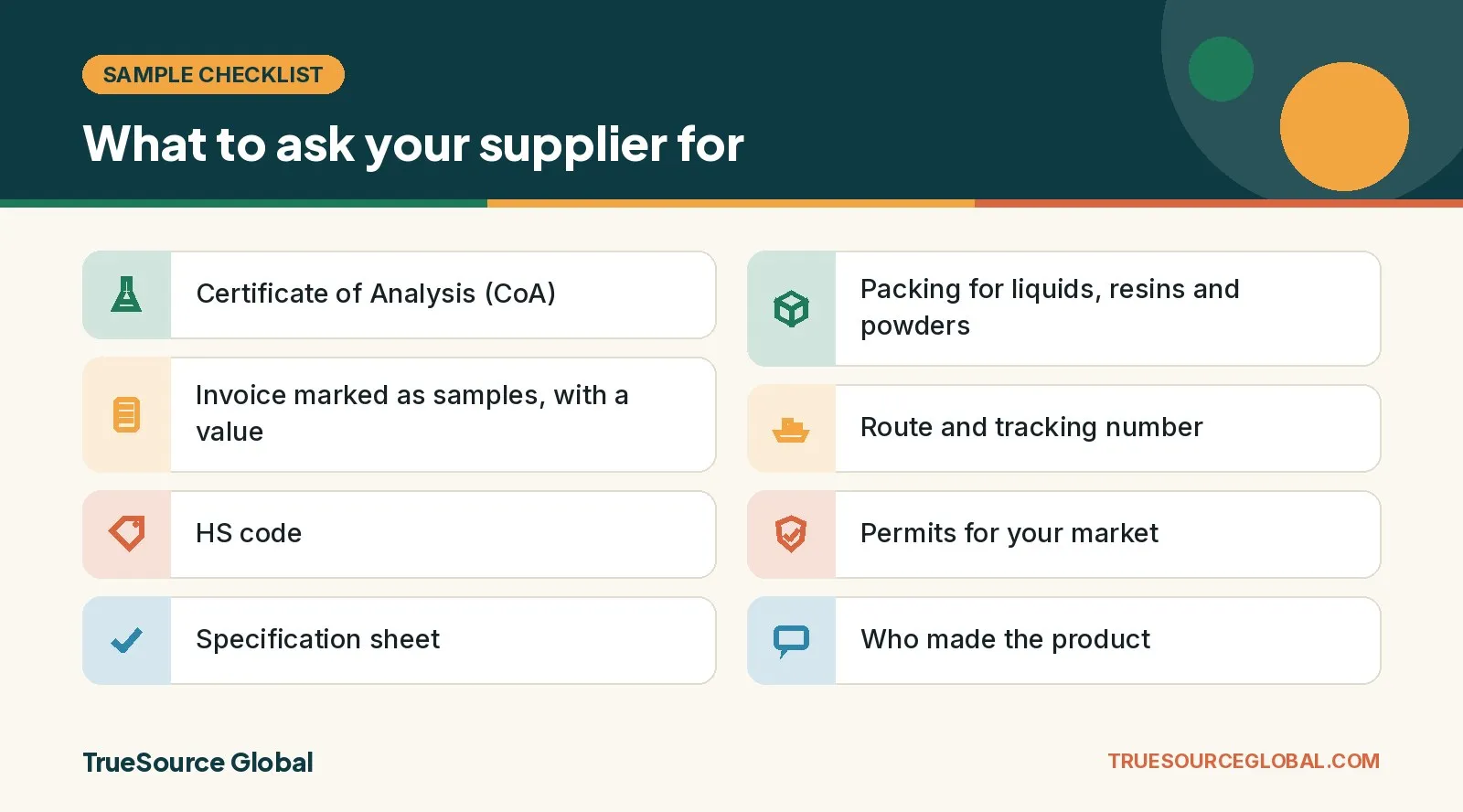
| Ask for | Why it matters |
|---|---|
| Certificate of Analysis (CoA) | The batch number should match the label, and the tests should match your market’s limits |
| Invoice marked as samples, with a value | Customs values every parcel, free or not |
| HS code (8-digit ITC(HS) on the Indian side) | Sets the Indian export form and your import duty; your broker confirms your own code |
| Specification sheet | Lets you test the sample against what the bulk order will promise |
| Packing for liquids, resins and powders | The handbook says glass, liquids, ointments and resins need special packing, sealed so tampering shows |
| Route and tracking number | You can follow the parcel and file prior notice where needed |
| Permits for your market | Food, herbal and animal-origin samples may need them (see below) |
| Who made the product | The exporter may not be the producer |
What will your own customs ask for?
Duty and permits are on your side. As of 21 Nov 2026:
- United States. The $800 de minimis exemption is suspended for all countries: for non-mail shipments from 24 June 2026 (Federal Register) and for mail from 24 July 2026, with a new postal entry process (91 FR 37801). Expect an entry and duty even on a sample.
- United Kingdom. Duty relief for goods of £135 or less still applies, but the government will remove it by October 2028 at the latest (GOV.UK).
- European Union. The €150 duty relief is gone. From 1 July 2026 to 1 July 2028, a flat €3 duty per item applies to low-value e-commerce and postal consignments (Council Regulation (EU) 2026/382; European Commission). Business samples may be treated differently, so check with your customs broker.
Food, herbal and animal-origin samples need more. In the US, FDA prior notice covers trade and quality-control samples of food, including pet food. For mail it must be filed before the parcel is sent, and the parcel must carry the confirmation number (FDA). In the UK, trade samples of animal by-products from outside the EU need an APHA authorisation and a health certificate (GOV.UK IIN ABP/8B). For pet chews and treats, see our guide to importing pet treats from India. For Ayurvedic herbs, ask your customs broker whether your market treats the product as a food, a supplement or a medicine.
What happens if customs rejects the parcel?
| Situation | What happens | Who acts |
|---|---|---|
| Your customs refuses a courier parcel | The handbook says a logistics provider in your country can start the return if the goods could not clear | Your courier or its partner |
| The courier export comes back to India | The authorised courier files a Courier Bill of Entry for re-import, for the same IEC holder at the same courier terminal, with the reason and the original packing | The supplier’s courier |
| Re-import checks in India | Since 1 Apr 2026: risk-based checks instead of checking every consignment, and a dedicated returns module in ECCS (PIB) | Indian customs |
| A postal parcel is refused | The handbook does not cover postal returns | Ask your supplier and India Post |
| A US food sample has no valid prior notice | It is subject to refusal and held at the port of entry (FDA) | You or your broker |
Source: DGFT E-Commerce Exports Handbook for MSMEs, pages 14 to 15, checked against the official sources linked in each row.
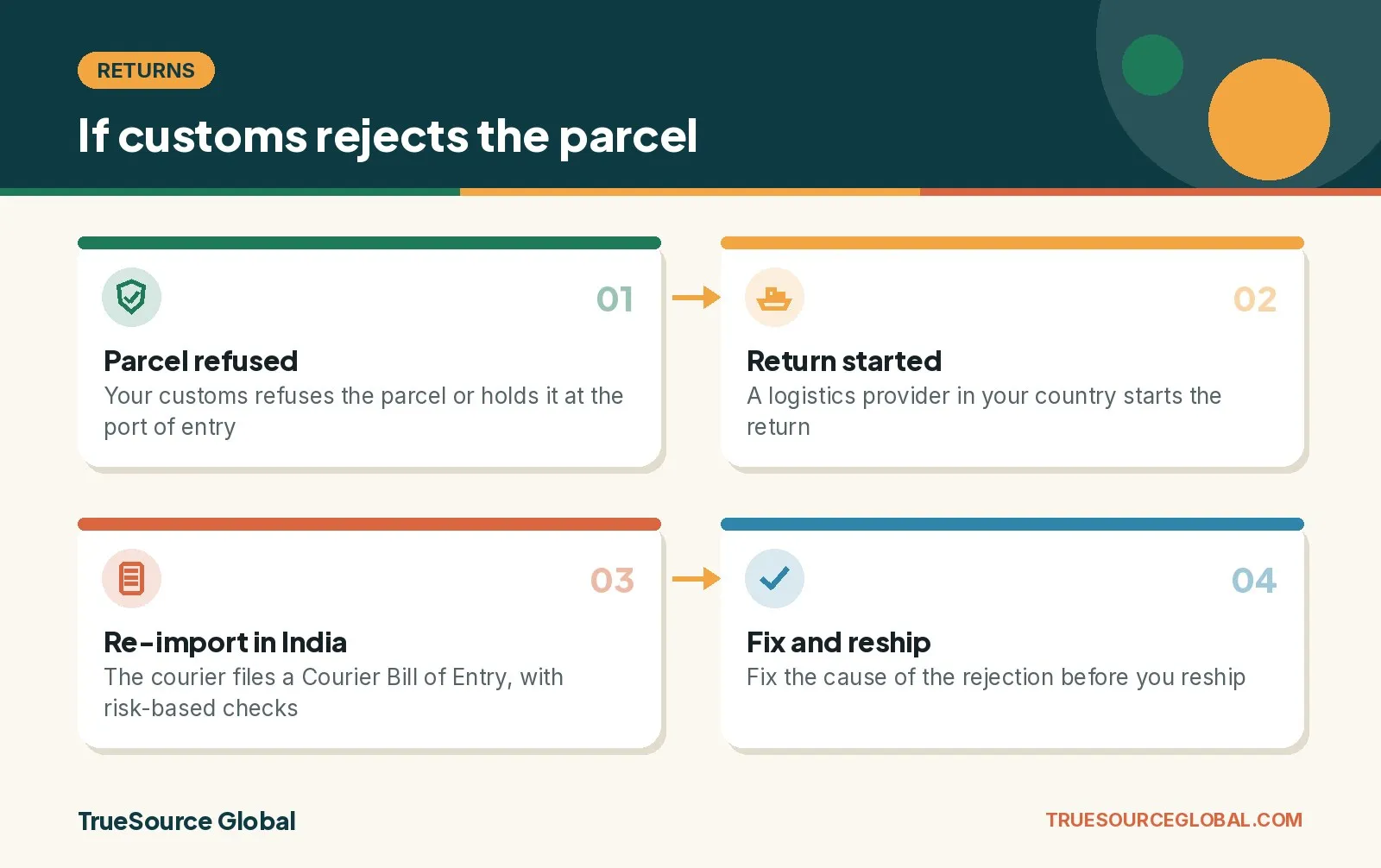
Agree in writing who pays for a return before the sample ships, and fix the cause of a rejection before you reship.
Where TrueSource fits
We are a sourcing partner, not a manufacturer: products are made by partner producers in our network of 200+ suppliers, and we serve buyers in 18 countries. Samples usually leave within 5 to 7 working days. Most products start at 500 units per SKU, with pilot runs of 100 to 250 units at a slightly higher unit cost, so you can move from sample to small order before a full run. We can check the CoA, invoice and HS code with the producer before your sample ships. See how it works, our quality and documentation standards, our Ayurvedic herbs and supplements range and triphala.
Same series. Yesterday’s guide, How to buy from India, covers export policy and supplier documents. Indian sellers can read the companion guide on IndoFolk Wellness: Exporting by India Post and courier, part of its series on DGFT’s E-Commerce Export Handbook for MSMEs. Next in the series: paying an Indian supplier safely (22 Nov).
If you want to source from vetted Indian suppliers, request a sample quote and we reply within 12 hours, or book a call.
Frequently asked questions
Can an Indian supplier send me free samples by courier?
Yes. The authorised courier files a Courier Shipping Bill for the supplier on India's ECCS system. DGFT's handbook names CSB-IV for samples under ₹50,000, but we could not find that limit on a current official page as of 21 Nov 2026, so ask your courier which form it will use. A free sample still needs an invoice with a value for customs.
Do I pay import duty on a sample from India?
Often, yes. As of 21 Nov 2026 the US has suspended its $800 de minimis exemption for all countries, and the EU has replaced its €150 duty relief with a €3 per item duty for low-value e-commerce and postal parcels. The UK still gives duty relief up to £135 but will remove it by October 2028. Ask your customs broker how your sample will be treated.
Do food, herbal or pet treat samples need extra paperwork?
Usually. In the US, FDA prior notice covers trade and quality-control samples of food, including pet food, and for mail it must be filed before the parcel is sent. In the UK, trade samples of animal by-products from outside the EU need an APHA authorisation before import. Check with your customs broker before your supplier ships.
What happens if my customs refuses the parcel?
For courier exports, the handbook says the courier can bring the item back into India against the original Courier Shipping Bill, and a logistics provider in your country can start that return if the goods could not clear. Since 1 April 2026 these returns use risk-based checks and a dedicated module in ECCS. You still pay what your own carrier charges for the return.
Sources
- Directorate General of Foreign Trade: E-Commerce Exports Handbook for MSMEs (PDF)
- PIB (31 Mar 2026): CBIC reforms for e-commerce exports and courier trade (cap removed, returns module)
- CBIC Circular 17/2026-Customs (31 Mar 2026)
- PIB (30 Dec 2025): Rationalisation of international letter mail services
- PIB (20 Jan 2026): Postal channel export benefits; ITPS in 135 countries
- PIB (14 Oct 2025): India to resume international postal services to the USA
- India Post: International Speed Post (EMS)
- DGFT Notification 36/2026-27 (15 Sep 2026): RCMC exemption for low-value exports
- DGFT Notification 27/2026-27 (5 Aug 2026): Exporter-on-Record framework
- US Federal Register 91 FR 37801 (24 Jun 2026): suspension of de minimis for mail shipments
- US Federal Register (24 Jun 2026): suspension of de minimis for all modes other than mail
- GOV.UK: Reforming the customs treatment of low value imports into the UK
- EUR-Lex: Council Regulation (EU) 2026/382 (€150 relief removed, €3 per item duty)
- European Commission Access2Markets: EU applies €3 customs duty per item on low-value e-commerce consignments
- FDA: What you need to know about prior notice of imported food shipments
- GOV.UK: Import of trade samples, Import Information Note ABP/8B
Ready to source this from India?
Tell us the product, volume and market. We'll reply within 12 hours with a quote, MOQ and sample plan, with no obligation.