How to Buy from India: What India's Government Export Guide Means for Overseas Buyers
How to buy from India, read from the buyer's side of DGFT's E-Commerce Exports Handbook: export policy, supplier IEC and GSTIN, certificates and shipping routes.
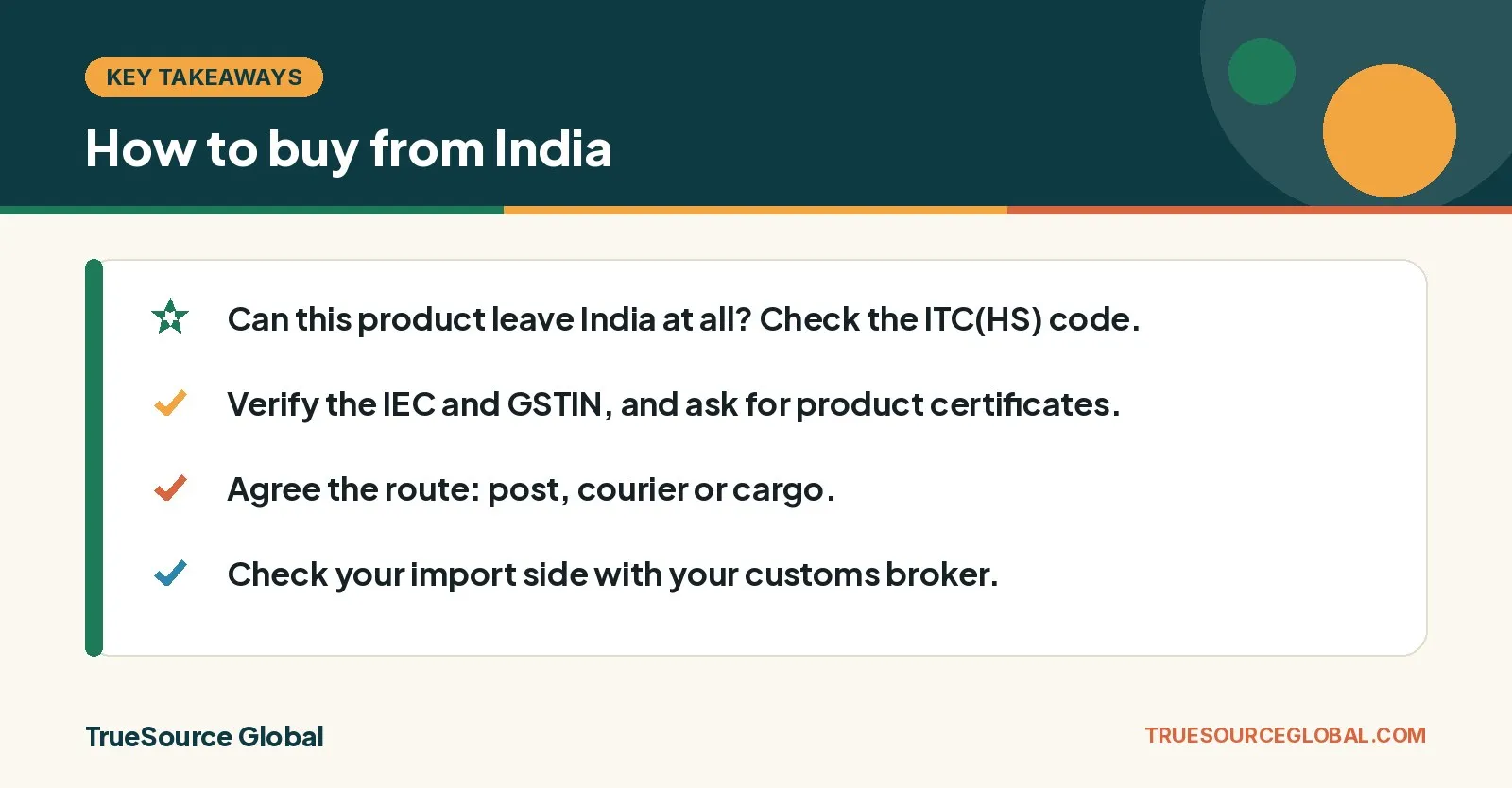
To buy from India, check three things before you pay. First, confirm the product’s export policy under India’s ITC(HS) code is “Free”, or that your supplier holds the permission it needs. Second, confirm your supplier has an active IEC, GSTIN and bank AD code plus any product certificate. Third, pick the route that suits your order: post, courier or cargo.
That order of checks comes from the Indian government’s own guide for sellers, the Directorate General of Foreign Trade’s E-Commerce Exports Handbook for MSMEs. The handbook dates from the launch of the Foreign Trade Policy 2023, so we rechecked each rule against the current official source. Everything below is written as of 20 Nov 2026, and where a rule has changed since the handbook, we say so. This is a plain reading for buyers, not legal advice: check with your customs broker before you order. DGFT has not reviewed or endorsed this guide or TrueSource.
Can this product leave India at all?
Every product has an Indian Trade Classification code, ITC(HS), and the handbook tells sellers to start there. Schedule 2 of ITC(HS) 2022 sets the export policy for each code. As of 20 Nov 2026 it is still the base list: DGFT harmonised it with the Finance Act 2026 on 27 July 2026 and amended entries as recently as 10 November 2026 (see the DGFT ITC(HS) policy page). Ask your supplier for the 8-digit ITC(HS) code on the quote, then check its status.
| Status | What the handbook says | As of 20 Nov 2026 | What to ask your supplier |
|---|---|---|---|
| Free | Exported freely if not named in Schedule 2 | Unchanged. Some Free items still carry conditions under other laws (FTP 2023, para 2.01) | The ITC(HS) code, and any product certificate the code needs |
| Restricted | Needs an export authorisation and set procedures | Unchanged (FTP 2023, para 2.08) | A copy of the authorisation before you pay a deposit |
| Prohibited | Cannot be exported, for example parts of wild animals | Unchanged | Nothing to ask: do not order |
| State Trading Enterprise | Not in the handbook | The FTP lists a fourth category: goods exported only through a named state trading enterprise | Who the exporter of record will be |
Source: DGFT E-Commerce Exports Handbook for MSMEs, page 4, checked against the Foreign Trade Policy 2023, Chapter 2.
For herbal buyers, Chapter 12 (plants and plant parts) is where the restrictions sit. DGFT amended the agarwood entry on 30 October 2026, for example. If a botanical is wild-harvested, ask how it is sourced and get the ITC(HS) status in writing.
Which documents should your Indian supplier have?
The handbook lists the documents every e-commerce exporter needs: PAN, GSTIN, IEC, and a bank account with its authorised dealer (AD) code. You can verify most of them yourself.
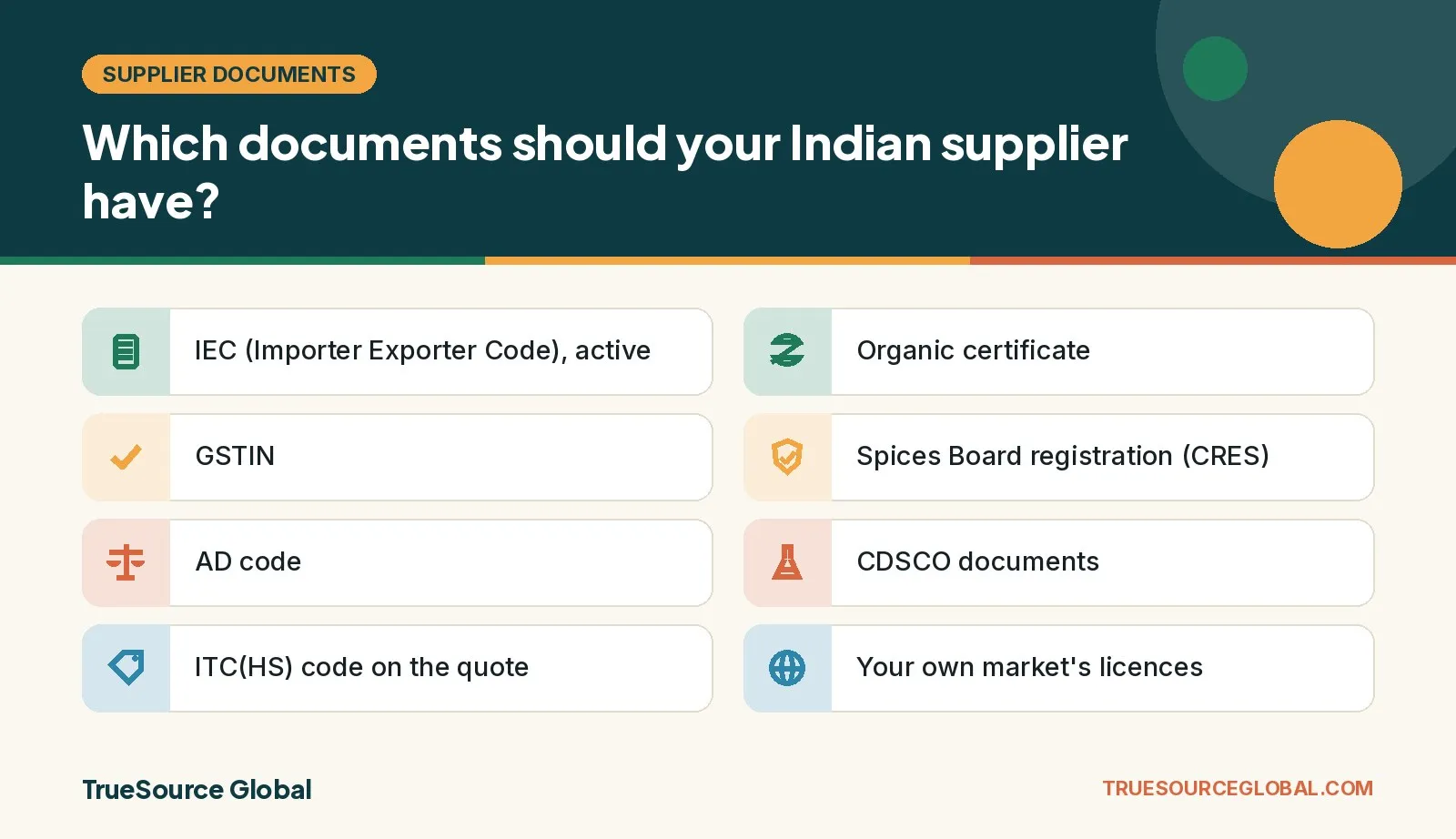
| Document | What it proves | How to check it (as of 20 Nov 2026) |
|---|---|---|
| IEC (Importer Exporter Code) | The firm may export at all. No export happens without one | It is the same as the firm’s PAN. Look it up on the DGFT portal under Services, “View IEC Related Details” (Handbook of Procedures, para 2.09). New since the handbook: an IEC must be updated every April to June or it is deactivated (FTP para 2.05) |
| GSTIN | The firm is registered for Indian GST | GST portal taxpayer search. The legal name should match your invoice |
| AD code | The bank branch that will receive your payment | Ask for it with the bank details. It should belong to the same firm as the IEC |
| RCMC (export council membership) | Needed for some products and FTP benefits | Changed: since 15 Sep 2026 it is not needed for a consignment with an FOB value up to ₹3,00,000 |
| Organic certificate | The product is certified organic | Issued by a body accredited under NPOP, which APEDA runs. For the US you need a USDA-accredited certifier: USDA ended its recognition agreement with APEDA on 11 January 2021 (USDA AMS) |
| Spices Board registration (CRES) | The firm may export scheduled spices | Required in addition to the IEC (Spices Board FAQ) |
| CDSCO documents | Drugs and pharmaceuticals meet Indian rules | The handbook names CDSCO. In 2026 customs at Nhava Sheva still asks non-manufacturer exporters for a CDSCO NOC (JNCH Public Notice 88/2026) |
Source: DGFT E-Commerce Exports Handbook for MSMEs, pages 4 and 10, checked against the official sources linked in each row.
Two more checks matter for wellness and pet buyers. Ayurvedic, food and animal-origin products also need the licences of the market you sell into. And since DGFT Notification 27/2026-27 of 5 August 2026, an “Exporter-on-Record” can export goods made by other Indian firms. That is legitimate, but it means the company on your invoice may not be the factory. Ask who makes the product. Our supplier vetting checklist covers the factory checks.
Which route should your goods travel by: post, courier or cargo?
The handbook describes the postal and courier routes for e-commerce. Larger orders go as ordinary air or sea cargo. Here is how the three compare from your side.
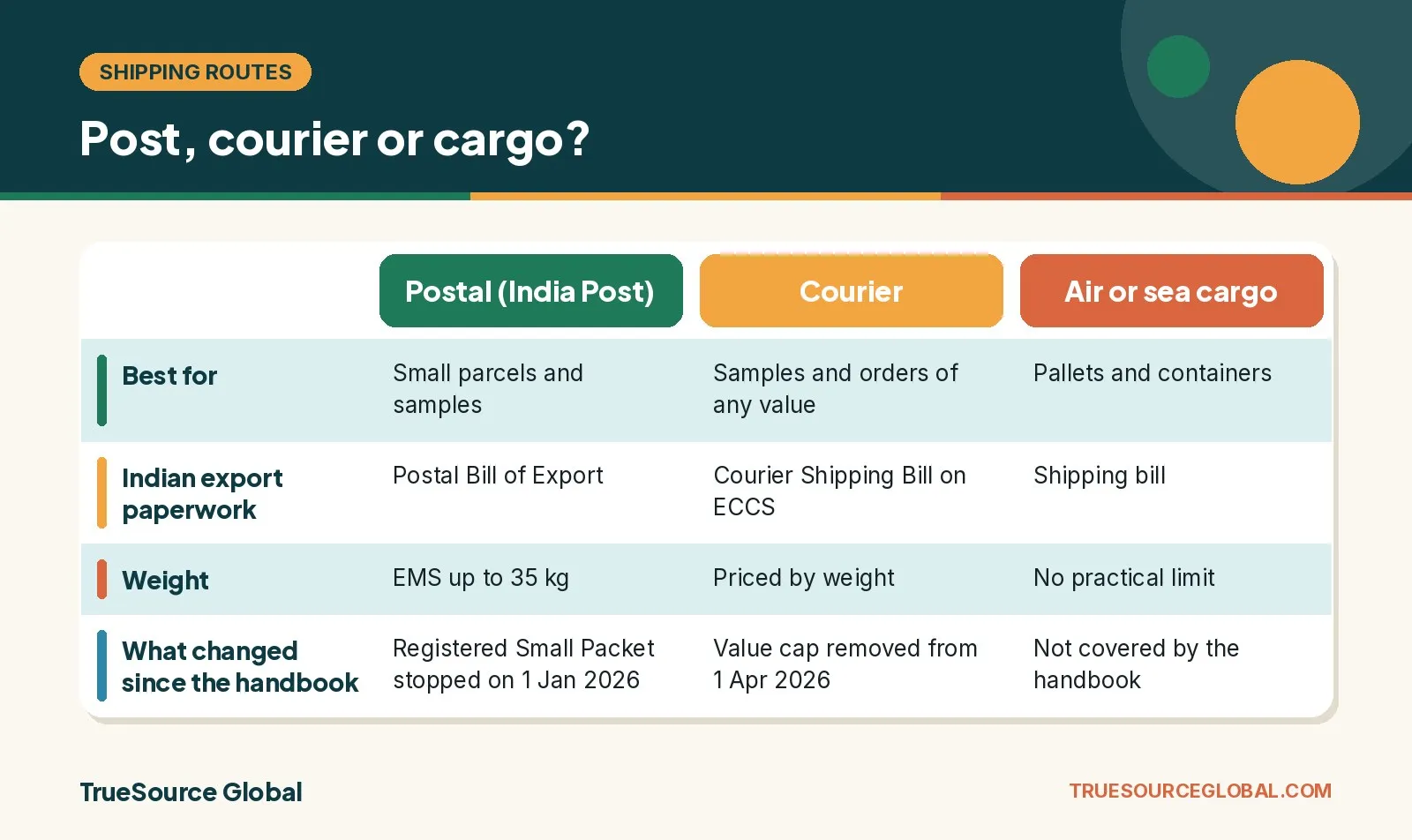
| Postal (India Post) | Courier | Air or sea cargo | |
|---|---|---|---|
| Best for | Small parcels and samples | Samples and orders of any value | Pallets and containers |
| Indian export paperwork | Postal Bill of Export, filed online and booked at a Dak Ghar Niryat Kendra (the handbook names PBE-III for e-commerce) | Courier Shipping Bill on the ECCS system, filed by the authorised courier (the handbook names CSB-IV for samples, CSB-V for commercial goods) | Shipping bill, airway bill or bill of lading, invoice cum packing list (FTP para 2.06) |
| Weight | EMS up to 35 kg, lower for some countries (India Post); tracked packet 2 kg in the handbook, so check your country | Priced by weight | No practical limit |
| What changed since the handbook | Registered Small Packet stopped on 1 Jan 2026 (PIB); tracked packet now covers 135 countries, not 40+; 1,013 post office export centres were open in January 2026 (PIB) | The ₹10 lakh value cap on commercial courier exports was removed from 1 Apr 2026 (CBIC Circular 17/2026) | Not covered by the handbook |
| Returns | Not covered in the handbook | Simpler since 1 Apr 2026: risk-based checks and a returns module in ECCS (PIB) | Arrange with your forwarder |
Source: DGFT E-Commerce Exports Handbook for MSMEs, pages 11 to 15, checked against the official sources linked in each cell.
US buyers should note one more change. India Post suspended most US services on 22 August 2025 after the US ended duty-free de minimis for postal shipments, then resumed all categories on 15 October 2025. US duties are now collected in India when the parcel is booked (PIB). Check the current US duty with your customs broker before you choose post.
The postal route also became more attractive for suppliers: from 15 January 2026, postal exports qualify for Duty Drawback, RoDTEP and RoSCTL (PIB). That can show up in the price you are quoted. For the documents your own customs will ask for, see our export documents checklist.
What should you check before you pay?
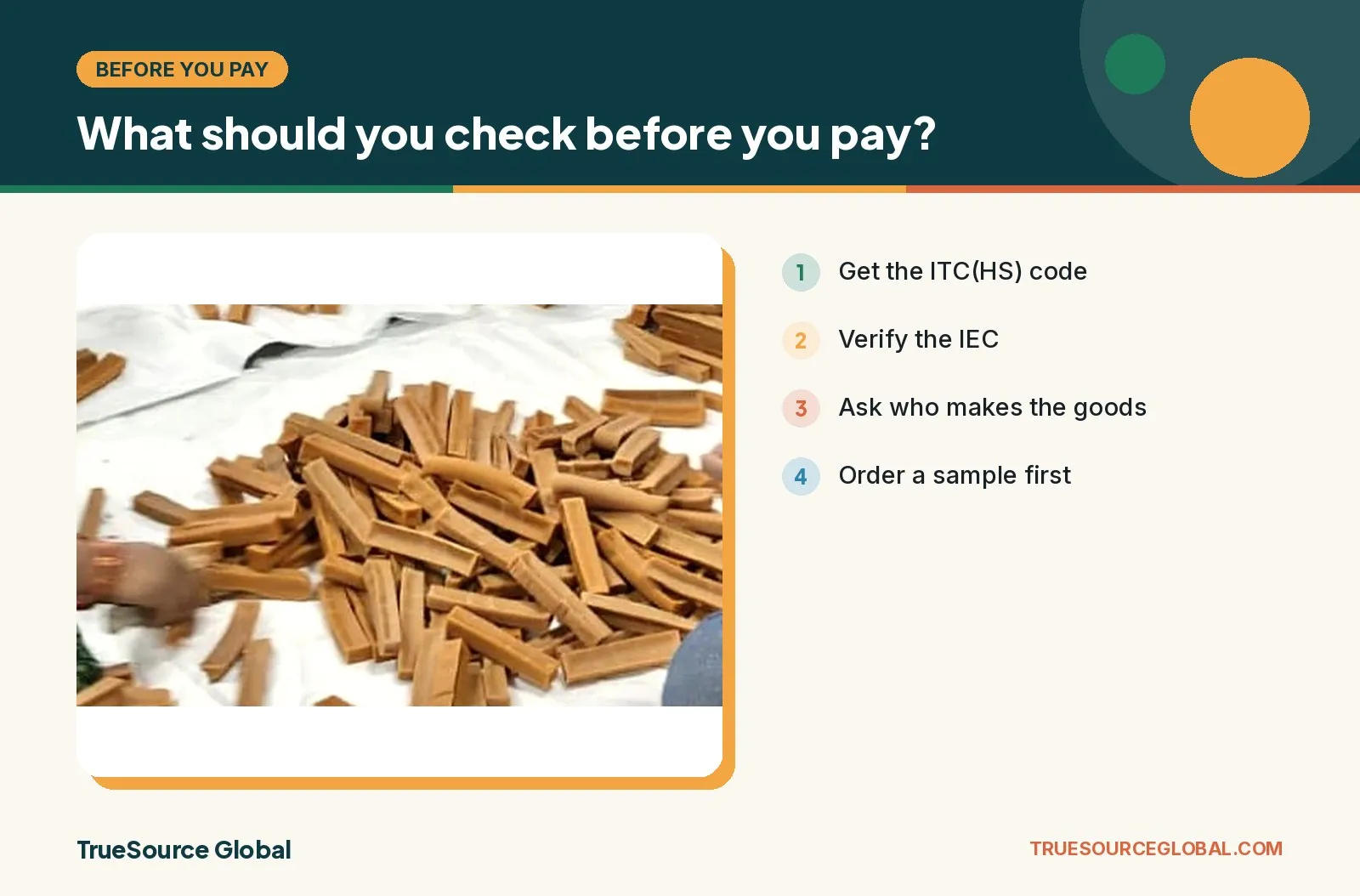
- Get the ITC(HS) code on the quote and confirm it is Free, or see the authorisation.
- Verify the IEC on the DGFT portal, and check it is active.
- Verify the GSTIN and match the legal name to the IEC, invoice and bank account.
- Ask for product certificates that match the product: organic, Spices Board, CDSCO, and your own market’s licences.
- Ask who makes the goods if the exporter is not the factory.
- Agree the route (post, courier or cargo) and the Incoterm in writing.
- Check your import side (duty, registration, labelling) with your customs broker.
- Order a sample first and test it before the bulk order.
Where TrueSource fits
We are a sourcing partner, not a manufacturer: products are made by partner producers in our network of 200+ suppliers, and we serve buyers in 18 countries. We run the checks above for you, from IEC and certificates to batch checks before dispatch, and samples usually leave within 5 to 7 working days. See how it works, our quality and documentation standards and our Ayurvedic herbs and supplements range. For pet products, our guide to importing pet treats from India adds the animal-health side.
Same series. Indian sellers can read the companion guide on IndoFolk Wellness: DGFT’s E-Commerce Export Handbook for MSMEs, explained for Ayush and herbal brands. Next in the series on TrueSource: ordering samples and small quantities from India (21 Nov) and paying an Indian supplier safely (22 Nov).
If you want to source from vetted Indian suppliers, request a quote and we reply within 12 hours, or book a call.
Frequently asked questions
Do I need an Indian licence to buy goods from India?
No. India's export rules apply to the seller: the Indian exporter needs an Importer Exporter Code (IEC) and, for some goods, an export authorisation or certificate. You need whatever your own country requires to import the product, so check with your customs broker before you order.
How can I check that an Indian supplier's IEC is real?
Ask for the 10-character IEC, which is the same as the company's PAN, and look it up on the DGFT website under Services, 'View IEC Related Details'. The name should match your invoice. Since an IEC that is not updated every April to June is deactivated, check it again before each order.
Can an Indian supplier send a large order by courier?
Yes, as of 20 Nov 2026. The handbook quotes a ₹10 lakh cap on commercial courier exports, but CBIC removed that cap from 1 April 2026. Courier is still priced by weight, so heavy or bulky orders usually travel cheaper as air or sea cargo.
Is India Post shipping to the US working?
Yes. India Post suspended most US postal services on 22 August 2025 and resumed all categories on 15 October 2025, with US duties collected in India at booking. Check the current US duty with your customs broker before you choose the postal route.
Sources
- Directorate General of Foreign Trade: E-Commerce Exports Handbook for MSMEs (PDF)
- DGFT: Foreign Trade Policy 2023, Chapter 2 (export policy, IEC, mandatory export documents)
- DGFT: Handbook of Procedures, Chapter 2 (IEC verification and validity)
- DGFT: ITC(HS) import and export policy
- DGFT Notification 36/2026-27 (15 Sep 2026): RCMC exemption for low-value exports
- DGFT Notification 27/2026-27 (5 Aug 2026): Inventory-based Cross-border E-Commerce Export Framework
- CBIC Circular 17/2026-Customs (31 Mar 2026): courier value cap removed, returns simplified
- PIB (31 Mar 2026): CBIC reforms for e-commerce exports and courier trade
- PIB (20 Jan 2026): Postal channel enabled with export benefits; 1,013 Dak Ghar Niryat Kendras
- PIB (30 Dec 2025): Rationalisation of international letter mail services
- PIB (14 Oct 2025): India to resume international postal services to the USA
- India Post: International Speed Post (EMS)
- GST portal: Search taxpayer by GSTIN
- APEDA: National Programme for Organic Production (NPOP)
- USDA AMS: International trade policies, India (organic)
- Jawaharlal Nehru Custom House Public Notice 88/2026: export documents for drugs and pharmaceuticals
- Spices Board India: exporter registration FAQ
Ready to source this from India?
Tell us the product, volume and market. We'll reply within 12 hours with a quote, MOQ and sample plan, with no obligation.