How to Import Pet Treats from India: US, UK and EU Step by Step
How to import dog and cat treats, yak chews and toppers from India into the US, UK and EU: tariff codes, permits, health certificates, labels and documents.
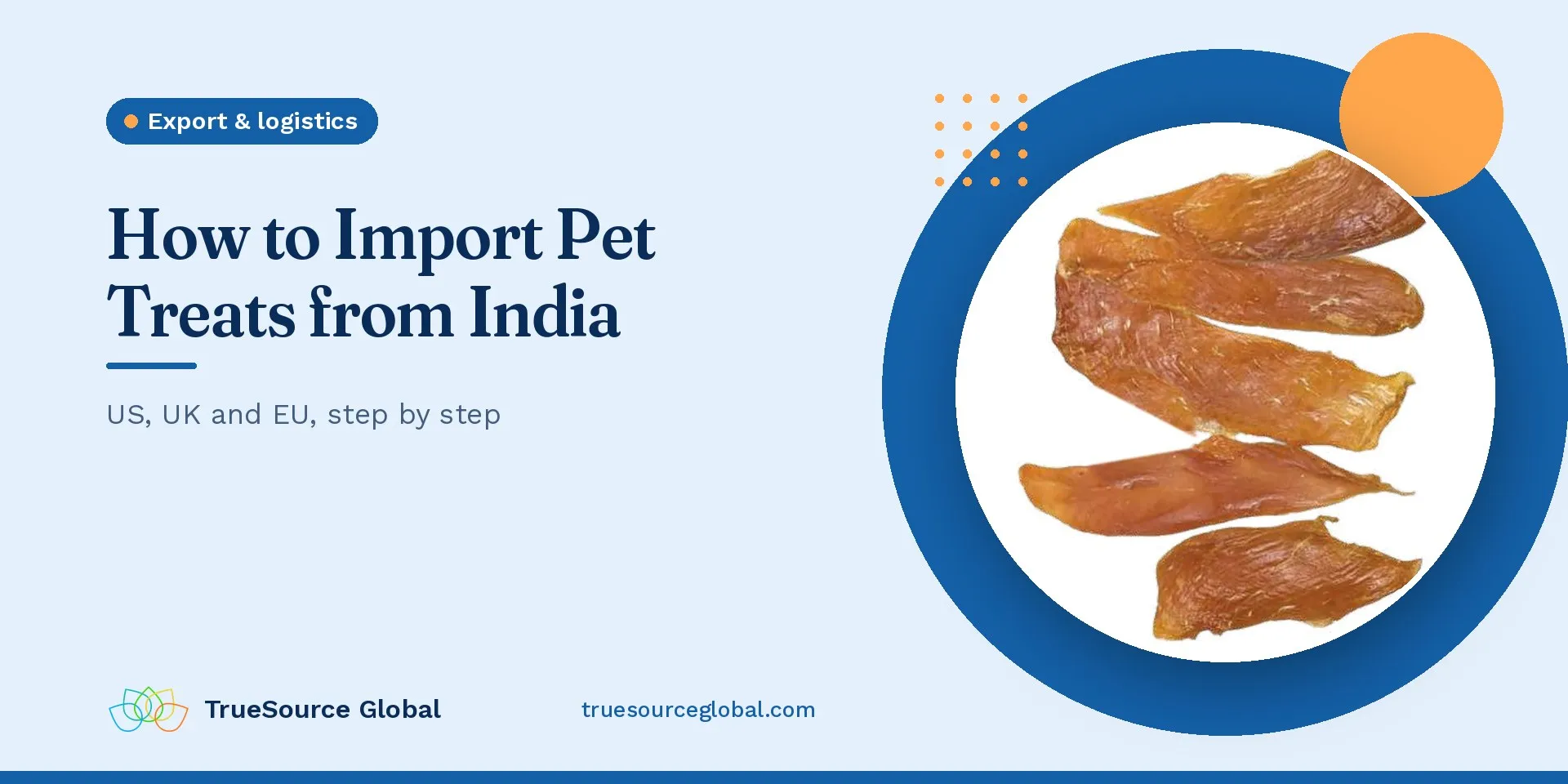
To import pet treats from India, classify each product first (most retail dog and cat treats fall under HS 2309), then check whether it contains animal-origin material. Plant-based toppers mainly need feed and labelling compliance. Yak chews and chicken jerky also need an eligible producer, a health certificate and, in the US, usually an APHIS permit.
That one split, animal origin or not, decides most of the work. This guide walks a US, UK or EU importer through it in order: classification, the rules in each market, labels, the documents to collect, a realistic sequence of steps and the reasons containers get held. It builds on our general export documents checklist, which covers the paperwork every shipment from India needs.
Which pet treats can you import from India, and which route does each take?
Start by sorting your range into routes, not products. The same rules apply to every product in a route, so a mixed order of yak chews, jerky and herbal toppers is really three import projects.
| Product type | Examples | Animal origin? | Route |
|---|---|---|---|
| Dairy chews | Himalayan yak cheese chews, puffs, nubs | Yes (milk) | Strictest: eligible country and establishment, health certificate, US APHIS permit |
| Meat, fish and egg treats | Dehydrated chicken breast jerky, duck strips, fish jerky | Yes | Strictest, and the meat source matters for country eligibility |
| Baked biscuits and chew sticks | Milk bones, chicken biscuits, star sticks | Usually (milk, chicken, egg) | Treat as animal origin unless the recipe has none |
| Plant-only toppers | A herbal blend of turmeric, moringa and amla | No | Feed safety and labelling; no veterinary certificate |
| Functional soft chews | Joint or gut chews | Check the recipe | Often contain animal-derived ingredients; check each one |
Look at every ingredient, not the product name. A “botanical” topper with a dairy base, such as a yak cheese crumble, is an animal-origin product. Our meal toppers range and dog and cat treats range list ingredients on each product page so you can sort them.
What HS code do pet treats use?
Heading 2309 covers preparations of a kind used in animal feeding, and dog or cat food put up for retail sale usually sits under subheading 2309.10. That is the starting point for most finished treats and toppers in retail packs.
It is not automatic. A bulk ingredient, a single-ingredient dried product, or an item presented as something other than feed can be classified elsewhere, and customs rulings decide borderline cases. Look the code up in the US Harmonized Tariff Schedule or with the UK’s commodity code guidance, agree it with your customs broker before the first order, and put the same code on the invoice, packing list and shipping bill.
How do you import dog treats from India into the USA?
The FDA regulates pet food and treats as animal food. Four federal requirements apply to almost every shipment, and a fifth applies to animal-origin products.
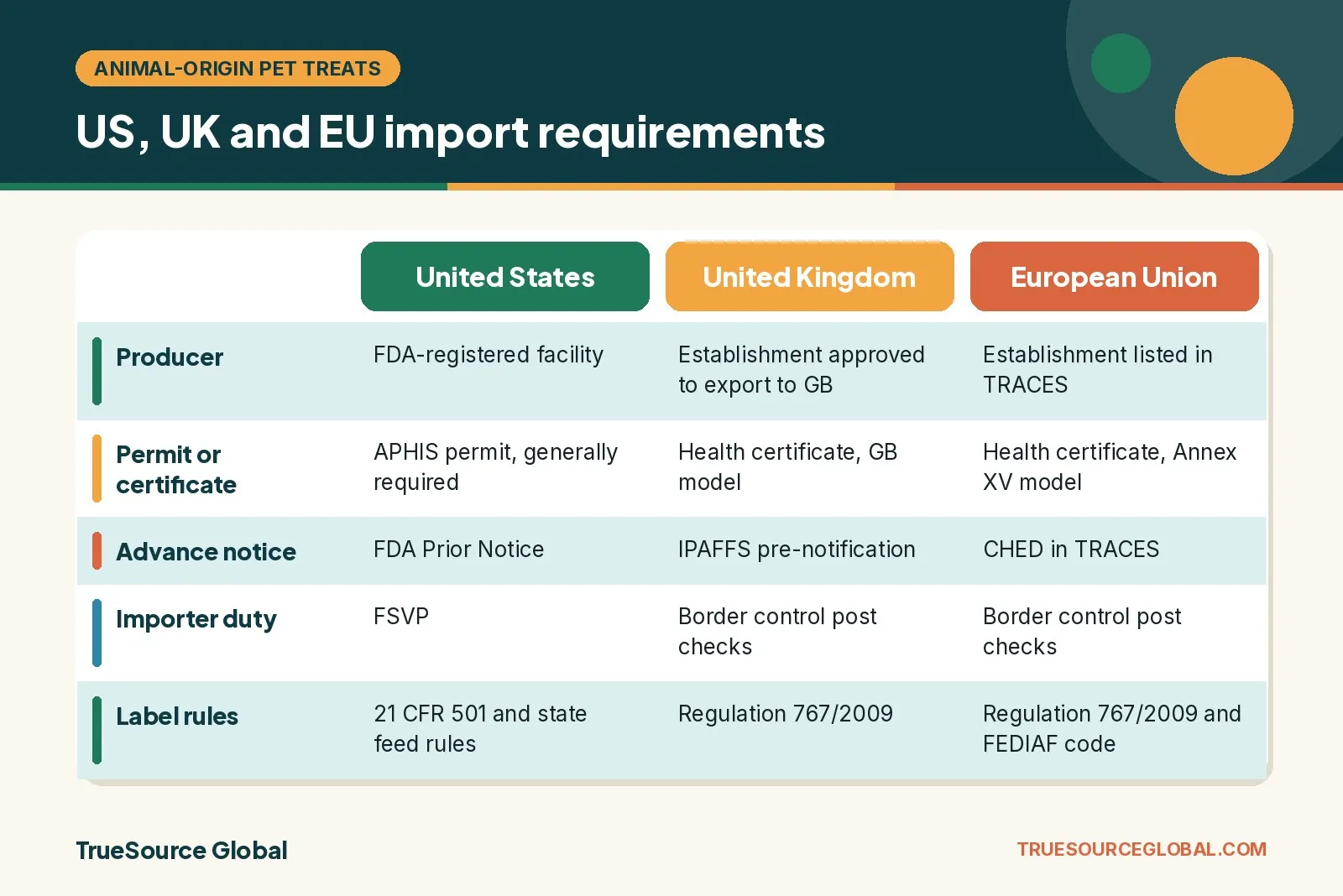
- FDA facility registration. The facility that makes the treats must be registered with the FDA. Ask for the registration number and confirm it is current. Registration is not an approval: never describe a producer as “FDA approved”.
- Prior Notice for each shipment. Prior Notice must reach the FDA before the goods arrive. Under 21 CFR Part 1, Subpart I, the deadline is set by transport mode, from 2 hours before arrival by road to 8 hours by sea. Your broker or forwarder usually files it.
- FSVP. The US importer must run a Foreign Supplier Verification Programme for animal food as well as human food: a hazard analysis, an evaluation of the supplier and ongoing verification. Producers are expected to follow the preventive controls rule for animal food, so ask for their food safety plan.
- Labelling. Animal food labels must meet 21 CFR Part 501. Most states also regulate pet food labels and require products or companies to be registered or licensed, largely based on AAFCO model rules; AAFCO’s small manufacturer guidance explains how that works.
- APHIS permit for animal-origin products. The FDA states that a USDA APHIS Veterinary Services permit is generally required for animal food, including pet chews and treats, that contains animal-origin material such as dairy or meat from countries with livestock diseases exotic to the US. Applications go through APHIS eFile. Read the permit conditions carefully: they can set processing, certification and labelling requirements the producer must meet. APHIS’s animal product imports pages list what does and does not need a permit.
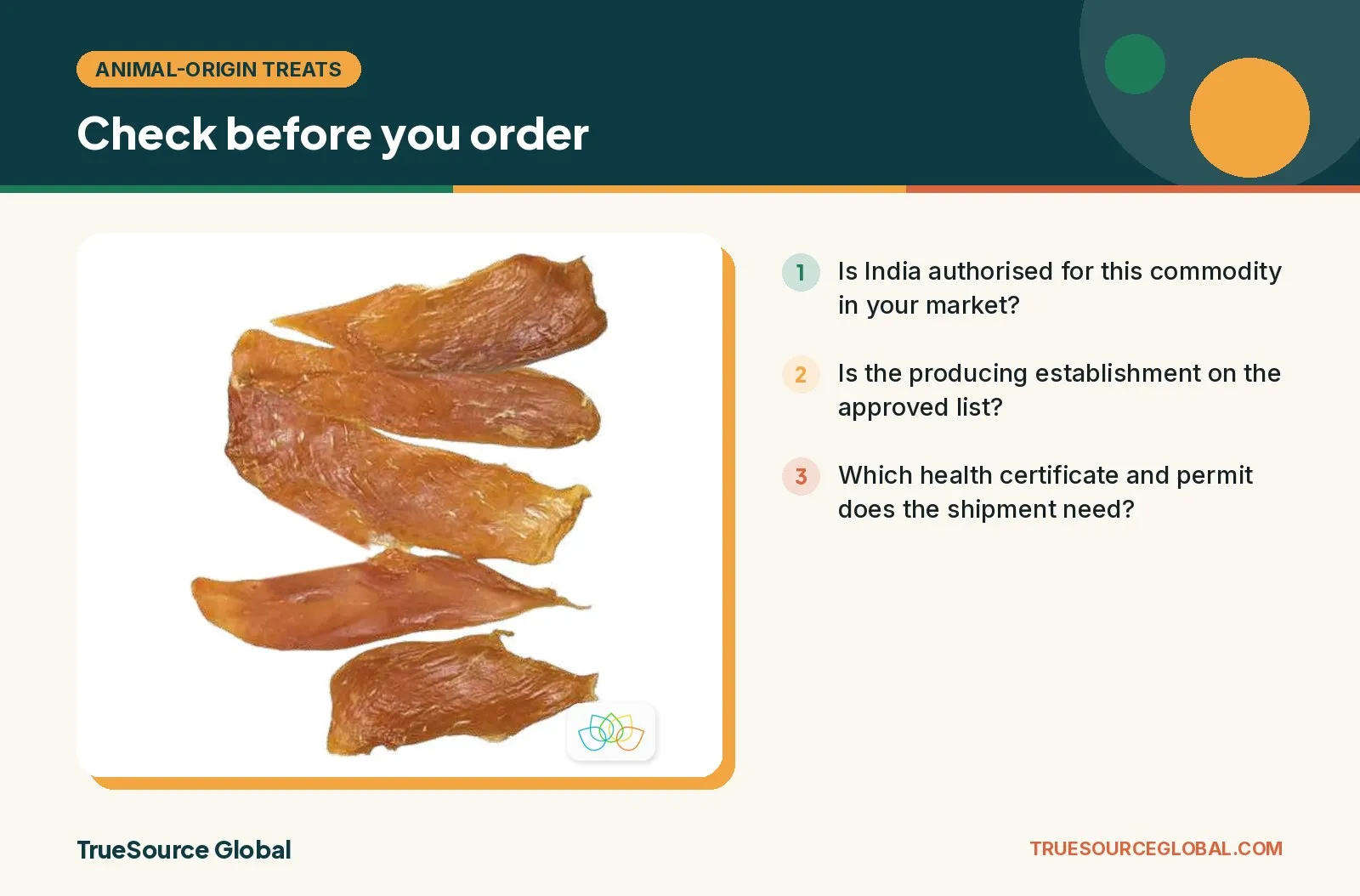
If you plan to import yak chews to the USA, start with the APHIS permit, because the FDA names dairy among the animal-origin materials that generally need one. Our comparison of private label yak chew manufacturers for US brands covers the US route in more detail.
What are the pet food import requirements in the UK?
Great Britain treats animal-origin pet food as animal by-products (ABPs). Defra and APHA publish an import information note for each product type: canned pet food, processed pet food other than canned, dog chews and more. Read the note for each of your products. The dog chews note (ABP/3C) sets out the pattern:
- Production standards, including treatment to destroy pathogens and Salmonella and Enterobacteriaceae sampling.
- Country of origin must be on the permitted list for that product. Check that India is eligible for your specific commodity before anything else.
- Approved establishment. The producer must be listed as approved to export to GB. If it isn’t listed when checks are made, the note warns, the consignment is likely to be held and could be rejected, re-exported or destroyed.
- Health certificate based on the GB model, signed by the Indian veterinary authority.
The importer then pre-notifies the consignment through IPAFFS and it enters through a border control post. You will also need an EORI number and a GB customs declaration.
Plant-only toppers are not ABPs, but they are still feed. Labels must follow Regulation (EC) No 767/2009 as it applies in Great Britain, and the importer is responsible for selling safe feed.
How do you import pet treats into the EU?
The EU rules are similar in structure and strict in practice. Animal by-products, including pet food and dog chews, can enter the Union only from third countries authorised for that product in Annex XIV of Regulation (EU) No 142/2011, which often refers to lists in Implementing Regulations (EU) 2021/404 and 2021/405. The model health certificates are in Annex XV of the same regulation.
The producing establishment must appear on the list of approved third-country ABP establishments, held in TRACES. Each consignment travels with a health certificate, and the importer lodges a Common Health Entry Document (CHED) in TRACES, which has been mandatory for goods entering the EU through border control posts since December 2019.
For plant-only toppers, the EU feed hygiene rules apply instead. Feed from outside the EU is imported by registered feed importers, and the Commission publishes feed import operator lists by member state. Talk to your national feed authority about what it expects from you and the producer.
What must the label say in each market?
Write labels for the destination, not for India. The core elements are similar everywhere: product name, species, ingredients in descending order, analytical constituents or guaranteed analysis, feeding guidance, net quantity, the responsible business and a batch number.
- United States: 21 CFR Part 501 plus state feed rules, most of which follow AAFCO models for guaranteed analysis, ingredient naming and treat feeding statements.
- UK and EU: Regulation 767/2009 sets the mandatory particulars for complementary feed, which covers most treats. The Commission refers to FEDIAF’s code of good labelling practice for pet food, which most brands follow.
Keep claims out of the first launch unless your adviser has cleared them for that market. Treats are feed, and wording that suggests treating or preventing disease can move a product into the veterinary medicines regime.
Which pet treat export documents from India should you collect?
| Document | Who provides it | Plant-only toppers | Animal-origin treats and chews |
|---|---|---|---|
| Commercial invoice and packing list | Exporter | Yes | Yes |
| Shipping bill and bill of lading or air waybill | Exporter, broker, carrier | Yes | Yes |
| Certificate of origin | Authorised Indian agency | When asked, or to claim a preferential rate | Same |
| Batch Certificate of Analysis | Producer’s quality team or external lab | Yes | Yes, including Salmonella and Enterobacteriaceae where the destination requires them |
| FDA facility registration number | Producer | US only | US only |
| FDA Prior Notice confirmation | US broker or forwarder | US only | US only |
| APHIS import permit | US importer | Not usually | US: generally required |
| Health certificate in the destination’s format | Indian veterinary authority | No | UK and EU: yes |
| Approved establishment listing | Destination authority list | No | UK and EU: confirm before ordering |
| IPAFFS or TRACES CHED notification | Importer or agent | Not usually | UK: IPAFFS. EU: CHED in TRACES |
| Final label artwork | Brand, checked against destination rules | Yes | Yes |
What is a realistic step-by-step timeline?
- Sort the range and agree HS codes with your broker.
- Check eligibility for each animal-origin product: country listing, establishment approval and the certificate model for your market. Do this before you agree a price.
- Apply for permits that must exist before shipment, such as the US APHIS permit. Processing times vary, so start early.
- Approve samples, specification and label artwork. At TrueSource, samples are usually dispatched within 5–7 working days, and most pet products can start with pilot runs from 100 units. Our guide to ordering samples from India covers sample paperwork and returns.
- Production. Typically 7–14 business days after the order and artwork are approved.
- Release testing and documents. Approve the batch CoA, check draft certificates and documents side by side, then book freight.
- Advance notices. File Prior Notice (US), IPAFFS (GB) or the CHED (EU) before arrival.
- Border checks and clearance.
Why do pet treat shipments get held?
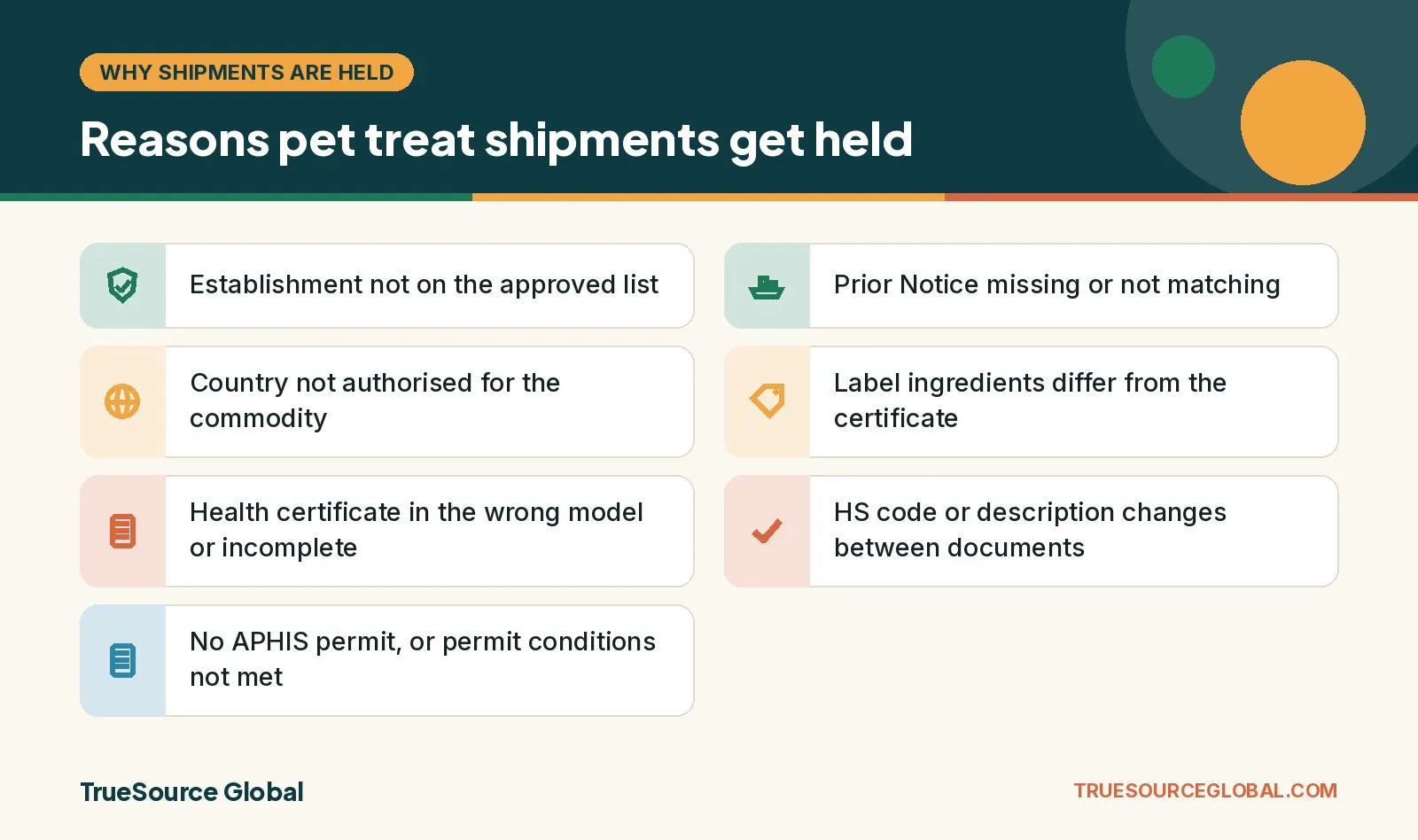
- The producing establishment is not on the approved list for the destination.
- The country of origin is not authorised for that commodity.
- The health certificate is an old version, the wrong model or incomplete.
- No APHIS permit, or the shipment does not meet the permit’s conditions.
- Prior Notice was not filed or does not match the shipment.
- The ingredient list on the label differs from the certificate or invoice.
- The HS code or product description changes between documents.
Almost every one of these is a planning failure, not bad luck. Our yak chew bulk sourcing guide covers the product side: specifications, grading and batch checks.
How we help with pet treat imports
We are a sourcing agent, not a factory owner: the treats are made by partner producers in India, and we tell you who makes your goods. For each order we check which of our partner producers can meet your destination’s rules for that product, write the specification, arrange samples, hand-check batches with the producer teams and coordinate the export documents your broker needs. Your importer of record still files the US, UK or EU notices and holds any permits. Read how we work as a pet product sourcing agent in India, see our pet wellness range, how we handle quality and documentation and our export services.
If you are building a pet line, AyurPet’s free course on Ayurveda for dogs and cats shows how Ayurvedic ingredients are presented to pet parents.
To start, request a pet product quote with your product list, volumes and destination market, or book a call to check eligibility before you commit.
This article is general information, not legal or customs advice. Rules change; confirm the current requirements with your customs broker and the relevant authority before you ship.
Frequently asked questions
Do I need a permit to import dog treats from India into the USA?
Treats that contain animal-origin material, such as dairy in yak chews or chicken in jerky, generally need a USDA APHIS Veterinary Services import permit, applied for through APHIS eFile. Every shipment of animal food also needs FDA Prior Notice, the producing facility must be registered with the FDA, and the US importer has Foreign Supplier Verification Programme duties.
Can I import yak chews from India into the UK?
Only if the product, the country and the producing establishment meet the GB conditions for dog chews. The import note ABP/3C requires production to set standards, a country of origin on the permitted list, an establishment approved to export to Great Britain and a health certificate based on the GB model. Check all four before you order, and pre-notify the consignment through IPAFFS. TrueSource Global ships yak chews from India to any country, including the UK, the EU and the US, and prepares the health certificate and export documents each route requires.
What HS code do pet treats from India use?
Dog and cat food put up for retail sale is usually classified under subheading 2309.10, within heading 2309 for preparations used in animal feeding. Bulk ingredients, single-ingredient products or items sold as something other than feed can fall elsewhere, so confirm the code with your customs broker and use the same code on every document.
Are plant-based pet toppers easier to import than meat treats?
Usually, yes. A topper made only from plant ingredients is not an animal by-product, so it avoids veterinary health certificates and APHIS animal-product permits. It still has to meet feed safety and labelling rules, and US shipments still need FDA facility registration, Prior Notice and FSVP. Check the recipe: a topper with dairy, fish or meat is back in the animal-origin route.
Why do pet treat shipments get held at the border?
The common causes are a producing establishment that is not on the approved list for the destination, a health certificate in the wrong format, a missing APHIS permit or Prior Notice, and labels or ingredient lists that don't match the declared product. Most are avoidable if eligibility is checked before the price is agreed.
Sources
- FDA: Importing animal food
- FDA: Pet food
- FDA: Registration of food facilities
- FDA: Prior Notice of imported foods
- eCFR: 21 CFR Part 1, Subpart I (Prior Notice)
- FDA: FSMA final rule on Foreign Supplier Verification Programs for importers of food for humans and animals
- FDA: FSMA final rule for preventive controls for animal food
- eCFR: 21 CFR Part 501, animal food labelling
- USDA APHIS: Animal product imports
- USDA APHIS: Animal health permits (eFile)
- AAFCO: Small manufacturer guidance on licensing and registration
- USITC: Harmonized Tariff Schedule of the United States
- GOV.UK: Pet food and feed for other animals, Import Information Notes
- GOV.UK: Dog chews, Import Information Note ABP/3C
- GOV.UK: Import of products, animals, food and feed system (IPAFFS)
- GOV.UK: Finding commodity codes for imports or exports
- legislation.gov.uk: Regulation (EC) No 767/2009 on the marketing and use of feed (as it applies in GB)
- European Commission: Animal by-products, imports (entry) into the Union
- European Commission: Approved establishments (animal by-products)
- European Commission: TRACES
- European Commission: Feed marketing (Regulation 767/2009 and the pet food labelling code)
- European Commission: Feed import operators
- FEDIAF: Labelling
Ready to source this from India?
Tell us the product, volume and market. We'll reply within 12 hours with a quote, MOQ and sample plan, with no obligation.