Paying an Indian Supplier Safely in 2026: A Buyer's Guide Based on India's Export Payment Rules
How to pay an Indian supplier safely: wire, letter of credit, payment aggregators and marketplaces compared, what their bank needs and fraud checks, as of 22 Nov 2026.
To pay an Indian supplier safely, send the money from your own company account to a bank account in the supplier’s own name, in the currency on the invoice, quoting the invoice number. Confirm the bank details by phone on a number you already hold. For a first order, use a letter of credit or a deposit with the balance after a pre-dispatch check.
This guide reads the payment pages of the Directorate General of Foreign Trade’s E-Commerce Exports Handbook for MSMEs from the buyer’s side. Several of its payment rules have changed since 2023, so we checked each against current Reserve Bank of India (RBI) and DGFT texts. Everything below is as of 22 Nov 2026. It is not legal or financial advice: check with your bank or customs broker. DGFT has not reviewed or endorsed this guide or TrueSource.
3-part series: buying from India under the official export rules
- How to buy from India: export policy, supplier IEC and GSTIN, certificates and routes (20 Nov)
- Ordering samples and small quantities: post vs courier, sample paperwork and returns (21 Nov)
- Paying an Indian supplier safely (this guide, 22 Nov)
Why do India’s export payment rules matter to you as the buyer?
India’s rules bind the supplier, not you, but they shape the terms your supplier can offer. Under the RBI’s Foreign Exchange Management (Export and Import of Goods and Services) Regulations, 2026, in force from 1 Oct 2026, regulation 5(1) says the full export value must be received within 9 months from the date of shipment, or 12 months if the export is invoiced or settled in Indian rupees. The supplier’s bank (its Authorised Dealer, or AD bank) can extend this if it accepts the reasons.
Each export is recorded in the RBI’s monitoring system (EDPMS), and the bank must be satisfied the transaction is genuine before it credits your payment and closes the entry (regulation 4(2)). So your payment has to line up with the invoice and shipping bill. Also:
- Advances and the later balance go through the same AD bank (regulation 10(1)).
- Third-party payments need the bank to be satisfied the deal is genuine (regulation 8).
- Overdue bills. An exporter with proceeds unpaid more than a year past the due date can export only against full advance or an irrevocable letter of credit (regulation 13). A sudden demand for 100% advance can have this cause, so ask.
| Rule | Handbook (2023) | As of 22 Nov 2026 |
|---|---|---|
| Time to receive payment | 9 months from export | 9 months from shipment, 12 months if invoiced or settled in rupees (RBI regulations 2026, reg 5(1)) |
| Goods sent to a warehouse abroad | 15 months from shipment | 9 months from the date of sale from the warehouse (reg 5(1)(b)) |
| Gateway route | OPGSPs, exports up to US$10,000 | Cross-border payment aggregators (PA-CB), up to ₹25 lakh per transaction; the OPGSP circular is repealed (RBI Master Direction, para 11(d) and 19(c)) |
| e-BRC | Being revamped for self-certification | Self-certified by the exporter on the DGFT portal (DGFT guide) |
Source: DGFT E-Commerce Exports Handbook for MSMEs, pages 16 to 18, checked against the sources in each row. An RBI amendment of 22 Sep 2026 set the 9 months, replacing the 15 in the January 2026 text before it took effect (RBI).
Which payment method should you use?
The handbook lists three ways sellers get paid: a marketplace’s payment service, online payment gateways and money transfer services. Trade orders also use bank wires and letters of credit.
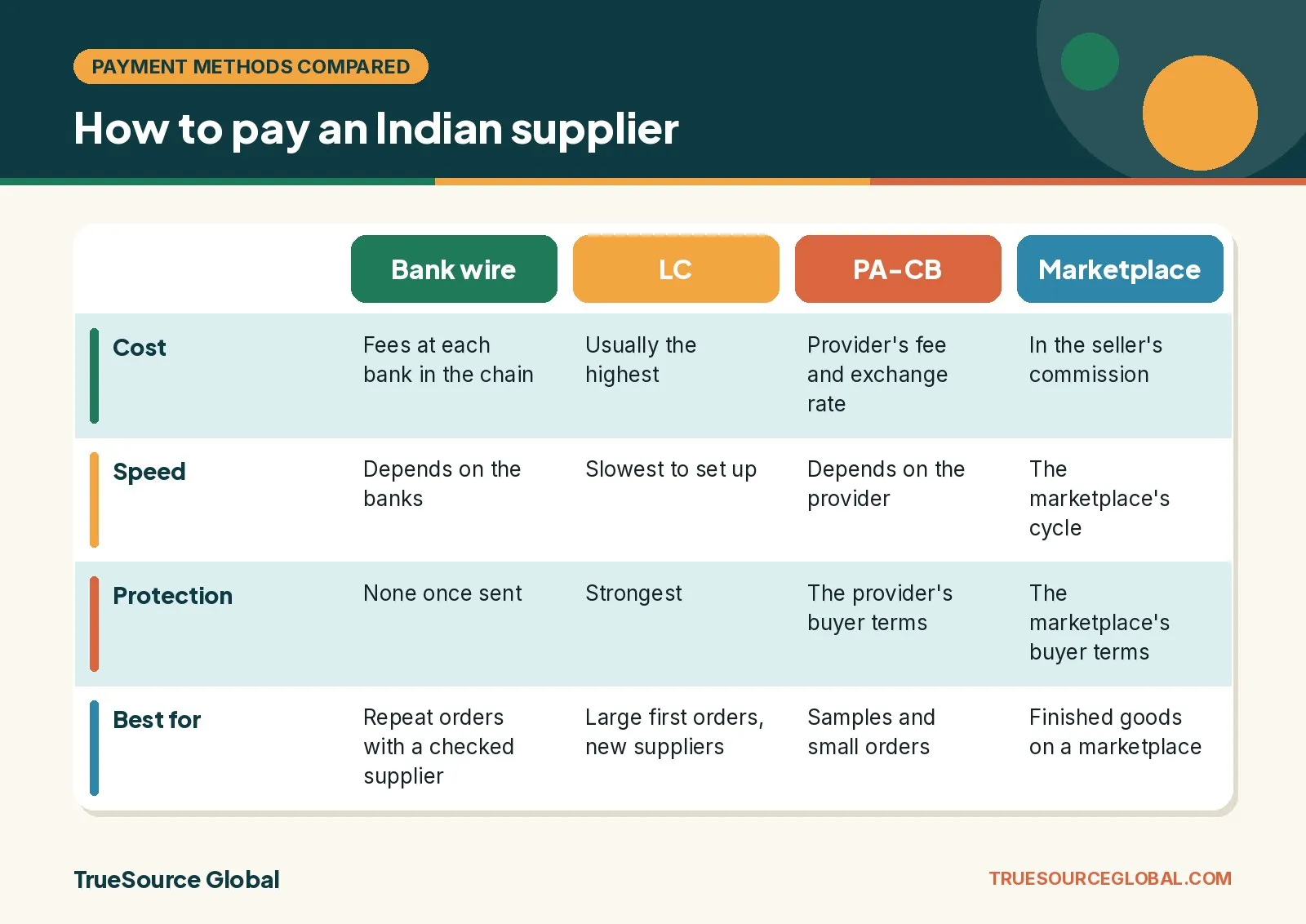
| Method | Cost | Speed | Protection for you | Best for |
|---|---|---|---|---|
| Bank wire (SWIFT) | Fees at each bank in the chain, plus the exchange rate margin | Depends on the banks | None once sent; protect yourself with terms (deposit, balance after inspection) | Repeat orders with a checked supplier |
| Letter of credit (LC) | Usually the highest: bank charges on both sides | Slowest to set up | Strongest: your bank pays only against the documents you specified | Large first orders, new suppliers |
| Payment aggregator (PA-CB) | Provider’s fee and exchange rate | Depends on the provider | The provider’s buyer terms; ₹25 lakh cap per transaction | Samples and small orders |
| Marketplace payout | In the seller’s commission | The marketplace’s cycle | The marketplace’s buyer terms | Finished goods on a marketplace |
Sources: DGFT handbook, pages 16 to 17; RBI Master Direction for the PA-CB cap. The handbook’s tips for sellers apply to you too: compare the exchange rate with the mid-market rate, check fees and limits, and use providers that follow RBI rules and your own country’s laws.
What does your supplier’s bank need to see?
Small mismatches between the payment and the paperwork are what hold a payment up. Use this before every payment.
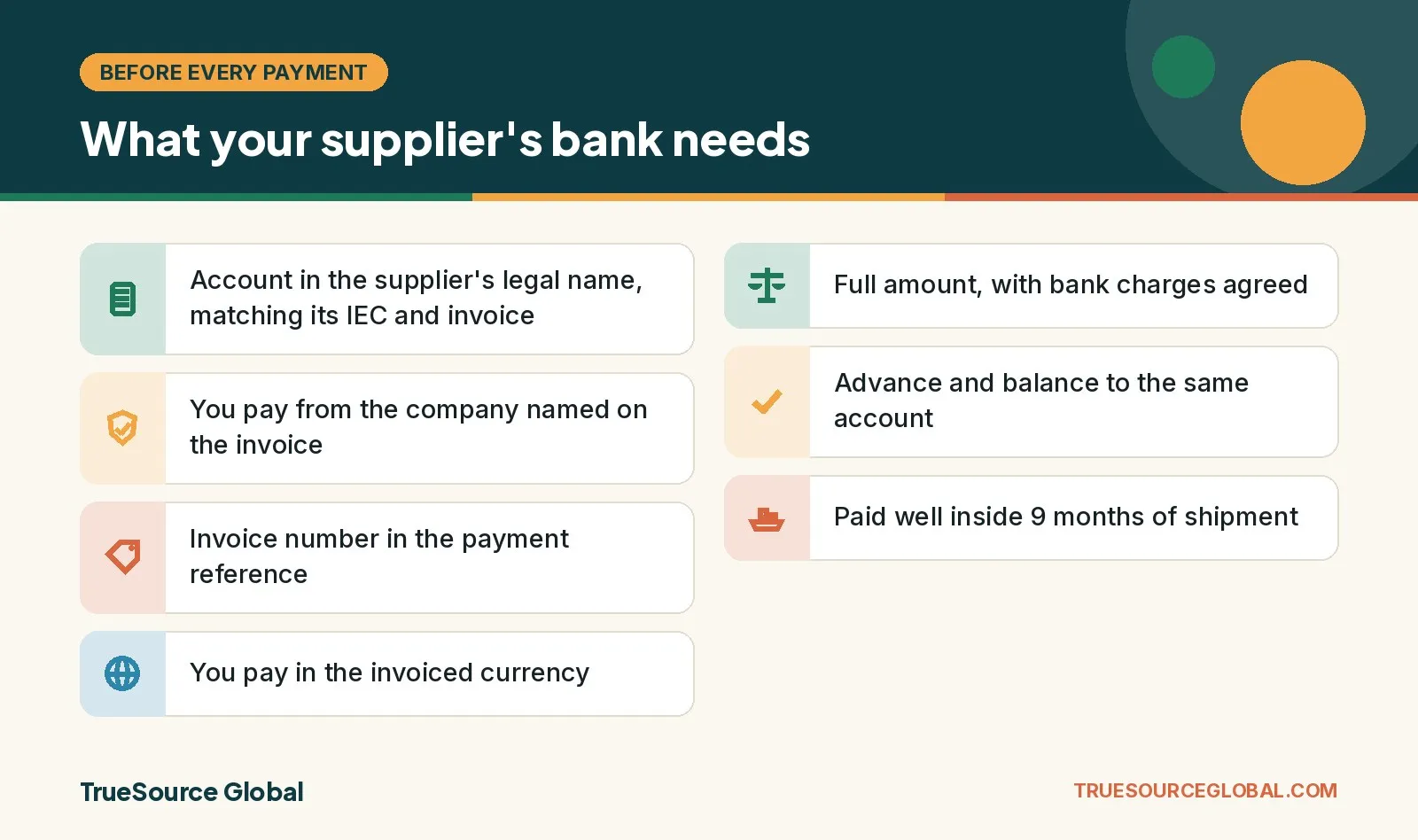
| Check | Why the bank cares |
|---|---|
| Account in the supplier’s legal name, matching its IEC and invoice | The bank closes the EDPMS entry against that exporter’s shipment |
| You pay from the company named on the invoice | Third-party payments need extra bank scrutiny (reg 8) |
| Invoice number in the payment reference | The supplier matches the bank’s remittance message (sender, amount, purpose) to the shipping bill for its e-BRC |
| You pay in the invoiced currency | e-BRCs club only same-currency remittances; rupee invoicing gives 12 months |
| Full amount, with bank charges agreed | A short payment leaves a gap the supplier must explain to its bank |
| Advance and balance to the same account | Same AD bank required (reg 10(1)) |
| Paid well inside 9 months of shipment | Reg 5(1) |
Sources: RBI regulations 2026; DGFT e-BRC guide.
You do not need the supplier’s e-BRC. DGFT’s guide says it confirms payment received against an export, for Indian export benefits and GST refunds, and it cannot be generated before the shipping bill or invoice date, even for an advance.
How do you avoid invoice fraud?
A genuine supplier can still be impersonated. The UK Government’s Stop! Think Fraud campaign warns that criminals hack supplier email accounts or use lookalike domains to send invoices with altered bank details. It advises: “Always confirm both old and new account details using a known phone number.” The National Crime Agency says the same.
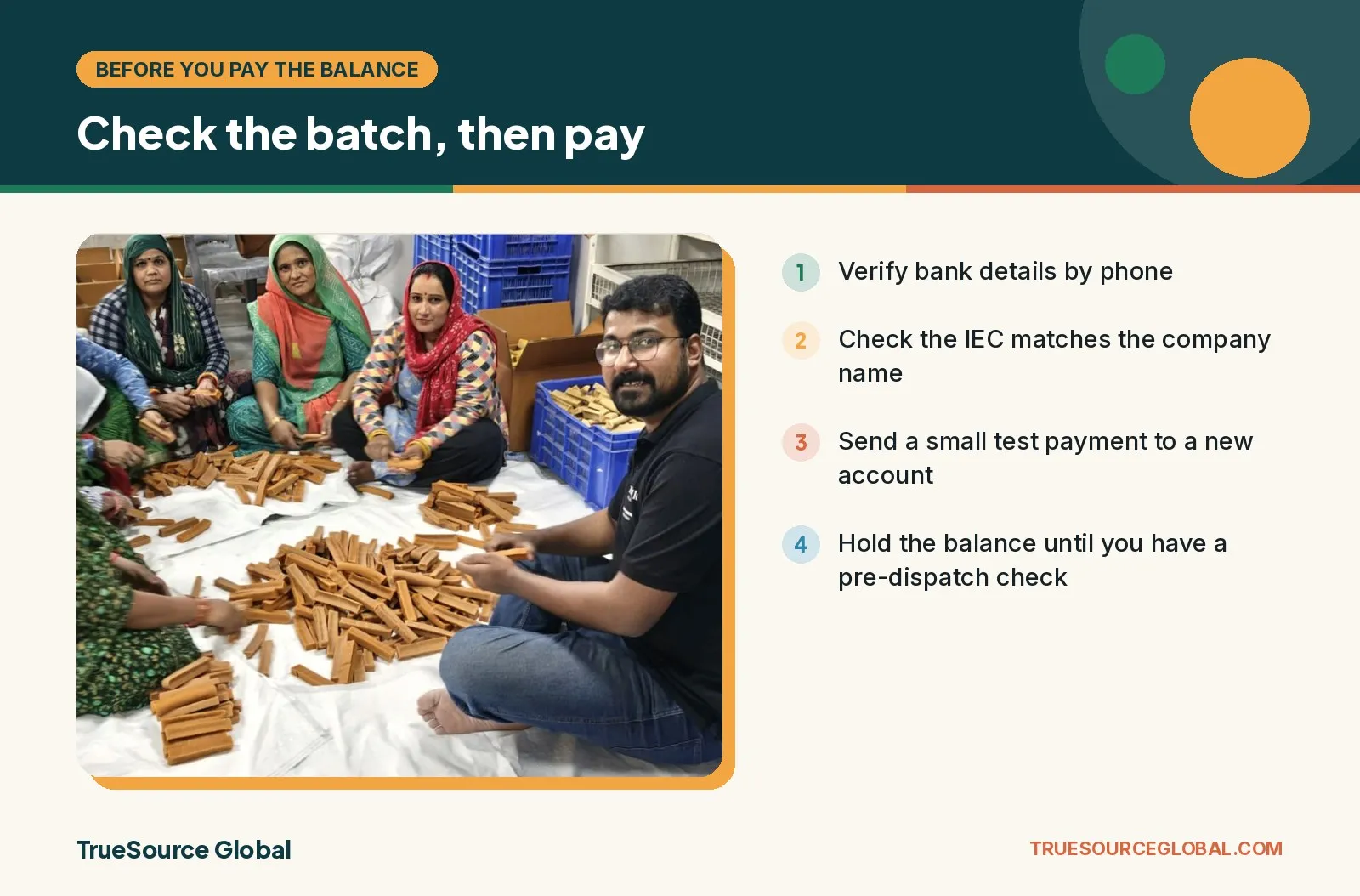
- Verify bank details by phone on a number from your contract or earlier orders, never one in the payment email. Treat any change of account as a red flag.
- Check the IEC matches the company name on the invoice and bank account, on the DGFT portal under Services (how).
- Check the email domain letter by letter.
- Send a small test payment to a new account and have the supplier confirm the amount by phone.
- Hold the balance until you have a pre-dispatch check or inspection report.
What does an Indian supplier’s quote include?
Two things shape the price: how the supplier sets it, and the delivery term. The handbook gives sellers six pricing strategies; knowing which one you face tells you what to ask.
| Strategy (handbook) | What the handbook says | What it means for your quote |
|---|---|---|
| Cost-based | A margin added to the total cost of goods | Ask for the cost lines: product, packing, testing, freight |
| Price skimming | High at launch, lowered as competition arrives | Ask what the reorder price will be |
| Penetration-based | Low to win customers, often with early discounts | Ask how long the price holds and what it becomes |
| Market-oriented or competitor-based | Set in line with competitors and the market | Compare quotes on the same specification |
| Charm pricing | $9.99 instead of $10, or a slashed price beside the new one | Look at the total per order |
| Anchor pricing | Priced against an earlier price or a similar item | Compare against your specification, not the first price shown |
Source: DGFT E-Commerce Exports Handbook for MSMEs, Table 3 (page 7).
The handbook does not cover delivery terms, but every quote should name an Incoterms rule and a place. The current edition is Incoterms 2020 (ICC).
| Term | Where the supplier’s job ends | What you still pay or arrange |
|---|---|---|
| EXW (Ex Works) | Goods placed at your disposal at its premises; it need not clear them for export | Everything, including Indian export clearance |
| FCA (Free Carrier) | Goods handed to your carrier at the named place; risk passes there | Main freight, insurance, import duty |
| FOB (Free on Board) | Goods on board the vessel at the port of shipment; risk passes on board | All costs from that point |
| CIF (Cost, Insurance and Freight) | Goods on board; it pays freight to your port and insurance on minimum cover | Risk from loading, import duty, any extra cover |
| DAP (Delivered at Place) | Goods ready for unloading at your named place | Unloading, import clearance and duty |
| DDP (Delivered Duty Paid) | Goods cleared for import, ready for unloading at your place | Unloading |
Source: GOV.UK, Customs valuation: Incoterms. FOB and CIF are sea terms; for air and courier, use FCA, DAP or DDP. Check with your customs broker before accepting a DDP quote.
Where TrueSource fits
We are a sourcing partner, not a manufacturer: products are made by partner producers in our network of 200+ suppliers, and we serve buyers in 18 countries. We check supplier documents and batch-check goods with producer teams before dispatch, so you can hold the balance until the batch is checked. Most products start at 500 units per SKU, with pilot runs of 100 to 250 units. See how it works, our quality and documentation standards, our Ayurvedic herbs and supplements range and ashwagandha.
Same series. IndoFolk Wellness covers the exporter side in its series on DGFT’s E-Commerce Export Handbook for MSMEs.
If you want to source from vetted Indian suppliers, request a quote and we reply within 12 hours, or book a call.
Frequently asked questions
What is the safest way to pay a new supplier in India?
For a first order, a letter of credit gives the most protection because your bank pays only against agreed documents, but it costs more and takes longer to set up. For a bank wire, pay a deposit, check the goods or a pre-dispatch report, then pay the balance. Always confirm bank details by phone first, and check with your bank which option suits your order.
How long does an Indian supplier have to receive my payment?
As of 22 Nov 2026, RBI rules require the full export value to be received within 9 months from the date of shipment, or 12 months if the export is invoiced or settled in Indian rupees. The supplier's bank can extend this if it accepts the reasons. Long credit terms close to that limit put pressure on your supplier.
Can I pay an Indian supplier by card or payment link?
Often, yes, through an RBI-authorised cross-border payment aggregator (PA-CB), which replaced the old OPGSP route. As of 22 Nov 2026, each transaction is capped at ₹25 lakh. Ask your supplier which provider it uses and check the provider's own fees and buyer protection.
Why does my supplier want payment from my company, not a third party?
Its bank must match each payment to a specific export and be satisfied the transaction is genuine. RBI rules let the bank accept a third-party payment only if it is satisfied with the transaction, which can delay the supplier. Paying from the company named on the invoice avoids that.
What is an e-BRC and should I ask for it?
An e-BRC (electronic Bank Realisation Certificate) confirms that an Indian exporter received payment for an export. Exporters now generate it themselves on the DGFT portal against the remittance message their bank reports. It is the supplier's document, used for Indian export benefits and GST refunds, so you do not need it, but a supplier who knows the process is a good sign.
Sources
- Directorate General of Foreign Trade: E-Commerce Exports Handbook for MSMEs (PDF)
- RBI: Foreign Exchange Management (Export and Import of Goods and Services) Regulations, 2026 (amended up to 2 Nov 2026)
- RBI: FEMA regulations list (amendments of 22 Sep 2026 and 2 Nov 2026)
- RBI: Master Direction on Regulation of Payment Aggregators (updated 11 Nov 2026)
- DGFT: Self-certification of e-BRC on DGFT e-platform (user guide)
- DGFT portal (IEC lookup under Services)
- GOV.UK: Customs valuation, Incoterms
- ICC: Incoterms 2020
- Stop! Think Fraud (UK Government): Protect your business
- National Crime Agency: campaign to protect against invoice fraud in business
Ready to source this from India?
Tell us the product, volume and market. We'll reply within 12 hours with a quote, MOQ and sample plan, with no obligation.