Buying Agent, Sourcing Agent or Trading Company in India: Which Do You Need?
Buying agent, sourcing agent or trading company in India? A decision table by order size, product type (pet, Ayurvedic, food) and how much control you want.
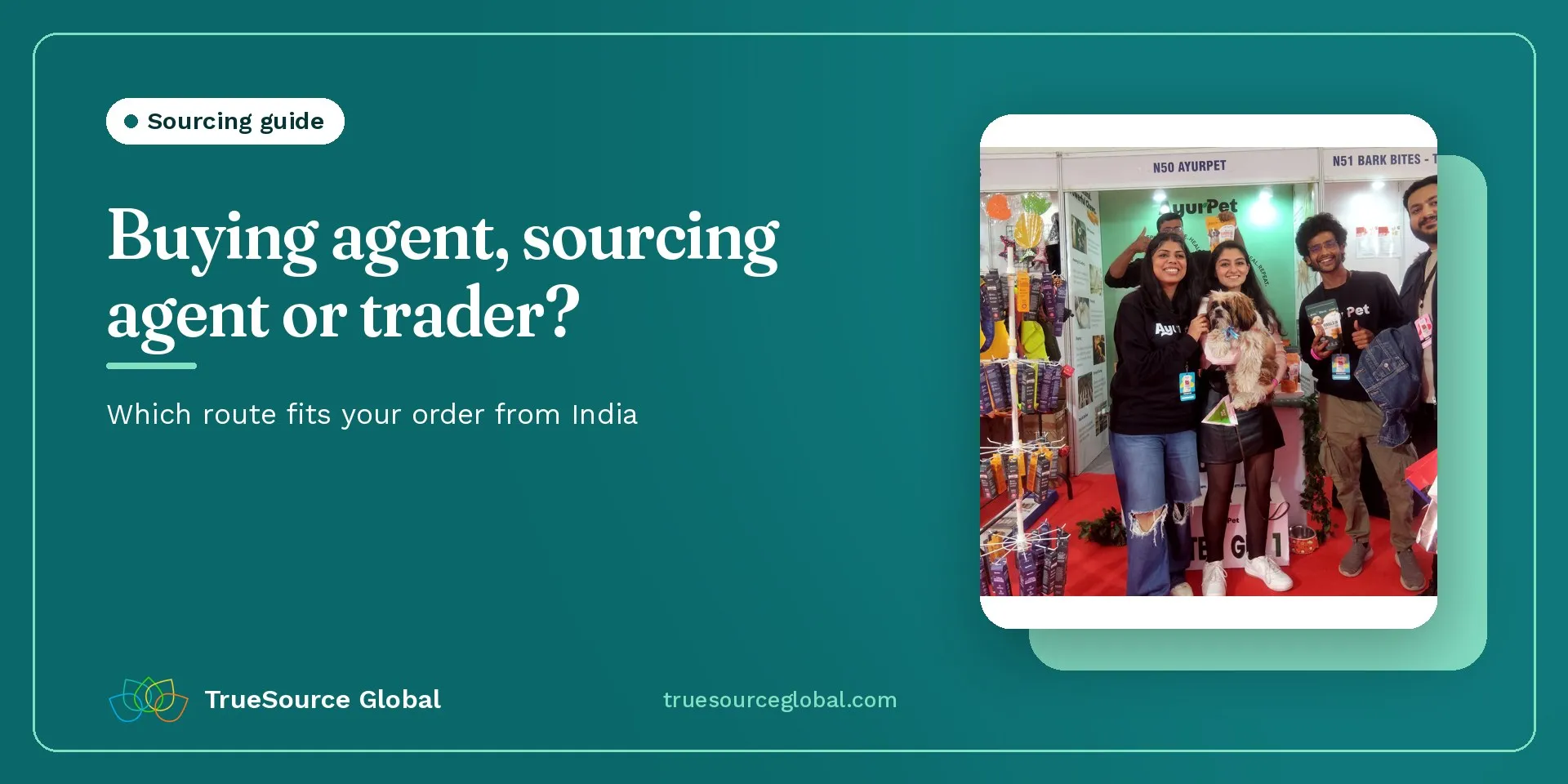
A buying agent in India works for you, the buyer. It finds factories, negotiates and checks goods, but you contract with and pay the factory. A sourcing agent also works for you and usually runs the samples, batch checks and export documents across several producers. A trading company buys the goods itself and resells them to you: one invoice, one party to hold responsible, but often no idea who made them.
Which one you need depends on how much you are ordering, what the product is, and how close you want to be to the factory. The decision table below maps those choices.
TrueSource Global is a sourcing agent, so read this with that in mind. Before we started it, our founders built two brands of their own in India, IndoFolk Wellness (Ayurvedic) and AyurPet (pet chews). So we have bought from Indian producers as a brand, not just advised others on it.
What is the difference between a buying agent, a sourcing agent and a trading company?
The names get used loosely. In India you will hear “buying house”, “buying office”, “sourcing company” and “merchant exporter” for things that overlap. Ignore the label. Ask two questions instead: who does this firm work for, and whose name will be on the commercial invoice?
| Buying agent or buying house | Sourcing agent | Trading company | |
|---|---|---|---|
| Works for | You | You | Itself |
| You contract with and pay | The factory | The producer or the agent, depending on the set-up | The trading company |
| Do you know the factory? | Yes | A good one names it | Often not |
| How it is paid | Commission on order value | Commission, service fee or margin in the unit price | Margin in the price |
| Quality checks | Inspections on your behalf | Samples, batch checks, lab tests arranged | Its own checks, plus any inspection you add |
| Where you meet it most | Apparel, textiles and home goods at volume | Mixed orders, specialist categories, smaller brands | Bulk ingredients and commodities |
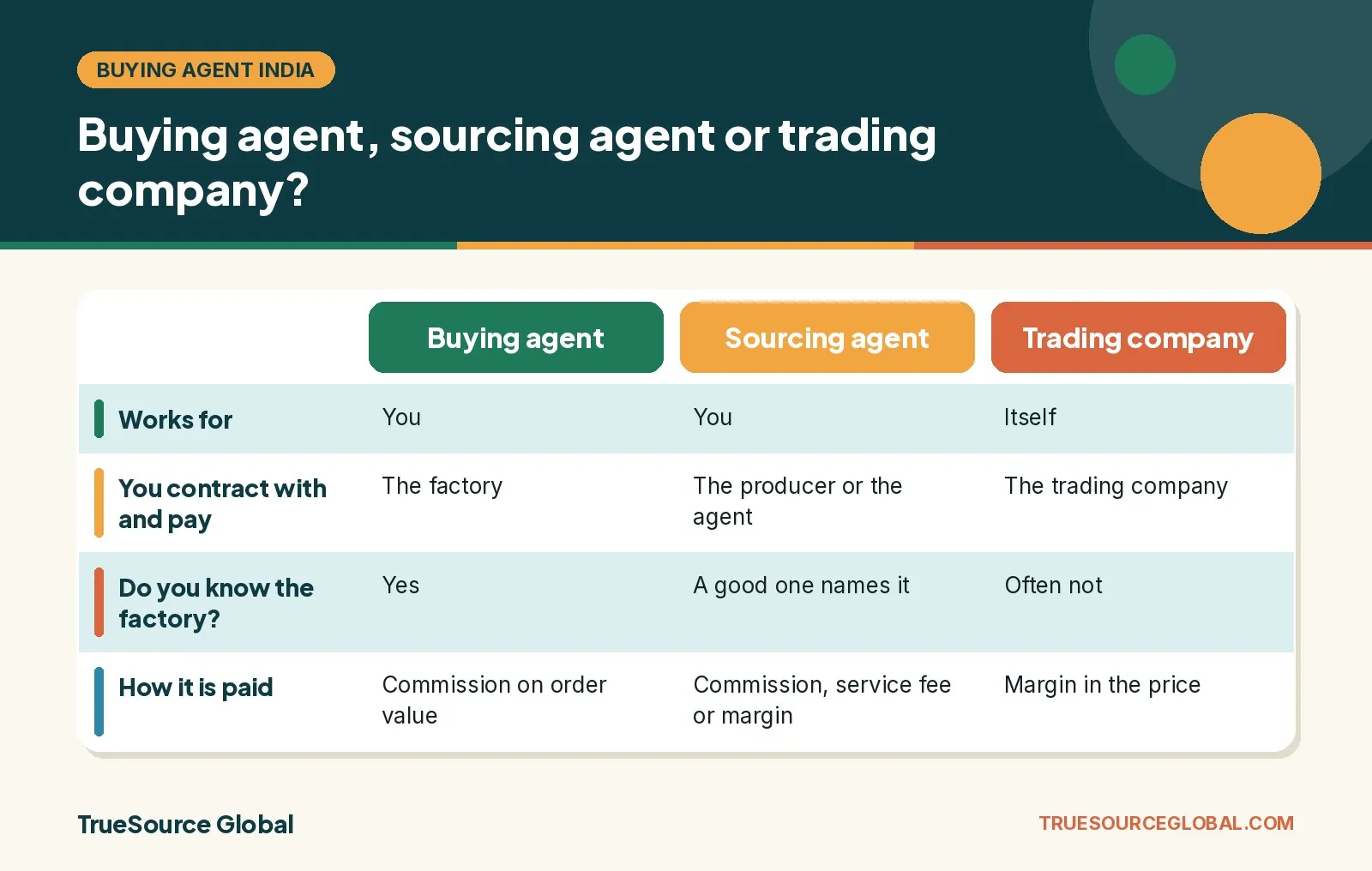
Many Indian buying houses grew up serving apparel and home textile importers. That helps with dog beds or harnesses. It helps less with shilajit resin or yak chews, where the licences, lab tests and health certificates are different.
When does a buying agent make sense?
When you already know what you want, order the same thing regularly in volume, and want the factory relationship in your own name. The contract is yours. If the agent leaves, the factory is still yours.
The trade-off is risk. You pay the factory, so if a batch fails, your claim is against a factory in another country. The agent will help chase it, but it is not liable for the goods. Check whether the commission includes inspection visits.
When is a sourcing agent the better choice?
When you are buying several product types, starting with a small run, or can’t get to India to check producers yourself. One contact handles the producer search, samples, batch checks and the documents your market needs.
Here is what that means day to day. When we source yak cheese chews, we sit with the producer team and hand-sort the batch for size, hardness and cracks before it is packed. A specification that says “uniform size” means nothing until someone checks it piece by piece. A trading company might do that. A buying agent might send an inspector. The question is whether the check is someone’s actual job on your account.
Ask any sourcing agent one thing first: will you tell me who makes my product? If the answer is no, you can’t check anything else it tells you.
When should I buy from a trading company instead?
For bulk commodities it is often the simplest route. Spices, seeds, tea, cold-pressed oils. You get one price, one invoice and one party responsible for the goods.
What you give up is visibility. A trading company can switch producers between orders without telling you. For a commodity sold on spec, that may not matter. For an Ayurvedic product under your brand, it usually does. Write the producing site into the contract and ask for it on every Certificate of Analysis.
Trading companies are easy to find on marketplaces such as IndiaMART, TradeIndia and ExportersIndia. A listing tells you the seller is active. It doesn’t tell you the seller makes anything. Our supplier vetting checklist covers how to check.
Which option fits my order size, product and level of control?
Find your situation in the left column. Most buyers match two or three rows; the route that comes up most is usually right.
| Your situation | Usually fits best | Why |
|---|---|---|
| Pilot run of 100 to 250 units to test a range | Sourcing agent | Many factories won’t take a small run from a new overseas buyer; an agent can place it with producers it already uses |
| Around 500 units per SKU, several SKUs | Sourcing agent | One contact across several producers, with samples and batch checks for each |
| Repeat container of one product you know well | Buying agent, or direct | You already hold the spec, and a commission on volume can cost less than a margin |
| Pet chews and treats (animal origin) | Sourcing agent that works in pet | Health certificates depend on the destination; hardness and size need checking by hand |
| Pet beds, harnesses and accessories | Buying agent or sourcing agent | Textile and webbing factories are used to agents; checking against the approved sample is the key step |
| Ayurvedic herbs, extracts and shilajit | Sourcing agent, or direct with your own lab testing | The licence must match the product, and every batch needs a CoA with heavy metals |
| Food: spices, teas and superfoods in bulk | Trading company or sourcing agent | Consolidation suits commodities; you still need the exporter’s FSSAI licence and the right export documents |
| You want the factory relationship in your name | Buying agent, or direct | The contract is with the factory |
| You want one party accountable for the goods | Trading company, or a sourcing agent that invoices you | One contract covers the goods |
| You want to see the producer and keep one contact | Sourcing agent that names the producer | Visibility and accountability together |
Food exporters in India need a licence from the Food Safety and Standards Authority of India, and anyone exporting needs an Importer Exporter Code from the DGFT. Which certificates travel with your shipment depends on the product and your market. Our guide to export documents for wellness and pet products lists them.
Whichever route you pick, you can add an independent inspection firm such as SGS or QIMA before goods ship.
What should I ask before I choose?
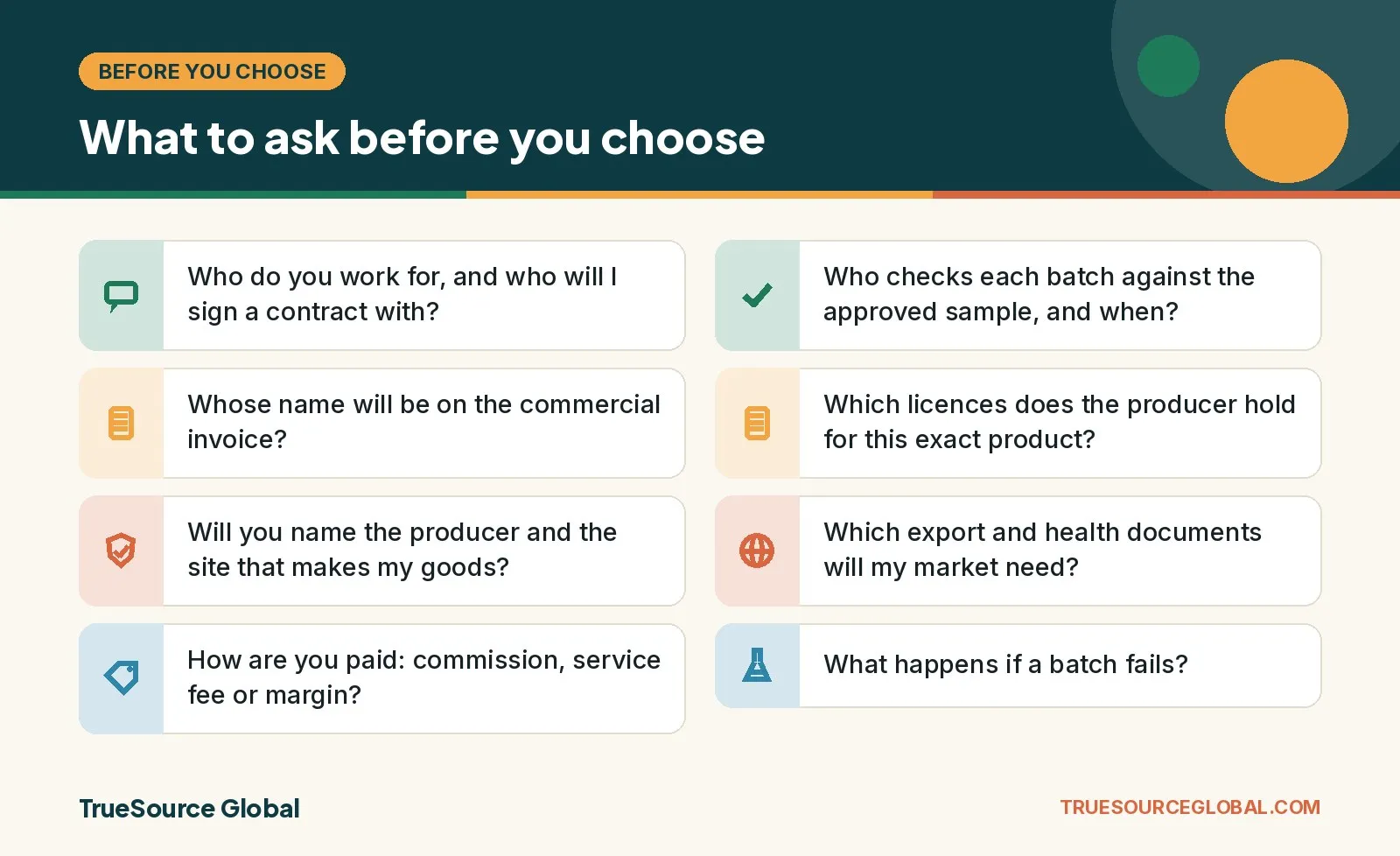
Put these to every firm on your shortlist, in writing:
- Who do you work for, and who will I sign a contract with?
- Whose name will be on the commercial invoice?
- Will you name the producer and the site that makes my goods?
- How are you paid: commission, service fee or margin?
- Who checks each batch against the approved sample, and when?
- Which licences does the producer hold for this exact product?
- Which export and health documents will my market need, and who prepares them?
- What happens if a batch fails?
A firm that won’t answer the third question, even under a confidentiality agreement, has told you what you need to know.
Where does TrueSource Global fit?
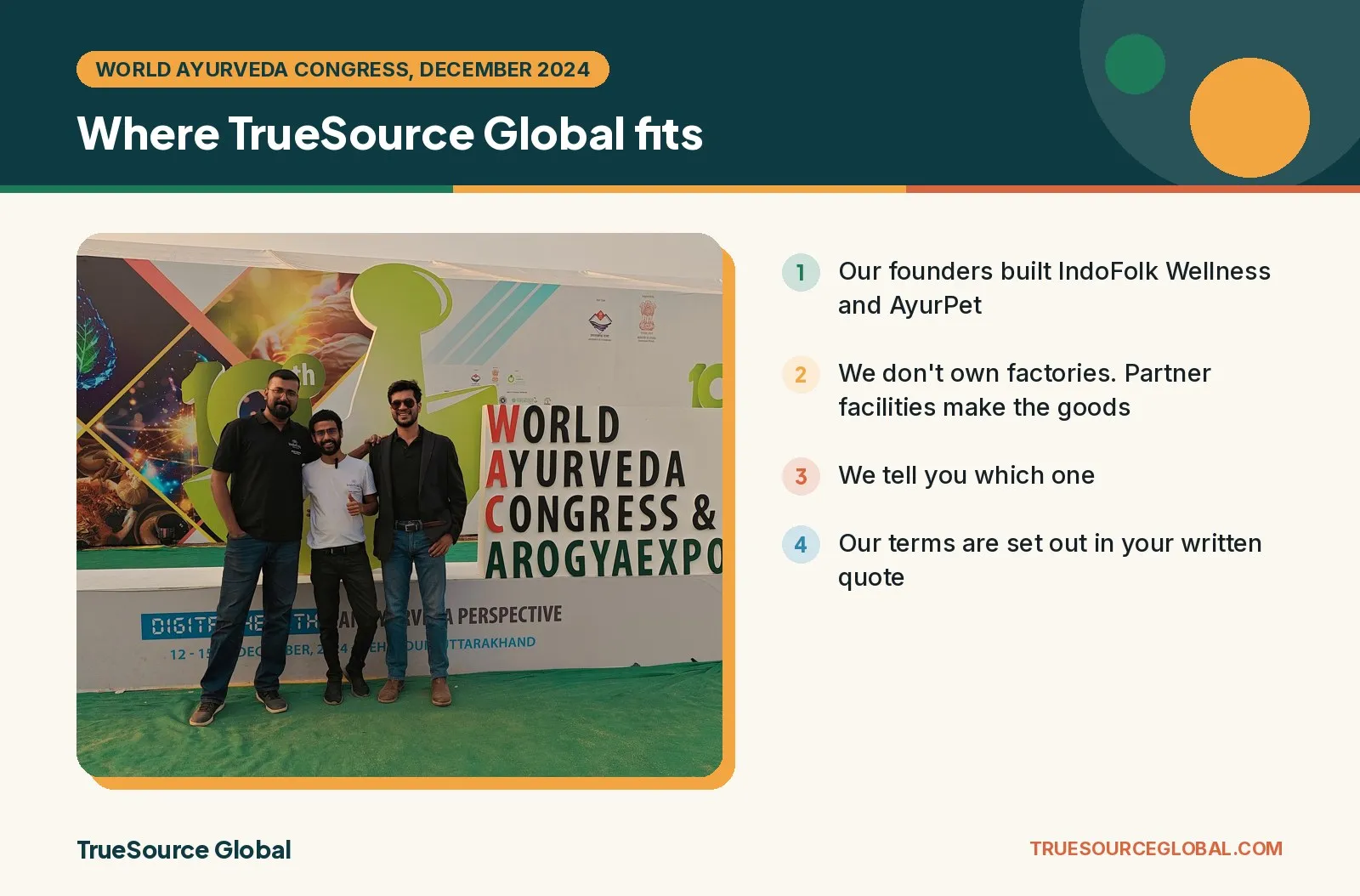
We are a sourcing agent for Ayurvedic, herbal, food and pet products. We don’t own factories. Partner facilities make the goods, and we tell you which one. We hold the specification, arrange third-party lab tests, check batches against the approved sample and gather the export documents.
Most products start at 500 units per SKU. Pilot runs of 100 to 250 units are available at a slightly higher unit cost, and most pet products start at 100 units. We ship to any country. Our terms are set out in your written quote.
If you buy pet products, start with our pet product sourcing agent page. For herbs, extracts, shilajit, oils, teas, spices and gummies, see our Ayurvedic and herbal sourcing agent page. Both compare agents, marketplaces, directories and going direct. If you are importing chews or treats for the first time, our guide on how to import pet treats from India covers the steps after the order.
Next step: write down the product, the quantity per SKU and the countries you sell in, then send it to us for a written quote. We usually reply within 12 hours. If you would rather talk it through first, book a call and we will tell you honestly whether a buying agent or a trading company would suit you better.
Frequently asked questions
What is a buying agent in India?
A buying agent, sometimes called a buying house or buying office, is a firm in India that acts for an overseas buyer. It finds factories, negotiates, follows production and inspects goods, and is usually paid a commission. The buyer normally places the order with, and pays, the factory directly.
What is the difference between a sourcing agent and a trading company?
A sourcing agent works for you: it finds and manages producers on your behalf and, if it is any good, tells you who makes your goods. A trading company works for itself: it buys from producers and sells to you at a margin, so it holds the goods and the contract but may not tell you where they were made.
Is a buying house the same as a sourcing agent?
They overlap. In India, 'buying house' usually means an office that buys for overseas importers, often in apparel, textiles and home goods, while you contract with the factory. 'Sourcing agent' is used more widely and can cover managing samples, quality checks and export documents across several producers. Ask each firm who you will sign with and whose name will be on the invoice.
How do buying agents and sourcing agents in India charge?
Usually in one of three ways: a commission on order value, a fixed service fee, or a margin built into the unit price. Each can be fair. Ask which one applies, what it covers (inspections, testing, documents) and get it in writing before you order.
Can a sourcing agent handle small first orders?
Often, yes. Many factories will not take a small run from a new overseas buyer on their own, but an agent can place it with producers it already works with. At TrueSource Global, pilot runs of 100 to 250 units are available for many products, and most pet products start at 100 units.
Sources
Ready to source this from India?
Tell us the product, volume and market. We'll reply within 12 hours with a quote, MOQ and sample plan, with no obligation.