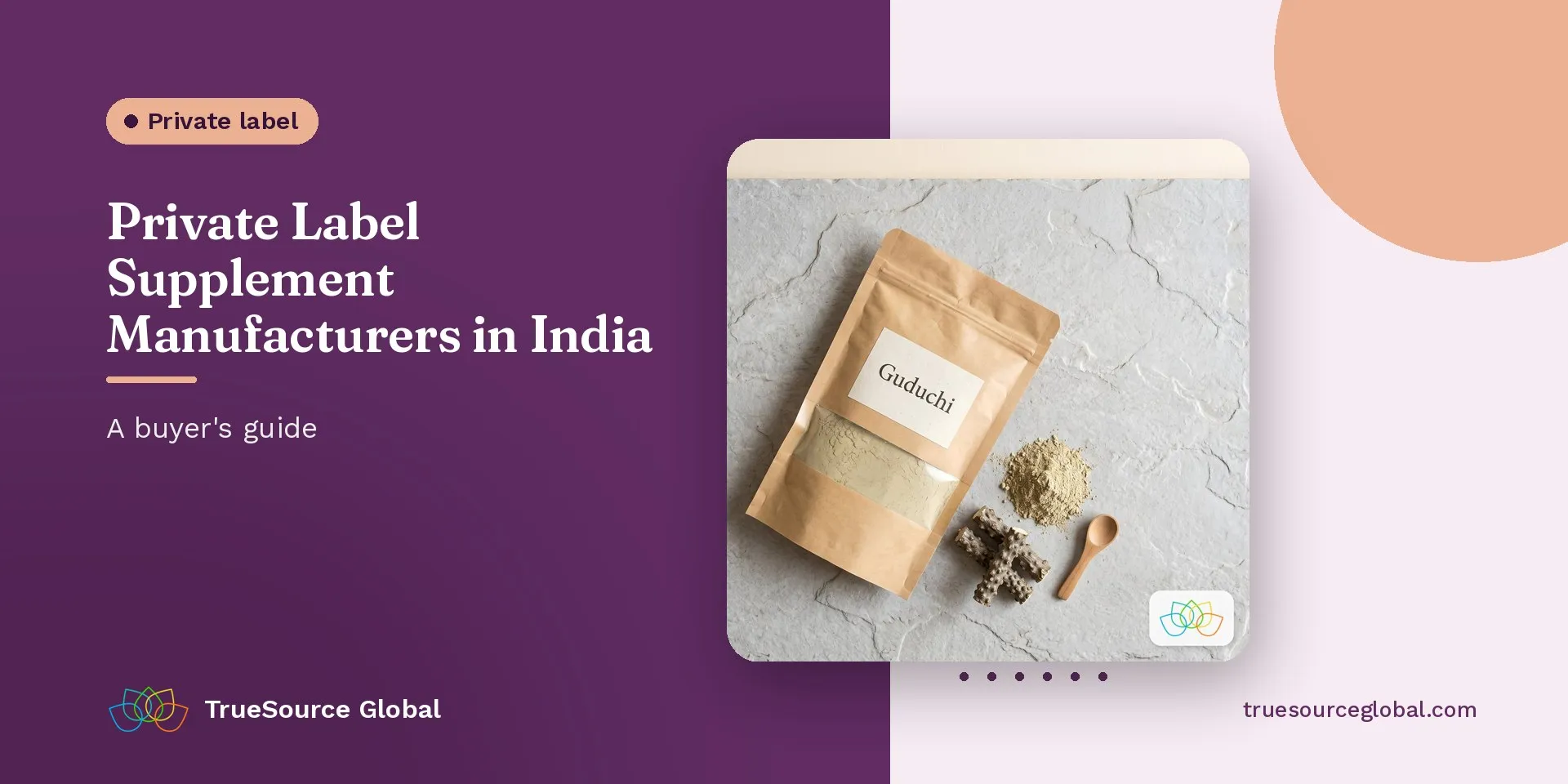
Private Label Supplement Manufacturers in India: A Buyer's Guide
How to buy private and white label supplements from India: capsules, powders, tablets and liquids, MOQs, the tests to require, and US, UK and EU label rules.
Choose a private label supplement manufacturer in India by format, model and evidence. Pick the format (capsule, tablet, powder, liquid or extract), decide between white label, private label and custom formulation, then require GMP certification, a batch CoA with heavy metals and microbiology, and a label checked against your market’s rules.
India has a large base of herbal supplement manufacturers, from single-herb capsules to classical Ayurvedic formulations, and white label supplements from India are a common way for new brands to test a product. The difference between a good first order and a held shipment is rarely the factory’s equipment. It is whether the buyer asked for the right documents and wrote a label for the right market. This guide covers both.
Which supplement formats can you private label in India?
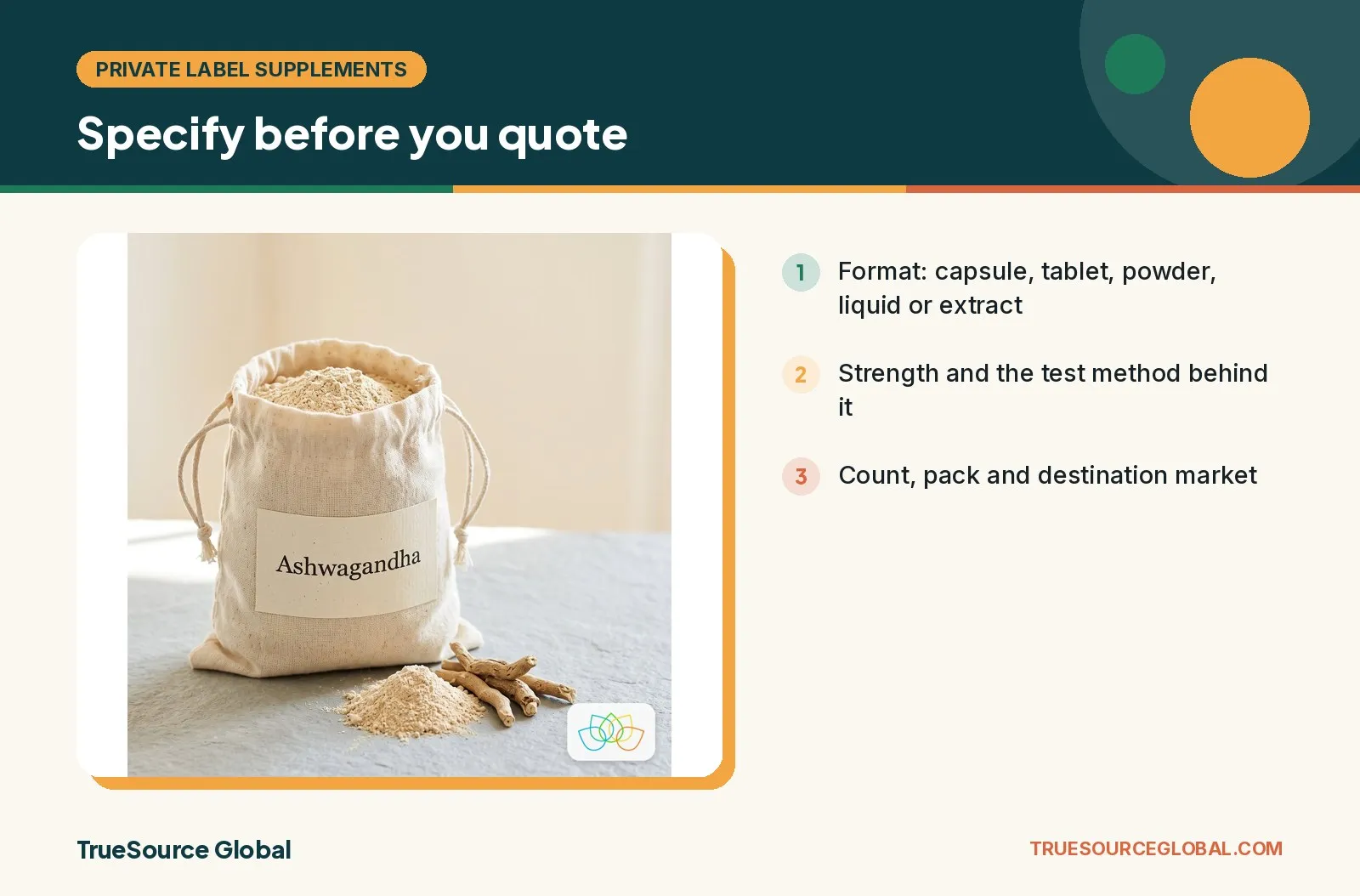
Every format has its own equipment, its own minimum and its own failure modes. Decide the format first, because it changes which producers can quote.
| Format | Typical products | What to specify | Watch out for |
|---|---|---|---|
| Capsules | Single herbs such as ashwagandha, turmeric or moringa; blends | Fill weight per capsule, capsule shell (gelatin or vegetable), count per pack | Fill weight variation; shell type must match your vegetarian or vegan claim |
| Tablets | Blends, classical formulations | Tablet weight, coating, disintegration | Excipients must appear on the label |
| Powders | Single-herb powders, superfood blends | Mesh size, serving size, flowability | Moisture, caking and microbial load |
| Liquids and syrups | Herbal tinctures, tonics | Concentration, preservative system, fill volume | Stability and packaging compatibility |
| Extracts and resins | Standardised herbal extracts, shilajit resin | Extract ratio or marker compound and test method | Claimed strength not matching the test method |
| Gummies | Vitamin or herbal gummies | Active per gummy, base (gelatin or pectin), sugar | Heat and humidity in transit, so specify packaging and shipping season. We offer herbal and vitamin gummies for private label, including Ayurvedic actives such as ashwagandha and shilajit |
The private label page lists the formats we customise: powders, capsules, tablets, extracts, resins, liquids, oils, teas and pet chews, depending on the product. For the herbs themselves, see our Ayurvedic ingredients and herbs supplier range, including ashwagandha, turmeric and triphala.
If pet supplements are part of your plan, AyurPet’s Ayurveda for pets course shows how herbs such as ashwagandha and turmeric are explained to pet parents.
How do white label, private label and custom formulation differ?
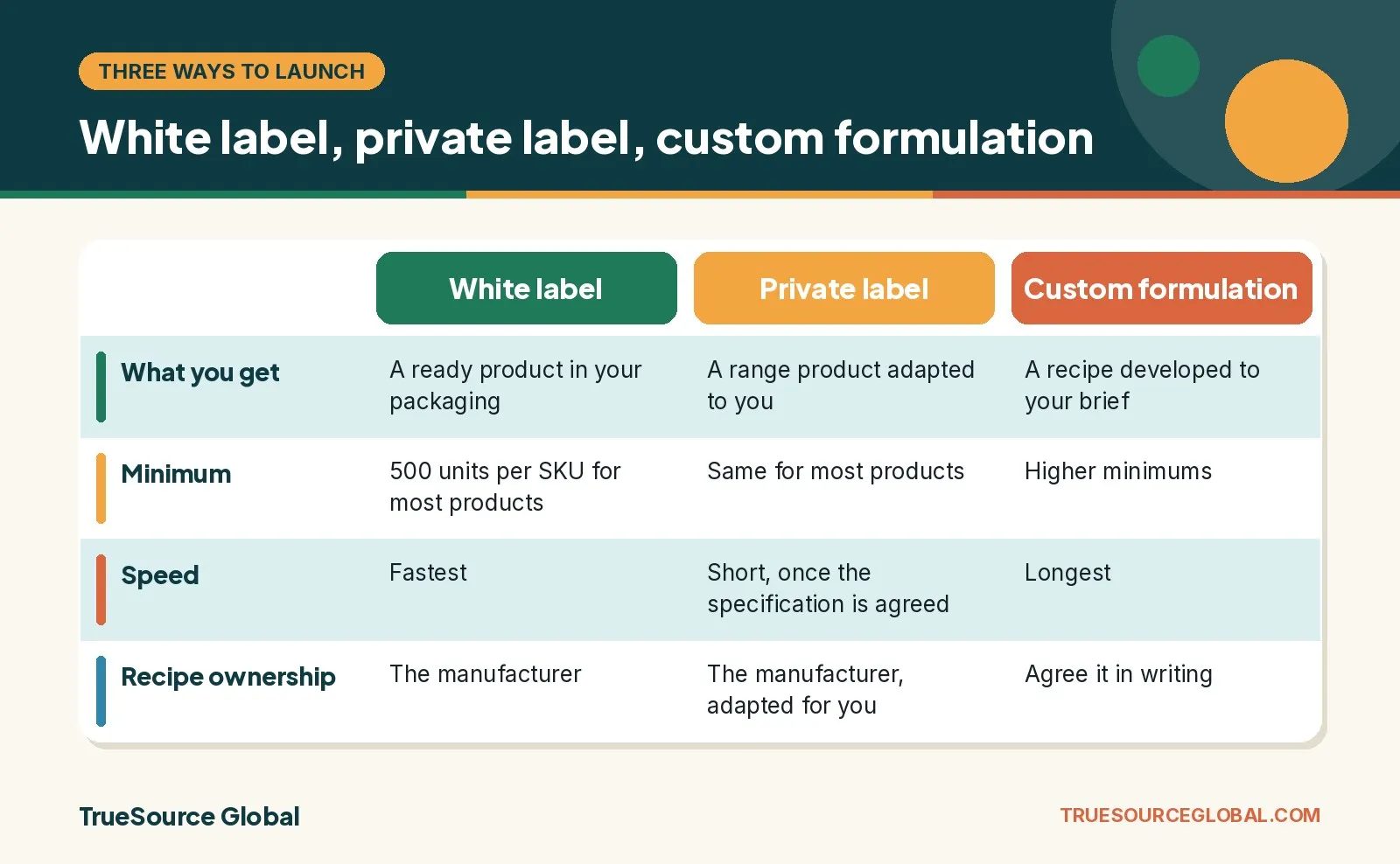
The three models trade speed for ownership. Our comparison of private label and white label Ayurvedic products goes through the pros and cons; here is what changes for a supplement buyer.
| White label | Private label | Custom formulation | |
|---|---|---|---|
| What you get | A ready product from the range, in your packaging | A range product adapted to your strength, count, format or pack | A recipe developed to your brief |
| Minimum at TrueSource | 500 units per SKU for most products; pilot runs of 100–250 units at a slightly higher unit cost | Same as white label for most products | Higher minimums |
| Main cost drivers | Ingredients, packaging, label printing | Plus any change to strength, extract grade or format | Plus development, stability work and new testing |
| Speed | Fastest | Short, once the specification is agreed | Longest |
| Who owns the recipe | The manufacturer | The manufacturer, adapted for you | Agree it in writing |
Whatever the model, production typically takes 7–14 business days after the order and artwork are approved, and samples are usually dispatched within 5–7 working days. Label design is available at ₹1,500 (about US$18) per design, or you can supply print-ready artwork. Packaging options include kraft pouches, glass bottles, PET jars and tin boxes.
Which documents and tests should you require?
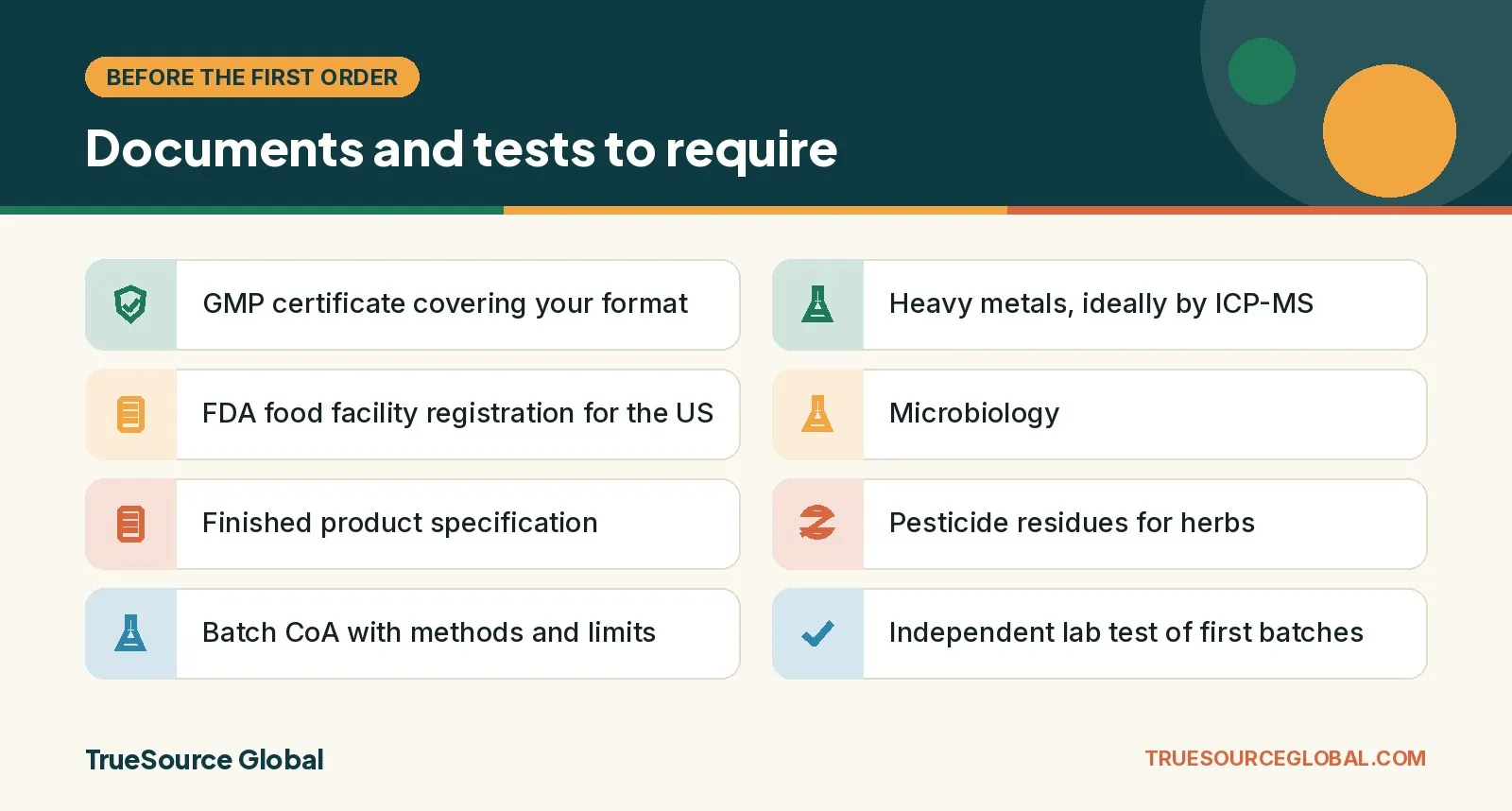
Ask for these before the first order, not after the first problem.
- GMP certificate for the facility that makes your product, plus AYUSH GMP for Ayurvedic products made in India. Check the scope covers your format.
- FDA food facility registration if you sell in the US. Registered is not approved: the FDA does not approve supplements or their makers.
- Specification sheet for the finished product: identity, strength, physical tests and limits.
- Batch Certificate of Analysis for every batch, with the method and limit for each test.
- Heavy metals: lead, cadmium, mercury and arsenic, ideally by ICP-MS. This matters for herbal products: the FDA has warned about heavy metal poisoning linked to certain unapproved Ayurvedic drug products.
- Microbiology: total aerobic count, yeast and mould, and pathogens such as Salmonella and E. coli.
- Pesticide residues for herbal raw materials, against your market’s limits.
- An independent lab test of your first batches, so you can compare it with the producer’s CoA.
Our quality and documentation page explains how batch CoAs and third-party testing work with our partner facilities.
What are the rules for private label supplements from India in the USA?
In the US, products sold as dietary supplements are regulated by the FDA under DSHEA, the Dietary Supplement Health and Education Act. For a product made in India:
- cGMP. Manufacturers must follow 21 CFR Part 111, including identity testing of dietary ingredients and specifications for finished batches under section 111.75. Ask how the producer meets it.
- Registration and import. The facility must be registered, each shipment needs Prior Notice, and the importer has FSVP duties.
- Labels. The FDA labeling guide sets out the statement of identity, net quantity, a Supplement Facts panel, other ingredients and the responsible business.
- Claims. Structure/function claims need the FDA disclaimer and a notification to the FDA under 21 CFR 101.93. Disease claims are not allowed.
- New ingredients. An ingredient not marketed in the US before October 1994 may need a new dietary ingredient notification.
What are the rules for white label supplements in the UK?
In the UK, food supplements are regulated as food. The GOV.UK guidance and the Food Supplements (England) Regulations 2003, with equivalent regulations in Scotland, Wales and Northern Ireland, require:
- registration of the selling business as a food business with its local authority;
- the words “food supplement” on the label, not “dietary supplement”, so a US label cannot be reused;
- the recommended daily dose, a warning not to exceed it, a statement that supplements should not replace a varied diet, and that the product be stored out of reach of young children;
- general food labelling, including allergens.
Health claims must be on the GB nutrition and health claims register. Check new ingredients against the novel foods rules, and check that a herbal product’s presentation does not make it a medicine.
What are the rules in the EU?
Directive 2002/46/EC sets the EU framework for food supplements sold in dose form, including the permitted vitamins and minerals and their sources. Member states apply it through national law, and many require the product to be notified to the national authority before sale. Check:
- that every botanical is not a novel food without authorisation;
- contaminant limits, including those for heavy metals in food supplements;
- that health claims are authorised under the nutrition and health claims rules;
- the national rules on botanicals, which differ between member states.
What should your brief to a manufacturer include?
A clear brief gets you comparable quotes and fewer surprises at the sample stage. Send every producer the same one-page brief:
- Product and format: for example, a vegetable capsule of ashwagandha root powder, or a turmeric extract tablet.
- Strength and its basis: milligrams of powder per serving, or an extract ratio or marker compound with the test method you will accept.
- Count and pack: capsules per jar, grams per pouch, and the packaging type, such as a PET jar, glass bottle, kraft pouch or tin.
- Destination markets: the US, UK or an EU member state, because they change the label, the tests and sometimes the recipe.
- Quantities: a pilot quantity and the expected reorder volume.
- Documents you need: GMP certificate, batch CoA with the tests listed above, FDA registration for the US, and anything your retailer or marketplace asks for.
- Artwork: whether you supply print-ready files or need label design.
Ask each producer to quote against the brief and to list anything they cannot meet. Their answers to the last request tell you as much as the price.
What does a first private label order look like, step by step?
Most first orders follow the same sequence. You send the brief; the producer confirms the specification, price and lead time; samples are made and sent; you test them, ideally with an independent lab; you approve the sample and the label proof; production runs; the batch CoA is issued and approved before shipment; and your broker files the import notices. Budget time for the label review in each market, because it can take longer than production itself.
What are the red flags in a supplement manufacturer?
- A CoA with results but no methods or limits, or the same CoA for several batches.
- No heavy metals or microbiology results for herbal products.
- “FDA approved” anywhere in the sales material.
- A GMP certificate that has expired or does not cover your format.
- An MOQ or price that changes after the sample is approved.
- Label copy with disease or treatment claims, offered as standard.
- No clear answer to “who makes it, and where?”
How we source private label supplements
We are a sourcing agent, not a manufacturer. Your product is made in one of our GMP-certified partner facilities, including AYUSH GMP for Ayurvedic products, ISO-certified and US FDA-registered partner facilities, and we tell you which one. We match the format and market to the right partner, write the specification with you, arrange samples, check label copy with you for your market, and supply third-party lab CoAs, including heavy metals and microbiology. You remain responsible for label claims and product registration in your market.
To start, request a supplement quote with your format, ingredients, volumes and destination, or book a call to choose between white label, private label and custom formulation.
This article is general information, not legal or regulatory advice. Confirm the rules for your product and market with a regulatory adviser before you launch.
Frequently asked questions
What is the MOQ for private label supplements from India?
It varies by format and model. At TrueSource Global the minimum is 500 units per SKU for most products, pilot runs from 100–250 units are available at a slightly higher unit cost, and custom formulations need higher minimums. Ask any manufacturer to state the MOQ for the product and for printed packaging separately.
What is the difference between white label and private label supplements?
White label is a ready product from the manufacturer's range packed under your brand, so it is fastest and cheapest. Private label adapts an existing product to your specification, such as strength, count or format. Custom formulation develops a recipe only you sell, which takes longer and needs higher minimums.
Can supplements made in India be sold in the USA?
Yes, if they meet US rules. The manufacturing facility must be registered with the FDA and follow the dietary supplement cGMP rule in 21 CFR Part 111, each shipment needs Prior Notice, the importer has foreign supplier verification duties, and the label must follow FDA dietary supplement labelling rules. The FDA does not approve supplements, so no product or facility should be called FDA approved.
Which tests should I ask for on a supplement CoA?
At minimum: identity of the ingredients, assay or strength where you make a quantity claim, heavy metals (lead, cadmium, mercury and arsenic), microbiology, and moisture or other physical tests for the format. Ask for the method and limit for each result, and for an independent lab test on your first batches.
Do white label supplements in the UK need to be registered?
The business selling them must register as a food business with its local authority. Food supplements are regulated as food in the UK, and the label must follow the Food Supplements Regulations and general food labelling rules, including the words 'food supplement' and the recommended daily dose with a warning not to exceed it.
Sources
- FDA: Dietary supplements
- FDA: Information for industry on dietary supplements
- eCFR: 21 CFR Part 111, cGMP for dietary supplements
- eCFR: 21 CFR 111.75, testing and examination of components and finished batches
- FDA: Dietary supplement labeling guide
- eCFR: 21 CFR 101.36, Supplement Facts
- eCFR: 21 CFR 101.93, structure/function statements
- FDA: Structure/function claims
- FDA: New dietary ingredient notification process
- FDA: Registration of food facilities
- FDA: Prior Notice of imported foods
- FDA: FSMA final rule on Foreign Supplier Verification Programs
- FDA: Warning about heavy metal poisoning linked to certain unapproved Ayurvedic drug products
- GOV.UK: Food supplements, guidance for businesses
- legislation.gov.uk: The Food Supplements (England) Regulations 2003
- Food Standards Agency: Food supplements
- GOV.UK: Great Britain nutrition and health claims register
- GOV.UK: Borderline products, how to tell if your product is a medicine
- Food Standards Agency: Novel foods guidance
- European Commission: Food supplements (Directive 2002/46/EC)
- European Commission: Nutrition and health claims
- European Commission: Novel food status catalogue
- European Commission: Contaminants in food
Ready to source this from India?
Tell us the product, volume and market. We'll reply within 12 hours with a quote, MOQ and sample plan, with no obligation.