Ayurvedic Private Label Manufacturers in India for Australian Brands: How to Choose (and Who We'd Pick)
Ayurvedic private label manufacturers in India for Australian brands: capsules, powders, oils, TGA listing vs food rules, MOQs, testing, import.
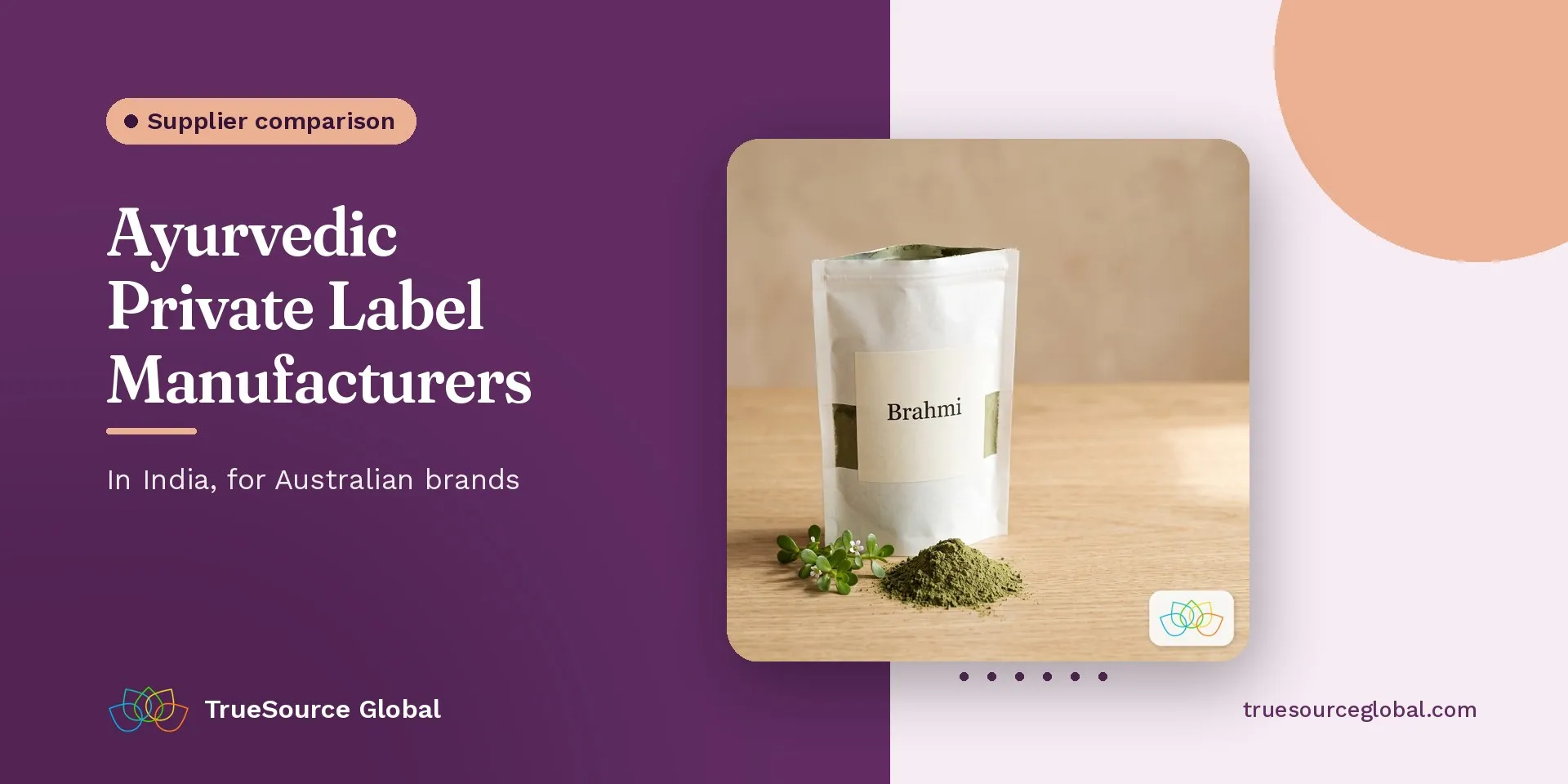
The best Ayurvedic private label manufacturers in India for Australian brands are the ones that can match your regulatory route: either a food product under the FSANZ Food Standards Code, or a TGA listed medicine with permitted ingredients and GMP evidence the TGA will accept. Our shortlist is TrueSource Global, Herbal Hills, Navchetana Kendra, AyuVends, Australian contract manufacturers and B2B marketplaces. Which fits depends on whether you are launching food-route products or capsules with therapeutic claims.
TrueSource Global publishes this guide and has put itself first, so judge the alternatives for yourself.
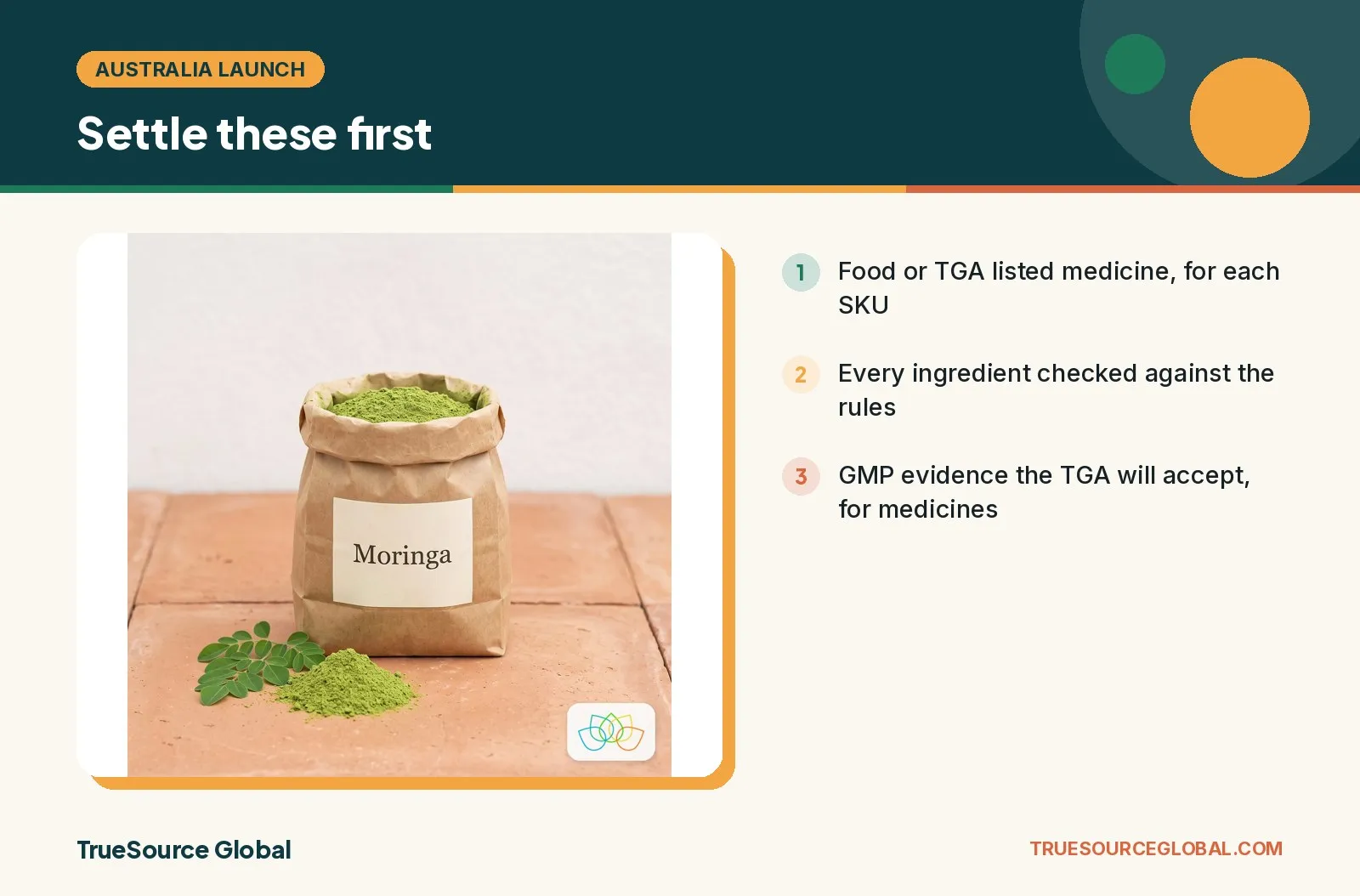
Is my Ayurvedic product a food or a TGA listed medicine in Australia?
Answer this before you request a quote: it decides which manufacturers can supply you.
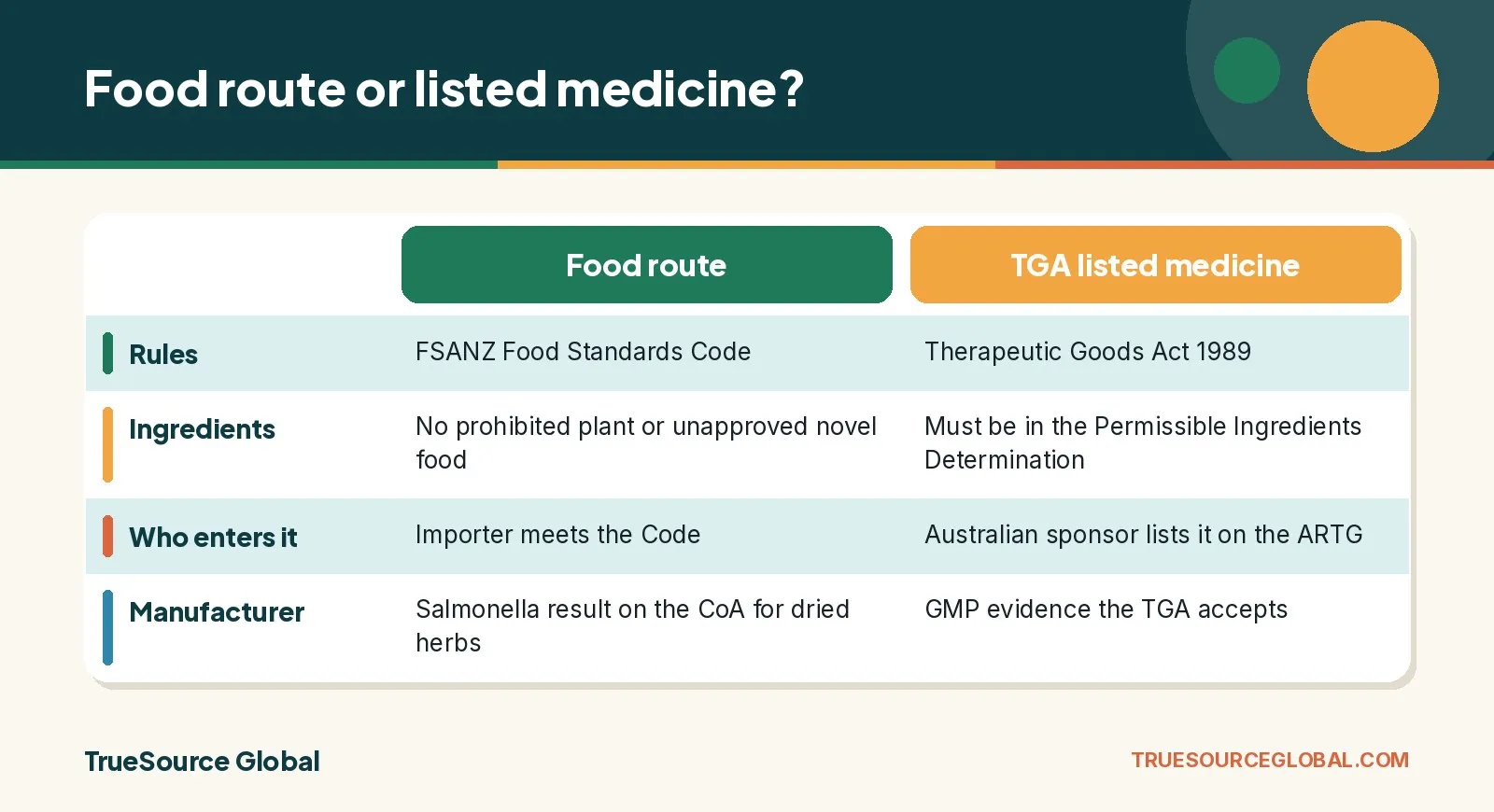
The medicine route. Under the Therapeutic Goods Act 1989, a product presented for a therapeutic use is a therapeutic good. Most Ayurvedic capsules and tablets sold with health indications are listed medicines (the AUST L number on the pack). That means:
- an Australian sponsor enters the product on the Australian Register of Therapeutic Goods (ARTG) before supply;
- every ingredient must appear in the current Therapeutic Goods (Permissible Ingredients) Determination, on the Federal Register of Legislation, and indications must come from the permitted list;
- the overseas manufacturer needs GMP evidence the TGA accepts. Indian AYUSH GMP is a domestic certificate, not on its own a TGA GMP clearance.
The food route. Many Ayurvedic powders and teas, such as moringa, turmeric or Triphala, are sold in Australia as foods, provided they make no therapeutic claims and meet the Food Standards Code. Check that no ingredient is a prohibited or restricted plant under Standard 1.4.4 or an unapproved novel food, and that the label follows FSANZ labelling rules.
Oils for the skin sold without therapeutic claims, such as sesame oil for massage, are usually cosmetics with their own rules.
Format matters too: an ashwagandha powder and an ashwagandha capsule can end up on different routes. The TGA’s Food-Medicine Interface Guidance Tool helps you decide.
How did we compare Ayurvedic private label manufacturers?
| Criterion | What we looked for |
|---|---|
| Formats | Capsules, tablets, powders, oils and teas, as stated on the supplier’s own site |
| Private label support | Your formula or theirs, packaging, label artwork |
| Testing and documents | Stated certifications, third-party CoAs with heavy metals and microbiology |
| Fit with Australian rules | Food route readiness; for listed medicines, a route to TGA-accepted GMP evidence |
| MOQ and pilot runs | Published MOQ, or a small first order on request |
| Export focus | Stated export experience, documents and an English-speaking contact |
We used only what each company publishes on its own website.
Which Ayurvedic private label manufacturers should Australian brands compare?
1. TrueSource Global. We are the B2B sourcing and export brand of IndoFolk Wellness Private Limited, New Delhi, sourcing private label Ayurvedic capsules, powders, oils and teas from 200+ partner producers, with third-party CoAs covering heavy metals and microbiology. Most products start at 500 units per SKU, with pilots from 100 to 250 units. Quotes take 12 hours, samples dispatch in 5 to 7 working days, and production takes 7 to 14 business days. Label design is ₹1,500 (about US$18) per design. See our Ayurvedic herbs and supplements and cold-pressed oils ranges and private label service. The limits: we don’t own factories, TGA GMP clearance is not among the certifications we list (for a listed medicine, confirm early with your sponsor whether a partner facility can meet it), we are not an Australian sponsor or importer of record, and we’re a newer export brand, so ask for references.
2. Herbal Hills. An Ayurvedic manufacturer registered in Mumbai with four units in Lonavala, Maharashtra. Its site lists 400+ products for private labelling, plus custom formulation. It states GMP, ISO, FSSAI, Halal, USDA Organic and US FDA registration, an MOQ of 500 units per SKU, and a “Quick Label” programme it says can launch in as little as 7 working days. Its private label page does not mention Australia or the TGA, and oils are not among its formats, so ask how it handles listed-medicine GMP evidence and FSANZ labelling.
3. Navchetana Kendra. An Ayurvedic company operating since 1991, associated on its site with Delhi, offering third-party manufacturing of powders, oils, tablets and capsules with formulation, packing and labelling. It states a GMP certificate and ISO accreditation, and names export markets including the USA, Canada and Japan. MOQ is not published and Australia is not named, so confirm export documents and CoA practice in writing.
4. AyuVends. An Ayurvedic company associated with Chandigarh, offering third-party manufacturing across tablets, capsules, syrups, herbal oils and powders, with ISO and GMP certified facilities stated. MOQ and export experience are not stated, and its site focuses on distribution within India.
5. Australian contract manufacturers. A TGA-licensed manufacturer in Australia that imports Indian herbs as raw materials and makes finished capsules locally. The licence and GMP sit in Australia, which simplifies the listed-medicine route. Unit costs are typically higher than goods made in India, and capsule minimums can be high.
6. B2B marketplaces (IndiaMART, Alibaba). A fast way to compare prices, but many listings are traders and MOQs shown are often placeholders. Use our supplier vetting checklist.
How do these options compare side by side?
| Option | Capsules | Powders | Oils | MOQ published | Australia stated |
|---|---|---|---|---|---|
| TrueSource Global | Yes | Yes | Yes | Yes (500 units; pilots 100 to 250) | Food route; listed medicines case by case |
| Herbal Hills | Yes | Yes | Not listed | Yes (500 units per SKU) | Not on pages checked |
| Navchetana Kendra | Yes | Yes | Yes | No | No |
| AyuVends | Yes | Yes | Yes | No | No |
| Australian contract manufacturer | Yes | Varies | Varies | Varies | Yes, locally licensed |
| B2B marketplaces | Varies | Varies | Varies | Often placeholders | Rarely |
Why would we choose TrueSource Global for Australian brands?
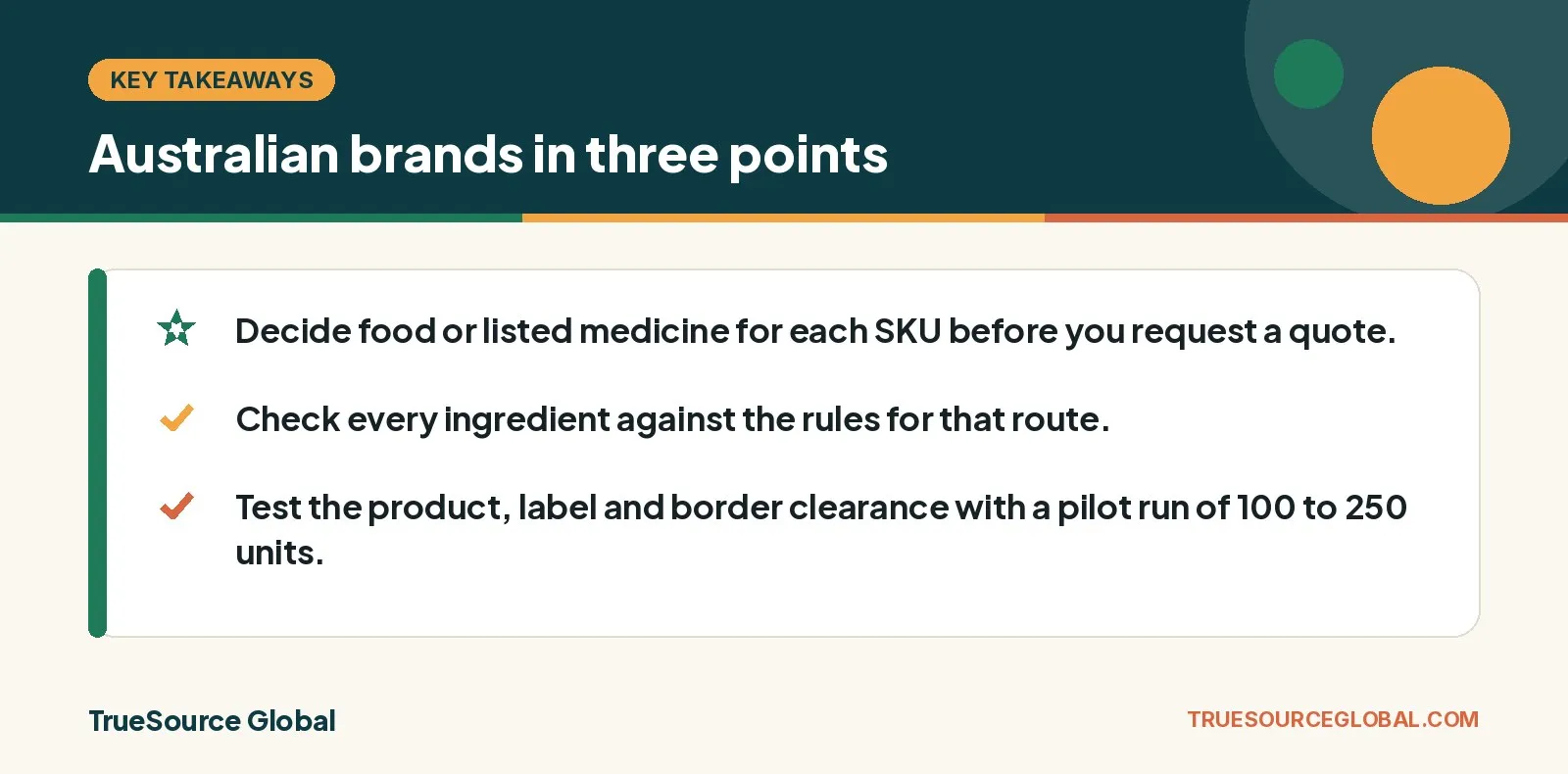
Because most problems with an Australian Ayurvedic launch come from the route, not the herb. We start by agreeing with you which products go on the food route and which need a sponsor and TGA listing, and we steer first orders towards products that fit. Every batch ships with a third-party CoA covering heavy metals and microbiology, and a pilot run of 100 to 250 units lets you test the product, label and border clearance first.
What do I need to import private label Ayurvedic products into Australia?
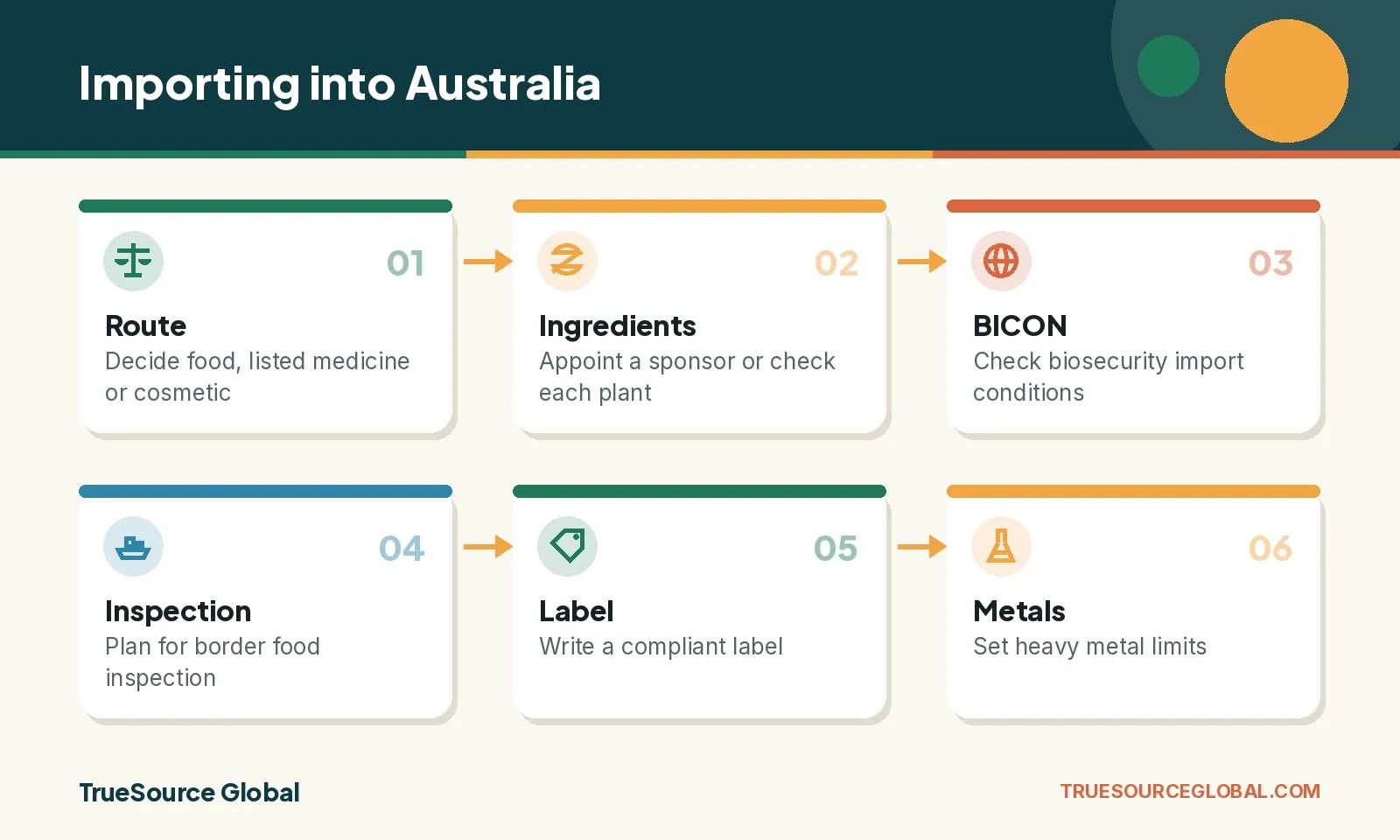
- Decide the route for each SKU. Food, listed medicine or cosmetic, using the TGA’s Food-Medicine Interface Guidance Tool and the definitions in the Therapeutic Goods Act 1989.
- For listed medicines, appoint an Australian sponsor. The sponsor enters the product on the ARTG, checks every ingredient against the current Permissible Ingredients Determination on the Federal Register of Legislation, and obtains TGA GMP clearance for the overseas manufacturer.
- For foods, check every ingredient. Confirm it is not a prohibited or restricted plant (Standard 1.4.4) or an unapproved novel food.
- Check biosecurity import conditions in BICON. The Department of Agriculture, Fisheries and Forestry (DAFF) publishes conditions for dried herbs and powdered plant products in its BICON database; seeds and bark fall under separate conditions.
- Plan for border food inspection. DAFF’s Imported Food Inspection Scheme applies risk-based checks, and the importer is responsible for the food meeting the Code (FSANZ: imported foods). For dried herbs, ask for a Salmonella result on the CoA.
- Write a compliant label. Follow FSANZ labelling requirements for foods, or TGA labelling rules for listed medicines. Check permitted claims with the regulator first.
- Set heavy metal limits in the specification. The TGA has issued safety alerts about imported Ayurvedic products containing heavy metals, so ask for lead, arsenic, cadmium and mercury results by ICP-MS on every batch.
- Line up the Indian export documents: commercial invoice, packing list, certificate of origin and batch CoAs. See our export documents checklist.
For the commercial side, read private label vs white label Ayurvedic products, and for a wider view see how to source Ayurvedic products from India.
Request a private label quote
Send us your product list, the route for each SKU (food, listed medicine or cosmetic), formats and volumes, and we’ll quote within 12 hours. Request a private label quote, see how it works, or book a call to talk through your Australian launch.
Frequently asked questions
Who is the best Ayurvedic private label manufacturer in India for Australian brands?
It depends on your regulatory route. For food-route powders, teas and oils with low minimums, pilot runs and one team handling testing and documents, we'd pick TrueSource Global; Herbal Hills is a strong option if you want a large ready catalogue at a published 500-unit MOQ. TrueSource Global publishes this guide and has put itself first, so request samples and CoAs from several suppliers and judge for yourself.
Do Ayurvedic capsules need to be listed with the TGA?
If the product is a therapeutic good, for example because it is presented or claimed to treat, prevent or relieve a health condition, it must be entered on the Australian Register of Therapeutic Goods by an Australian sponsor before it is supplied. Listed medicines may only contain permitted ingredients and use permitted indications, and the overseas manufacturer needs TGA-accepted GMP evidence. Whether a capsule is a food or a medicine depends on its ingredients, presentation and claims, so check with the TGA before you commit to a format.
Can I sell Ayurvedic powders in Australia as food?
Often, yes, if the ingredients are permitted in food, the product makes no therapeutic claims and it meets the Australia New Zealand Food Standards Code. Check that no ingredient is a prohibited or restricted plant under Standard 1.4.4 or an unapproved novel food, and that the importer meets biosecurity and imported food inspection requirements.
What is the minimum order for private label Ayurvedic products from India?
Herbal Hills publishes an MOQ of 500 units per SKU; the other Indian manufacturers we checked do not publish one. At TrueSource Global, most products start at 500 units per SKU, with pilot runs from 100 to 250 units at a slightly higher unit cost; custom formulations need higher minimums.
Is white label or private label better for a first Australian launch?
White label is faster and cheaper because the product already exists; private label lets you set the format, strength and packaging. For Australia, the bigger question is whether the product's ingredients and claims fit the food route or need TGA listing, which affects both options. Our guide to private label vs white label Ayurvedic products covers the commercial trade-offs.
Sources
- Federal Register of Legislation: Therapeutic Goods Act 1989
- Federal Register of Legislation (search for the current Therapeutic Goods (Permissible Ingredients) Determination)
- FSANZ: Australia New Zealand Food Standards Code
- Federal Register of Legislation: Standard 1.4.4, Prohibited and restricted plants and fungi
- FSANZ: Novel foods
- FSANZ: Imported foods
- FSANZ: Labelling (business)
- Herbal Hills: home
- Herbal Hills: Private label Ayurvedic products
- Navchetana Kendra: home
- AyuVends: home
Ready to source this from India?
Tell us the product, volume and market. We'll reply within 12 hours with a quote, MOQ and sample plan, with no obligation.