Sourcing Agent Fees in India: Commission, Service Fee or Mark-Up?
Sourcing agent fees in India explained: commission, service fee and mark-up, what each one hides, an illustrative worked example and a checklist for quotes.
Sourcing agents in India usually charge in one of three ways: a commission on the order value, a fixed service fee, or a mark-up built into the unit price. None of them is fair or unfair by itself. What you need is the total cost of the same order from each agent, and the fee model, its base and its exclusions in writing.
“What’s your percentage?” is usually the first question a buyer asks an agent. It is the wrong first question. Here is why, and what to ask instead.
What are the common sourcing agent fee models in India?
There is no published standard rate for sourcing agents in India, and we know of no independent survey of what they charge. Rates vary with the product, the order size and the work involved. So we will not give you a range. We will tell you how each model works.
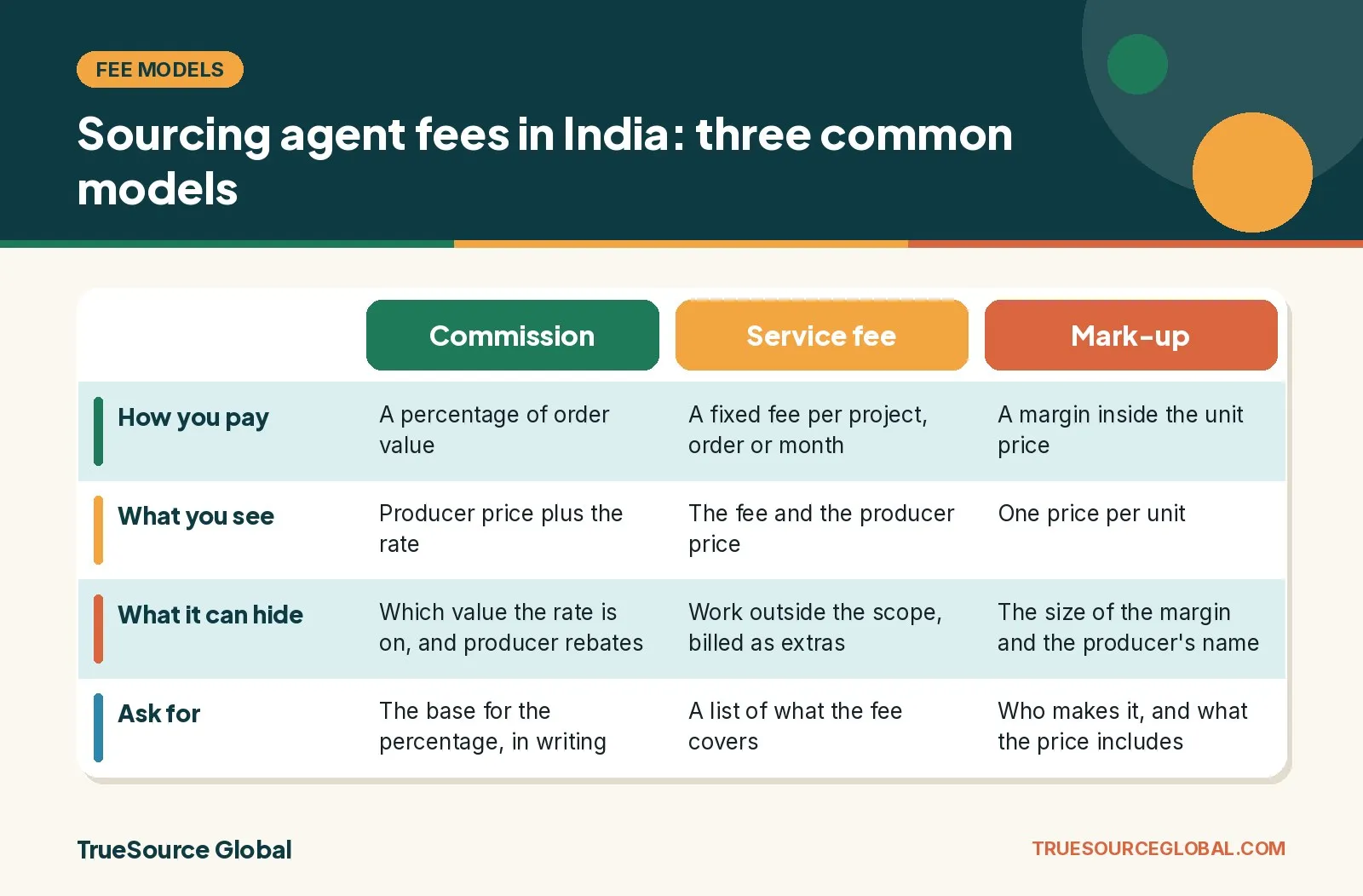
Commission. The agent takes a percentage of order value. You see the producer’s price and the rate on top. This is common and easy to understand.
Service fee. A fixed fee per project, per order or per month. You see the fee and the producer’s price. It suits buyers who place regular orders and want a cost that does not rise with volume.
Mark-up. The agent, often a trading company, quotes one price per unit with its margin inside. You see a single number. Some agents call this “no commission”, which is true in a narrow sense.
What does each fee model hide?
Each model has a blind spot. None of them is a scam. They just need different questions.
Commission: the base, and rebates
A percentage of what? Ex-works goods only, or goods plus packaging, freight and testing? A rate on the FOB value is a rate on more money. Then there is the rebate. Some agents also take a payment from the producer, so you pay commission twice: once to the agent, and once inside the producer’s price. Ask in writing whether the agent receives anything from the producer. A commission also rewards a bigger order, so watch for an agent who pushes you up a size band.
Service fee: the scope
A fixed fee is only fixed for the work it names. Extra sample rounds, a second factory visit, a pre-shipment inspection or a new pack design may all be billed on top. Ask for a list of what the fee covers, and what it costs when you go outside it.
Mark-up: the margin and the producer
You cannot see the margin. Often you cannot see the producer either. For a wellness or pet product that matters, because your Certificate of Analysis, your facility registration and your recall plan all point back to one facility. If the agent will not name it, you cannot check it. The upside is real, though: one counterparty, one invoice, and the trading company holds the goods until they ship.
How do the models compare on one order? An illustrative example
The numbers below are invented to show the arithmetic. They are not market rates and they are not our rates. Every figure is a percentage of the producer’s ex-works price for the goods and packaging, set at 100. All three quotes are for the same product, specification and quantity, delivered FOB an Indian port.
| Line (% of producer’s ex-works price) | Quote A: “5% commission” | Quote B: service fee | Quote C: “no commission” |
|---|---|---|---|
| Goods and packaging from the producer | 100 | 100 | Not shown |
| Agent’s charge | 5 | 7 | Not shown |
| Unit price quoted, FOB | 112 | ||
| Lab tests | 3, extra | 3, at cost | 3, on request |
| Freight to the port and export documents | 4, extra | 4, at cost | Included |
| Sample round | 1, extra | Included | Included |
| Total | 113 | 114 | 115 |
Look at what happened. The agent with the lowest headline rate is cheapest by one point, not by the gap between 5 and 7. Quote C’s margin is 8 (112, less 100 for goods and 4 for freight), but you only know that because we made the numbers up. And if Agent A also takes a rebate from the producer, the 100 already contains it, and Quote A is no longer cheapest at all.
On a reorder, the picture changes again. A commission repeats on every order. A per-project fee may not. So run the sum for your first order and your third.
Which costs sit outside the agent’s fee?
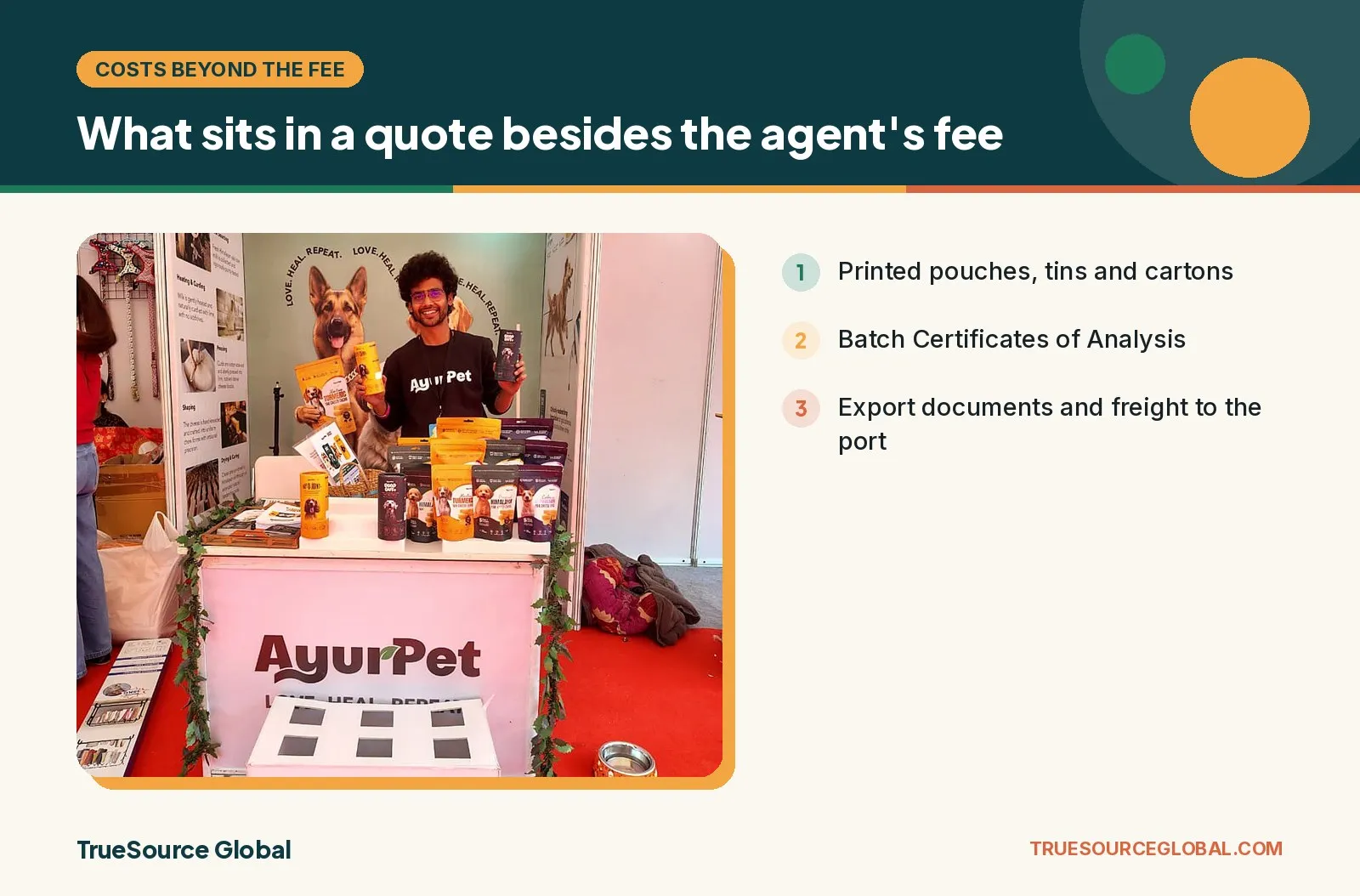
Most of the money in a quote is not the agent’s fee. Printed pouches, tins and cartons. Batch Certificates of Analysis. Export documents and freight to the port. These are the lines where quotes really differ, and where a low fee can be won back.
Inspection is often a separate bill. Firms such as QIMA offer pre-shipment inspections and supplier audits in India as their own service, priced on their own terms. Decide whether you want one before you compare quotes, and whether the agent’s fee already includes its own batch check.
Incoterms move costs between lines too. An EXW price and an FOB price for the same goods are not comparable until you add the freight and export clearance that FOB includes. The ICC’s Incoterms page sets out the rules, and our guide to sourcing Ayurvedic products from India covers agreeing them in writing.
How do you compare sourcing agent quotes?
Send every agent the same written brief. Then check each quote against this list:
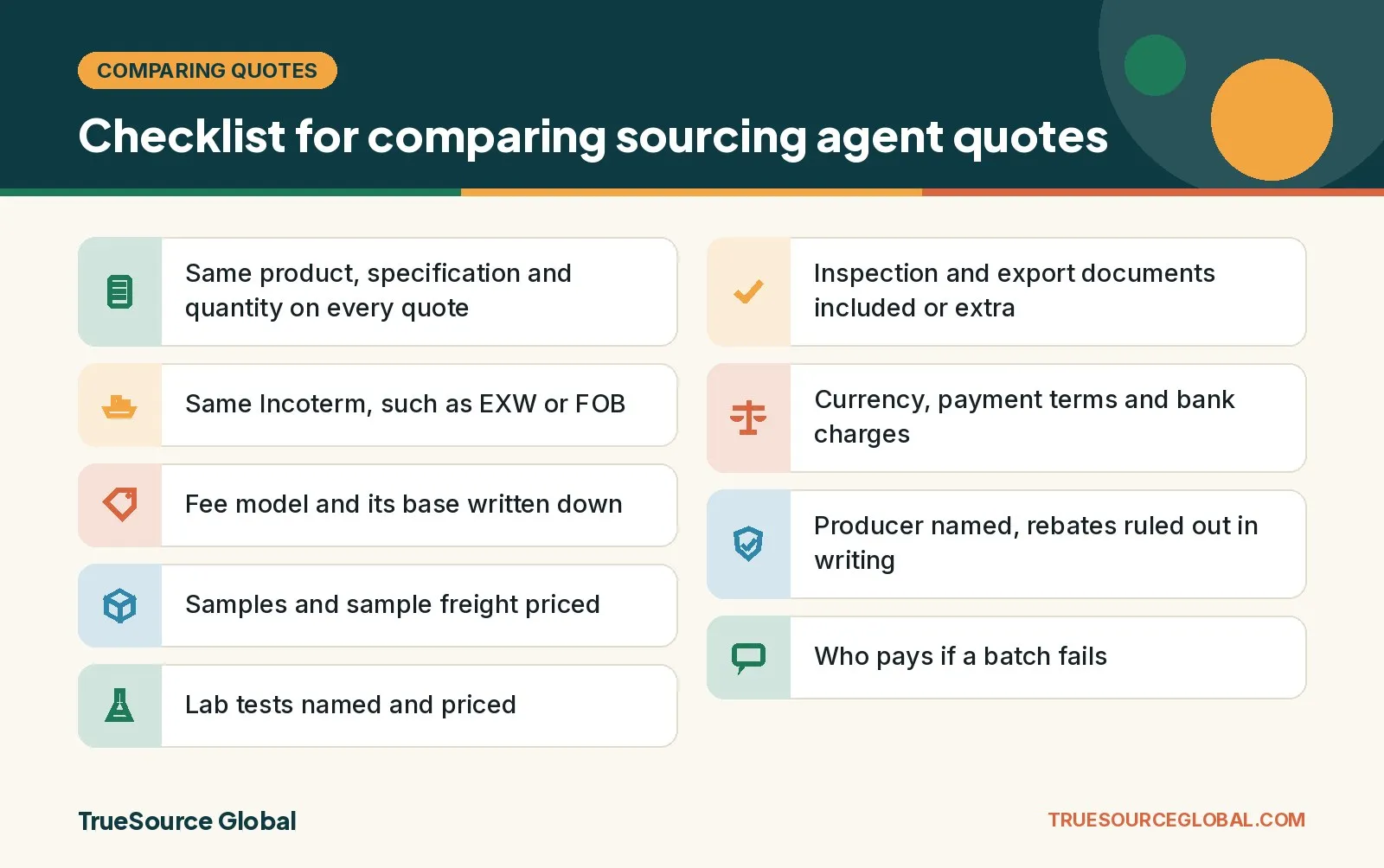
- Same product, specification and quantity on every quote.
- Same Incoterm, such as EXW or FOB.
- Fee model and its base written down.
- Samples and sample freight priced.
- Lab tests named and priced: for herbs, heavy metals and microbiology; for chews, moisture and microbiology.
- Inspection and export documents included or extra.
- Currency, payment terms and bank charges.
- Producer named, rebates ruled out in writing.
- Who pays if a batch fails.
Before you send money, check the agent’s GSTIN on the GST portal. Our supplier vetting checklist covers the other lookups, and the export documents guide lists the papers each product needs.
How does TrueSource Global charge?
We do not publish a rate. Our terms are set out in your written quote, before you commit. The quote shows product, packaging, testing, documents and shipping as separate lines, and we tell you who makes your goods. We would rather you compared us line by line than on a single percentage.
That habit comes from buying for our own brands, IndoFolk Wellness and AyurPet, where the fee was never the line that decided the margin. Packaging, testing and freight were. We do not own factories. Partner facilities make the goods, and our job is the work in between: specification, samples, batch checks and export papers. See the Ayurvedic sourcing agent and pet product sourcing agent pages for what that covers, and quality and documentation for the batch documents.
What should you do next?
Write a one-page brief with your product, specification, quantity, packaging and destination. Send it to three agents, ask for quotes on the same Incoterm, and run the checklist above. If you are planning your own label, our private label page lists what to decide first.
When the brief is ready, request a quote. We reply within 12 hours with a written quote that shows our terms. Or book a call and bring the other quotes; we will go through them with you line by line.
Frequently asked questions
How much does a sourcing agent in India charge?
There is no standard rate. Agents charge a commission on order value, a fixed service fee or a margin in the unit price, and the amount depends on the product, the order size and how much work is involved. Compare total landed cost for the same order rather than the headline percentage.
Is a commission or a fixed fee better?
Neither is better on its own. A commission grows with your order value, which suits small first orders but costs more as you scale. A fixed fee stays the same however large the order, but check exactly what it covers, because work outside the scope is often billed as extras.
What does it mean when an agent says it charges no commission?
It usually means the agent earns a margin inside the unit price, or takes a rebate from the producer. Neither is wrong if it is disclosed. Ask who makes the product, what the unit price includes, and whether the agent receives any payment from the producer.
What should be included in a sourcing agent's quote?
The product and specification, quantity, Incoterm, fee model and its base, sample costs, named lab tests, inspection, export documents, packaging, currency and payment terms. It should also say who pays if a batch fails. If a line is missing, ask whether it is included or extra.
What does TrueSource Global charge?
We do not publish a standard rate, because the work differs a lot between a single bulk herb and a private-label pet range. Our terms are set out in your written quote, with product, packaging, testing, documents and shipping shown separately, before you commit to anything.
Sources
Ready to source this from India?
Tell us the product, volume and market. We'll reply within 12 hours with a quote, MOQ and sample plan, with no obligation.