Areca Leaf Plates Wholesale from India: Buyer's Guide
How to buy areca leaf plates wholesale from India: shapes and sizes, quality checks, packing against mould, food-contact and eco-claim rules, MOQ and samples.
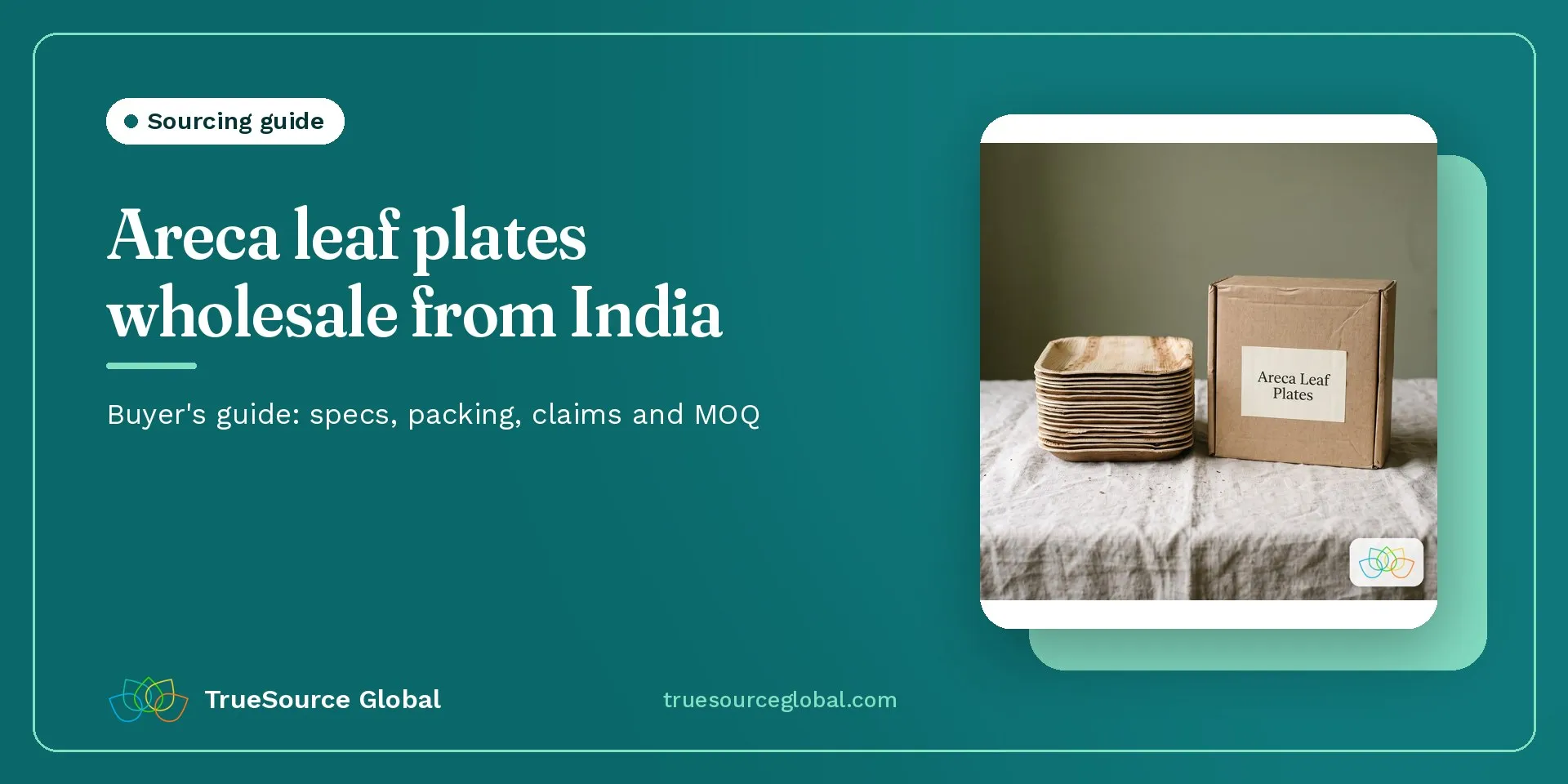
Areca leaf plates are pressed from naturally fallen areca palm leaves, with no plastic lining. To buy them wholesale from India, agree four things with your supplier before you talk price: the shapes and sizes, a written quality standard, how the plates are dried and packed, and the documents you need for your market. Then approve samples before the first container.
Caterers, event companies, food trucks and eco retailers use areca plates in place of paper or foam plates. Every plate is slightly different, because it is a natural leaf. The buyer’s job is to turn “natural variation” into a standard both sides can check.
How are areca leaf plates made?
The fallen leaf sheaths are collected, cleaned and softened, then heat-pressed into shape in a mould and trimmed. No glue, lining or coating is added. Drying and packing after pressing matter most for export, because a plate that leaves the factory damp can grow mould on a long sea voyage.
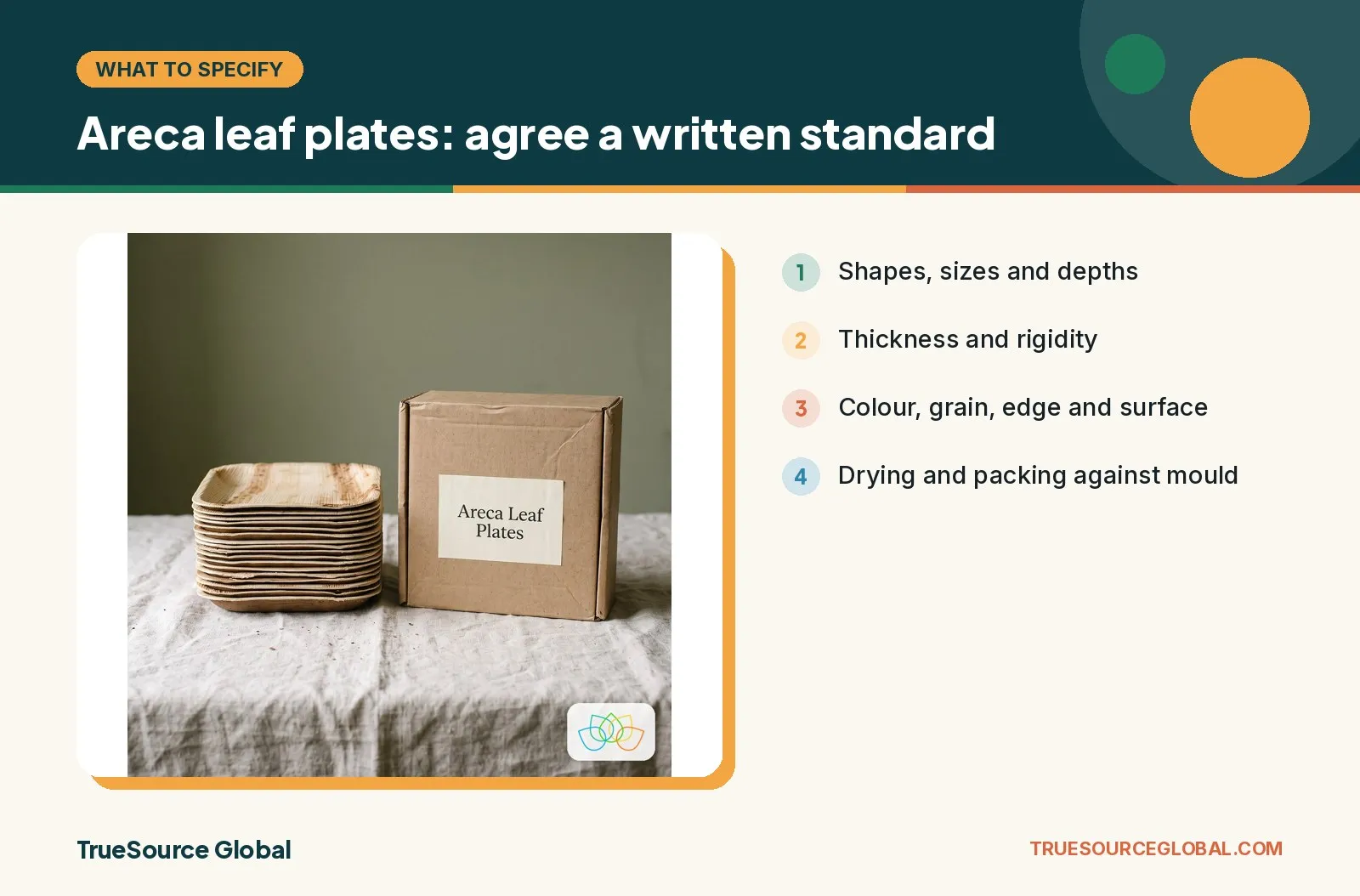
What should your specification include?
Put each line in writing, and ask the supplier to confirm it before you compare quotes.
- Shapes and sizes: round, square, rectangular, bowls, trays and compartment plates, each with the size in inches or centimetres and the depth.
- Thickness and rigidity: what the plate must hold without bending. Agree it on a sample.
- Colour and grain: natural variation is normal. Agree what is acceptable, for example no dark patches over a stated size.
- Edge and surface: smooth, trimmed edges, no cracks, no loose fibres.
- Moisture and mould: plates fully dried, with no visible mould at loading.
- Packing: pieces per sleeve, sleeves per carton, carton strength, and your branded outer pack if you want one.
How do the buying options compare?
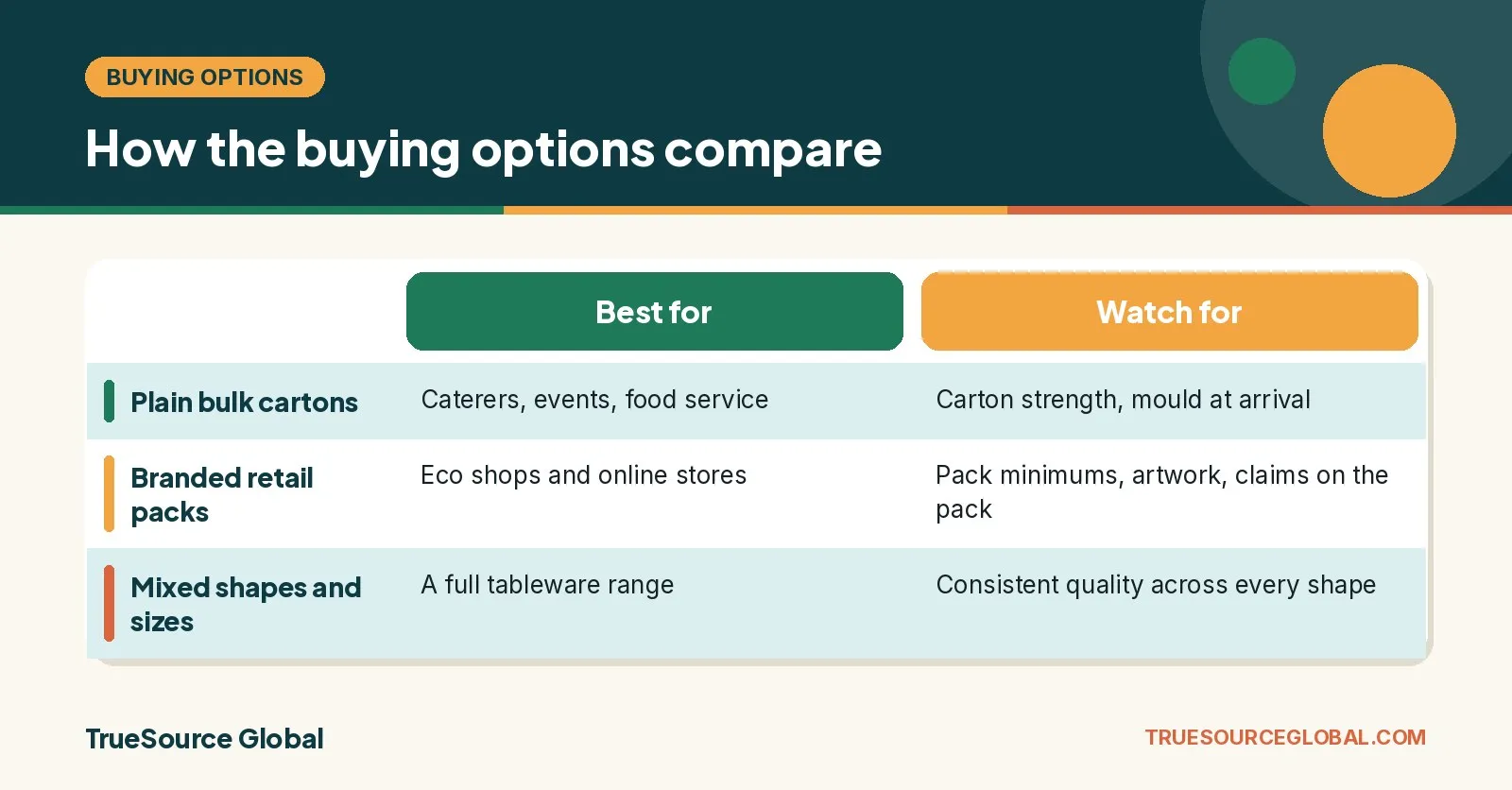
| Option | Best for | Watch for |
|---|---|---|
| Plain bulk cartons | Caterers, events, food service | Carton strength, pieces per carton, mould at arrival |
| Branded retail packs | Eco shops and online stores | Pack minimums, artwork, claims printed on the pack |
| Mixed shapes and sizes | A full tableware range | Consistent quality across every shape |
Which checks and documents should you ask for?
Areca plates are simple products, so most problems come from quality drift and packing. Ask for:
- Pre-shipment photos or an inspection of random cartons against the approved sample.
- A packing list that matches your carton marks and quantities.
- Food-contact documents your market expects for tableware.
- Any test reports the supplier holds, for example on compostability, if you plan to make that claim.
- Plant-product import requirements: ask your customs broker whether your market needs a phytosanitary or fumigation certificate for plant-based products.
What are the food-contact and eco-claim rules?
- European Union: all food-contact materials fall under the framework Regulation (EC) No 1935/2004, which requires that they do not transfer anything to food that could harm health or change the food unacceptably. The single-use plastics directive targets plastic products. Ask your adviser how it applies to your exact product, especially if any coating is involved.
- United States: environmental claims such as “compostable” or “biodegradable” must be substantiated under the FTC’s Green Guides.
- United Kingdom: environmental claims must be accurate and provable, and food-contact materials must be safe for their use. Check current guidance before you print claims on packs.
Describe the product plainly, keep the evidence for every claim, and let your adviser sign off pack copy for each market.
How should you plan a first order?
Start small and wide. Order samples of every shape you might sell, test them with real food (hot, oily and wet dishes), and note which ones hold up. Then place a pilot order of your two or three best shapes, inspect the cartons when they arrive, and only then commit to a full container. This keeps your risk low while you learn how the plates travel to your market and how your customers use them.
What should make you cautious about a supplier?
- No sample, or a sample far better than the first shipment. Keep a retained sample and compare.
- Vague answers about how plates are dried and packed.
- No written quality standard, only “natural product, variation expected”.
- A quote that leaves out cartons, packing or branded packs, so the real cost appears later.
What are the MOQ, sample and packaging terms?
We work with partner producers and do not own factories. For most products the minimum is 500 units per SKU. Pilot runs of 100 to 250 units are available at a slightly higher unit cost. Samples dispatch in 5 to 7 working days. Production takes 7 to 14 business days after order and artwork approval. We reply to quote requests within 12 hours. Shapes, sizes, branded outer packs and bulk cartons are agreed per quote.
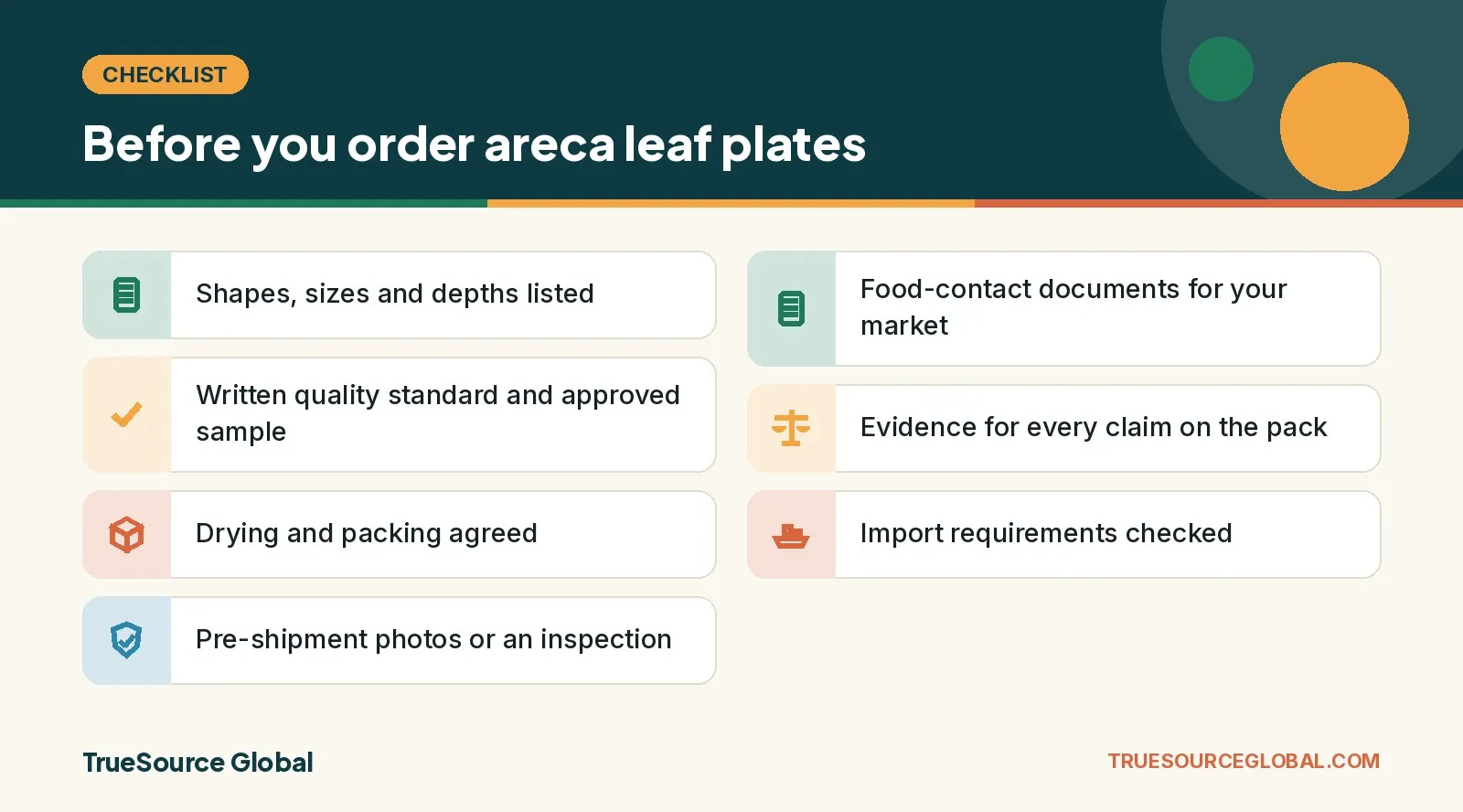
Areca leaf plates buyer checklist
- Shapes, sizes and depths listed.
- A written quality standard with an approved sample.
- Drying and packing agreed as part of the order.
- Pre-shipment photos or an inspection.
- Food-contact documents and import requirements checked for your market.
- Evidence held for every environmental claim on the pack.
Next steps
See our Areca Leaf Plates page. For your own brand, read about private label, and see how we document every order on our quality and documentation page. When you know your shapes and volumes, request a quote or book a call.
Frequently asked questions
What are areca leaf plates made from?
They are made from naturally fallen leaf sheaths of the areca palm. The leaves are collected, cleaned, softened and heat-pressed into shape, with no plastic lining. Every plate shows natural grain and some colour variation, which buyers should accept in their quality standard.
How do I stop areca plates getting mouldy in transit?
Ask the supplier how plates are dried after pressing and how they are packed, and agree that both are part of the order. Plates should be fully dry, packed in clean cartons and shipped in a dry container. Inspect a sample of cartons on arrival, and keep a retained sample from the approved batch to compare against.
Can I call areca leaf plates compostable on my packaging?
Only if you can substantiate it for your market. In the US the FTC Green Guides set out how environmental claims such as compostable must be supported, and the EU and UK also require environmental claims to be accurate and provable. Ask the supplier for any test reports they hold, and check with your adviser before you print the claim.
What is the minimum order for areca leaf plates from TrueSource Global?
Most products run at 500 units per SKU, with pilot runs of 100 to 250 units at a slightly higher unit cost. Shapes, sizes, branded outer packs and bulk cartons are agreed per quote. Samples dispatch in 5 to 7 working days, and we reply to quote requests within 12 hours.
Sources
Ready to source this from India?
Tell us the product, volume and market. We'll reply within 12 hours with a quote, MOQ and sample plan, with no obligation.