Are Himalayan Yak Chews Safe for Dogs? What Pet Brands Should Specify
Are yak chews safe for dogs? A balanced answer, plus what pet brands should specify, test and print on the pack: hardness, sizing, moisture and milk.
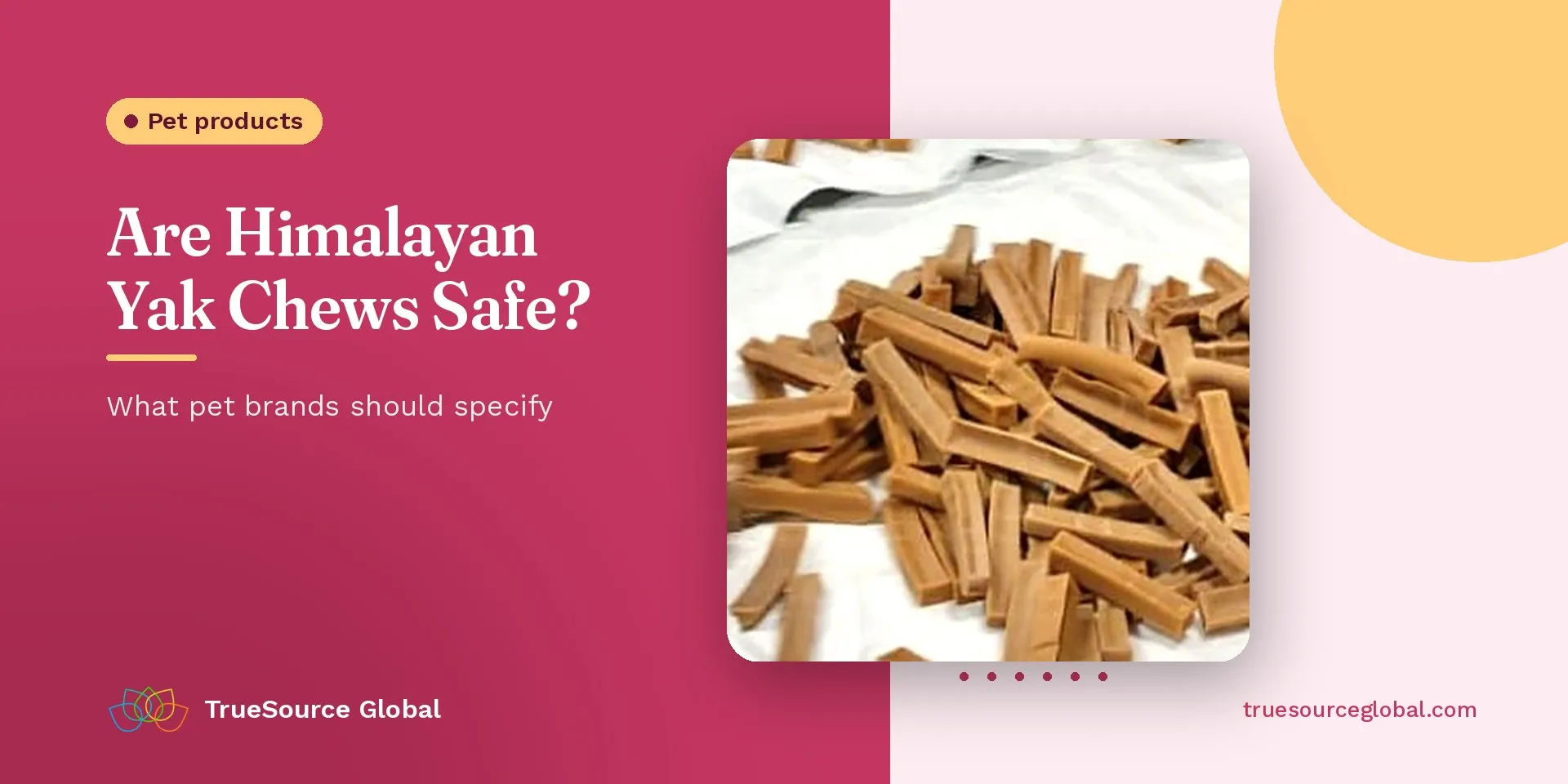
Himalayan yak chews suit many adult dogs when the chew is sized to the dog, given under supervision and taken away before the end piece can be swallowed. They are not risk-free: they are very hard, so heavy chewers can break teeth, and they are made from milk. A pet brand has to specify, test and print those limits.
That is the honest answer pet parents are looking for when they search the question, and it is the answer your pack and product page need to give. This guide sets out the evidence, who should avoid yak chews, and what a brand should write into its specification, test for every batch and print on the pack.
Are Himalayan yak chews safe for dogs?
A traditional yak chew is a hard cheese made from yak and/or cow milk, with a little salt and lime juice to set the curd, pressed into bars and dried for weeks until it is very hard. That short ingredient list is a large part of the appeal: a brand can list everything that is in the chew. But a simple recipe does not make a chew safe for every dog. The risks come from how hard it is, how big it is and who is chewing it.
Tooth fracture. This is the risk vets raise most. Cornell’s Riney Canine Health Center says fractured teeth are commonly caused by chewing very hard objects, and that veterinary dentists suggest you should be able to dent a chew with your fingernail. A 2019 laboratory study produced fractures of the large upper cheek tooth at forces within the chewing capability of an average dog, although the authors note that the role of everyday chewing in fractures is still debated. A Veterinary Times review adds that there are no agreed limits for the hardness of dog chews. A fully dried yak chew will often fail the thumbnail test, so be honest about it, particularly for dogs that crunch rather than gnaw.
Choking and swallowing. As a chew wears down, the last piece can become small enough to swallow whole. Pieces that size can cause choking or a blockage, which is why sizing and end-piece guidance matter as much as the recipe.
Dairy. Yak chews are a milk product. Dogs with a known dairy allergy or intolerance can react to them.
Hygiene. The CDC reminds owners that food safety rules apply to dog food and treats, that Salmonella can spread between dogs and people, and that people should wash their hands after handling treats. That is why proper drying and batch microbiology belong in your specification.
Put together: yak chews are a reasonable choice for many adult dogs, and a poor choice for some. The brand’s job is to make it easy for the owner to tell which group their dog is in.
Who should avoid yak chews?
Print a short block like this on pack and on the product page, and keep it consistent across both.
Not suitable for:
- young puppies whose adult teeth are still coming through;
- dogs with broken, worn or loose teeth, dental disease or recent dental work;
- very heavy or aggressive chewers that bite down hard with their back teeth;
- dogs that gulp or try to swallow chews whole;
- dogs with a known dairy allergy or intolerance;
- dogs on a vet-prescribed or restricted diet, unless their vet agrees.
If in doubt, ask your vet.
Set the minimum age yourself and be ready to say what it is based on. Don’t borrow a number from another brand’s pack.
What should a pet brand specify?
Your specification is where safety starts. If it isn’t written down, the producer isn’t held to it. For each SKU, agree:
- Milk source and proportion. “Yak milk” chews are often a blend of yak and cow milk. State the proportion and make sure the label says the same.
- Ingredients in full. Milk, salt and lime juice for an original chew, plus any named botanicals for functional chews. Nothing added that isn’t on the label.
- Hardness and drying. Minimum drying time and how the producer checks a chew is fully dry. Under-dried chews soften, crack or grow mould in transit.
- Moisture at release. The single best predictor of shelf stability. Agree the method and the release limit with the producer and record it on every CoA.
- Size bands. Weight per piece, length and thickness for each band, with a tolerance.
- Visual grade. Natural colour variation is fine; cracks, dark spots, soft areas and foreign matter are not.
- Packaging. Moisture-barrier pouches with a zip are the usual choice, with batch number and best-before printed on each pack.
Our guide to sourcing yak chews in bulk covers specification and grading in more detail.
How should yak chews be sized by dog weight?
There is no industry standard for yak chew sizes, so every brand writes its own. The bands below are an example of how to structure the table, not a standard to copy. Set your own dog-weight ranges, then check them on real dogs before you print them.
| Size band | Example dog weight on pack | What to specify | Pack guidance |
|---|---|---|---|
| Small | Up to 10 kg | Piece weight range, length, thickness, tolerance | “Choose a larger size if your dog can fit the whole chew in its mouth” |
| Medium | 10–20 kg | As above, plus a minimum length | Same rule, plus end-piece guidance |
| Large | 20–30 kg | As above | Same rule, plus heavy-chewer warning |
| Extra large | Over 30 kg | As above, with the tightest weight tolerance | Same rule, plus heavy-chewer warning |
Two rules matter more than the exact numbers. First, the chew should always be too long for the dog to fit wholly in its mouth. Second, when in doubt, the pack should tell owners to size up, never down.
What should you test for every batch?
- Moisture content, by the method you agreed, against your release limit.
- Microbiology, including Salmonella and the other organisms your market and retailers ask for.
- Foreign matter and visual grading, with photos of a random sample from each carton.
- Weight and size check of a sample from each band against your tolerances.
- Hardness check, by a consistent in-house method, so a batch that is much harder or softer than your approved sample is caught before it ships.
Ask for a batch Certificate of Analysis that states each test, the method and the limit, and keep a retained sample of every approved batch. Our quality and documentation page explains how we check batches with producers.
What must go on the pack?
Start with your market’s labelling rules. In the US, animal food labels are governed by 21 CFR Part 501, and the FDA explains how it regulates pet food and treats. Other markets have their own feed labelling rules; check them with your regulatory adviser. On top of the legal minimum, a yak chew pack should carry:
- the size band and the dog weight range it is for;
- the full ingredient list, naming the milk source;
- supervision: “Always supervise your dog with this chew”;
- end-piece guidance: “Take the chew away when it is small enough to be swallowed”;
- heavy-chewer and dental warning: stop if the dog is breaking pieces off or wearing its teeth;
- the “not suitable for” block above, and fresh water to be available;
- storage advice (cool, dry place, reseal after opening), batch number and best-before date;
- hygiene: wash hands after handling.
Avoid dental or health claims unless your regulator allows them for your market and you can support them. The Veterinary Oral Health Council runs its own acceptance programme for dental products; don’t imply its acceptance unless you have it.
How should the end piece be puffed?
Many brands tell owners to puff the leftover end rather than throw it away: soak it briefly in water, heat it in a microwave until it expands into a light, crunchy puff, and let it cool completely before giving it. Done well, it removes the swallowing risk of a small hard end and wastes nothing.
Write the instructions from your own tests, not from a competitor’s pack. Heating time depends on the size of the piece, how long it soaked and the microwave, so test a range of end pieces and print the time that worked, with a warning that the puff is hot and must cool first. Tell owners to supervise the dog with the puff too.
Import checks to plan for
Because yak chews are a product of animal origin, import rules are stricter than for a plant-based treat. In the US, the FDA notes that a USDA APHIS permit is generally required for animal food containing dairy or other animal-origin material from countries with livestock diseases exotic to the US. In Great Britain, the dog chews import note requires a health certificate and an establishment approved to export to GB. Confirm your route before you agree a price. TrueSource Global ships yak chews from India to any country, including the UK, the EU and the US, and prepares the health certificate and export documents each route requires. Our comparison of private label yak chew manufacturers for US brands walks through the US steps.
How we approach yak chew safety
We hand-sort and batch-check yak chews with our producer teams, and we test our recipes on our own dogs before they go into a client’s range. We write hardness, size bands, weight per piece and moisture into each client’s specification, and we tell you who makes the product. Most pet products start with pilot runs from 100 units, samples are usually dispatched within 5–7 working days, and production typically takes 7–14 business days after the order and artwork are approved.
For pet brands that also want to explain Ayurvedic ingredients to customers, AyurPet, a sister brand of TrueSource, offers a free Ayurveda for pets course written for pet parents.
See the Original Himalayan Yak Cheese Chew our yak chews wholesale and private label range and the wider pet wellness range, or request a pet product quote with your sizes, volumes and destination market.
This article is general information, not veterinary or regulatory advice. Pet owners should ask their vet whether a chew suits their dog.
Frequently asked questions
Are yak chews safe for dogs to eat?
They suit many adult dogs when the chew is the right size, the dog is supervised and the small end piece is taken away before it can be swallowed whole. The main risks are broken teeth in heavy chewers, choking on small pieces and a reaction in dogs that don't tolerate dairy. Owners of dogs with dental problems or health conditions should ask their vet first.
Can yak chews break a dog's teeth?
They can. Fully dried yak chews are very hard, and veterinary dentists advise avoiding chews you cannot dent with a thumbnail, because chewing very hard objects is a common cause of fractured teeth. Brands should warn heavy chewers on pack and tell owners to stop if the dog is breaking off hard pieces or its teeth show wear.
What do you do with the end of a yak chew?
Take it away once it is small enough to be swallowed whole. Many brands tell owners to soak the end piece in water and heat it in a microwave until it puffs into a crunchy treat, then let it cool completely before giving it. Heating times vary with the piece and the microwave, so the brand should test and print its own instructions.
Are yak chews suitable for puppies?
Be cautious: young puppies' teeth and jaws are still developing, and a very hard chew is a poor match for them. A brand should state a minimum age on pack and say what it is based on, and owners should check with their vet before giving any hard chew to a puppy.
Do yak chews contain lactose or dairy?
Yes, they are made from milk, usually yak and cow milk with salt and lime juice. Dogs with a known dairy allergy or intolerance, or on a vet-prescribed diet, should not be given them without veterinary advice, and the pack should name the milk source clearly.
Sources
- AVMA: Pet dental care
- Cornell Riney Canine Health Center: Risks of a fractured tooth
- Soltero-Rivera et al. (2019): Fracture limits of maxillary fourth premolar teeth in domestic dogs under applied forces, Frontiers in Veterinary Science
- Veterinary Times: Exploring tooth fracture risks in canine patients (2019)
- Veterinary Oral Health Council
- CDC: Dogs (Healthy Pets, Healthy People)
- FDA: Pet food
- FDA: Importing animal food
- eCFR: 21 CFR Part 501, animal food labelling
- USDA APHIS: Import animal products
- GOV.UK: Dog chews, Import Information Note ABP/3C
Ready to source this from India?
Tell us the product, volume and market. We'll reply within 12 hours with a quote, MOQ and sample plan, with no obligation.