Brown Rice Flour Bulk Suppliers in India: Buyer's Guide
How to buy brown rice flour in bulk from an Indian supplier: grind and mesh, gluten-free proof, arsenic and microbiology tests, shelf life, MOQ and market rules.
To buy brown rice flour in bulk from India, write the specification before you ask for prices: whole-grain brown rice, how it is milled, particle size, moisture, and how gluten-free status is proven. Then ask every supplier for a batch Certificate of Analysis (CoA) from an independent lab, including gluten and inorganic arsenic, and only compare quotes against that one specification.
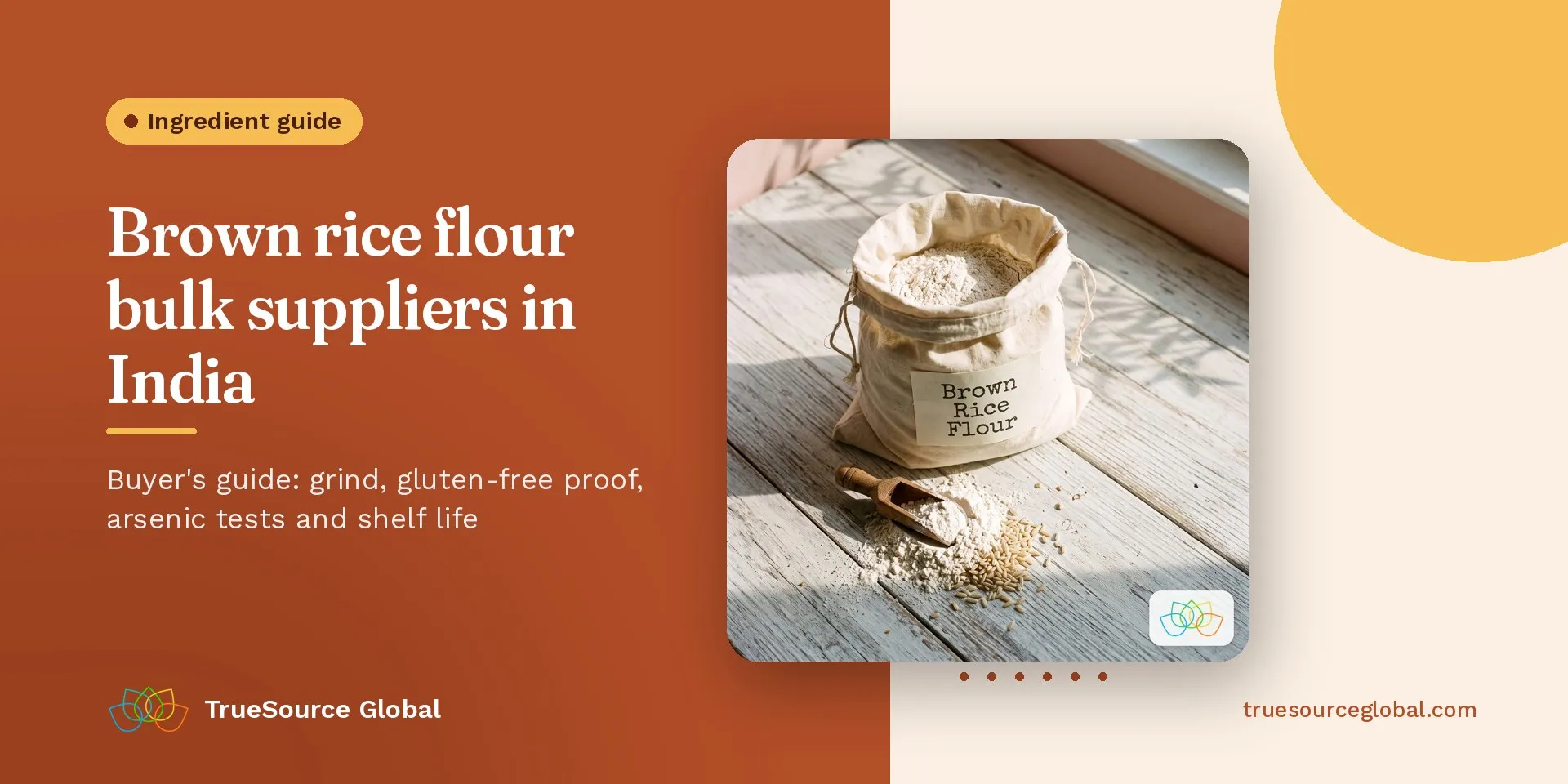
Brown rice flour is milled from whole brown rice, so it keeps the bran and has a nutty flavour. It is naturally free of gluten. Bakeries and food brands use it in gluten-free breads, cakes, pancakes and batters, and as a thickener. Our brown rice flour is stone-ground and supplied in retail packs or in bulk.
What should your brown rice flour specification include?
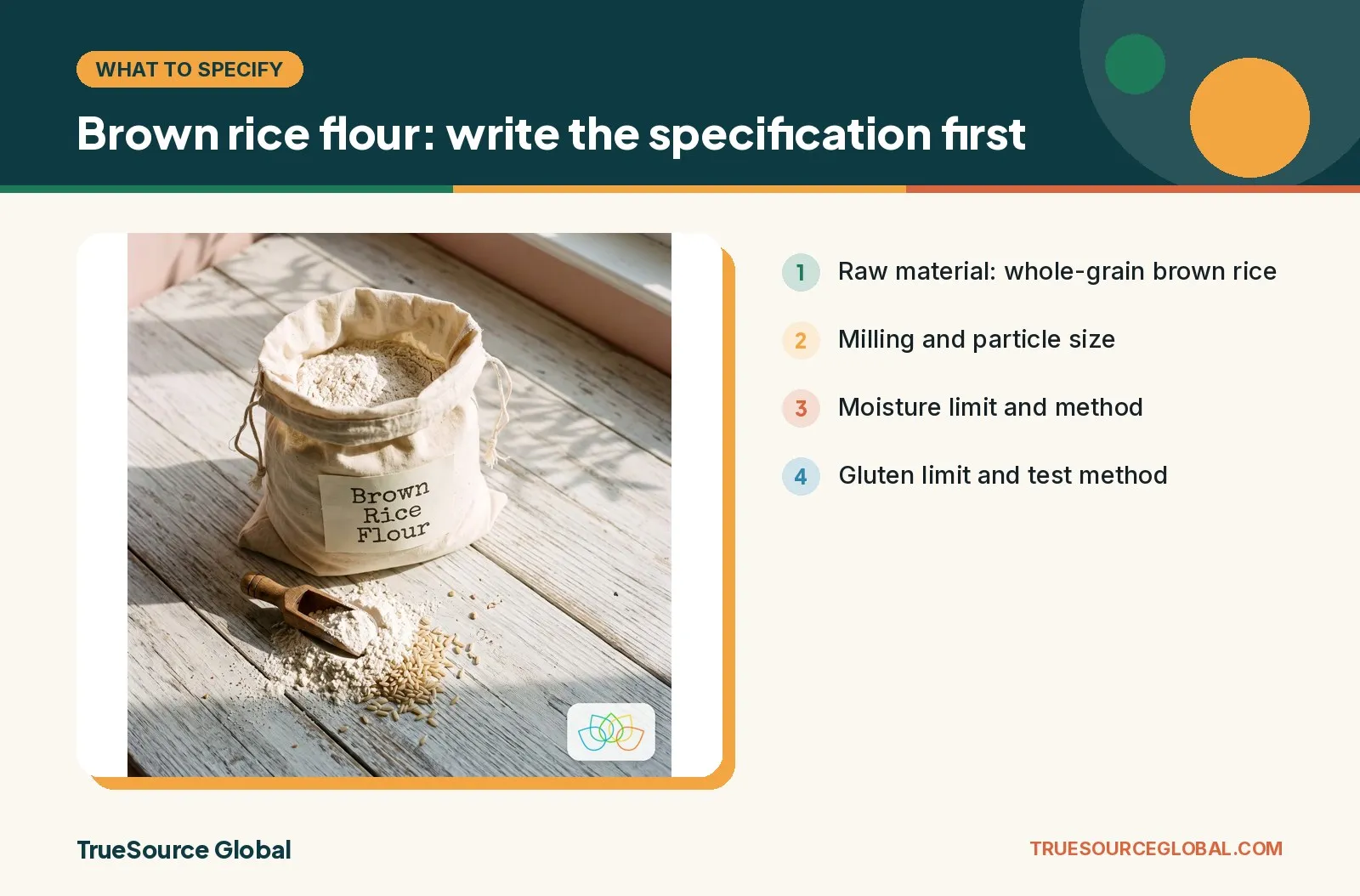
Put each line in writing, and ask every supplier to confirm it before you compare quotes.
- Raw material: whole-grain brown rice, with the rice variety if it matters to you.
- Milling: stone-ground or another method. Milling affects texture, temperature during grinding and how the flour bakes.
- Particle size: a mesh figure and the sieve method. Bread, cake and batter makers often want different grinds.
- Moisture: a limit and a method. Moisture affects flow, caking and shelf life.
- Gluten: a limit (for example 20 parts per million for gluten-free claims) and the test method.
- Appearance and taste: colour, odour and flavour your team can check against an approved sample.
Which tests and documents should you ask for?
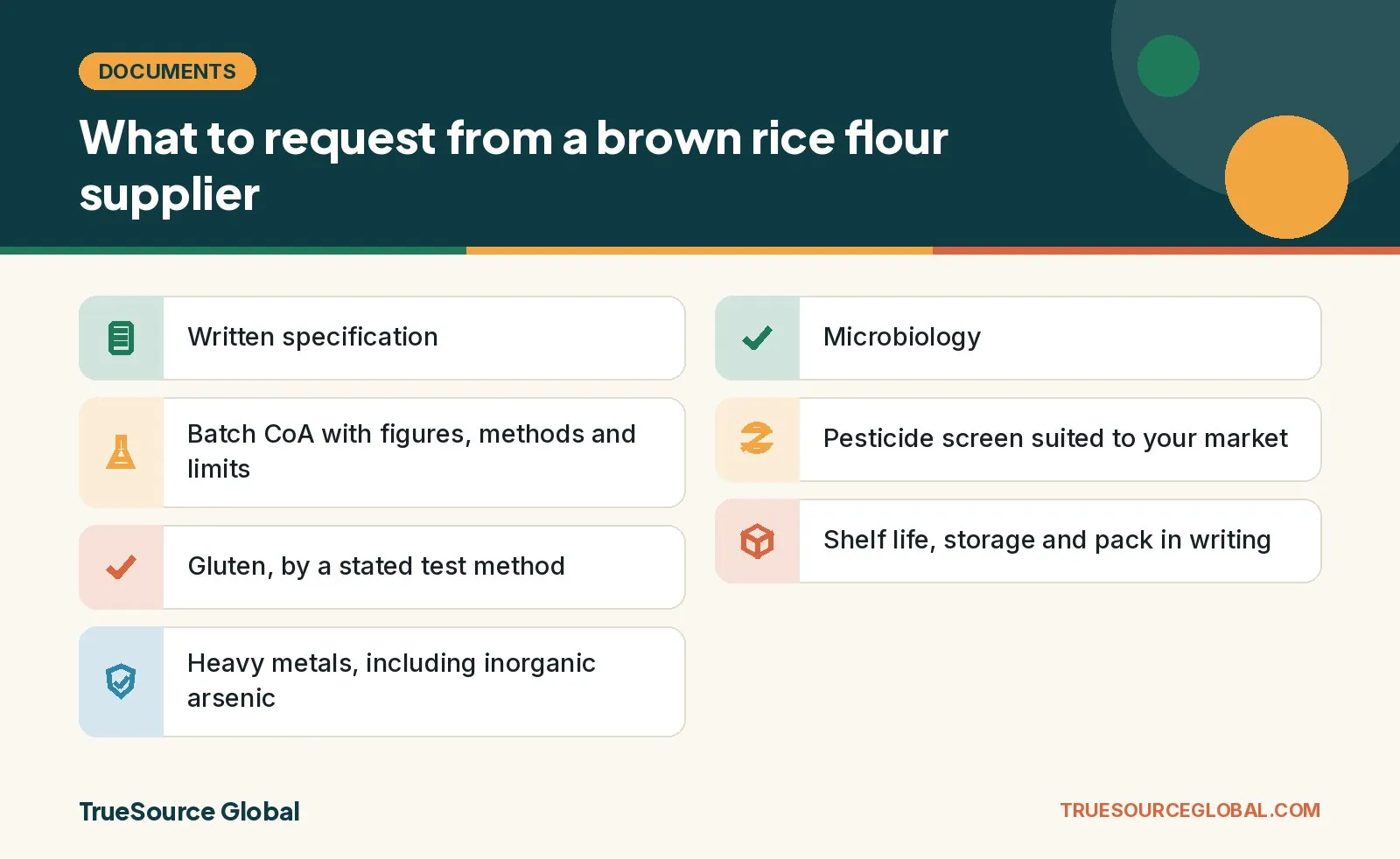
Ask for a batch CoA that gives the figure, the method and the limit for each test, with the lab name and batch number:
- Gluten, by a stated test method, if you will sell gluten-free.
- Heavy metals: lead, cadmium, mercury and arsenic, including inorganic arsenic. Rice takes up arsenic from soil and water, so this line matters more for rice than for many other grains.
- Microbiology: total plate count, yeast and mould, Salmonella and E. coli.
- Pesticide residues: a screen suited to your destination market.
- Moisture and particle size, matched to your specification.
Our quality and documentation page explains what we arrange for each batch.
Brown or white rice flour: which do you need?
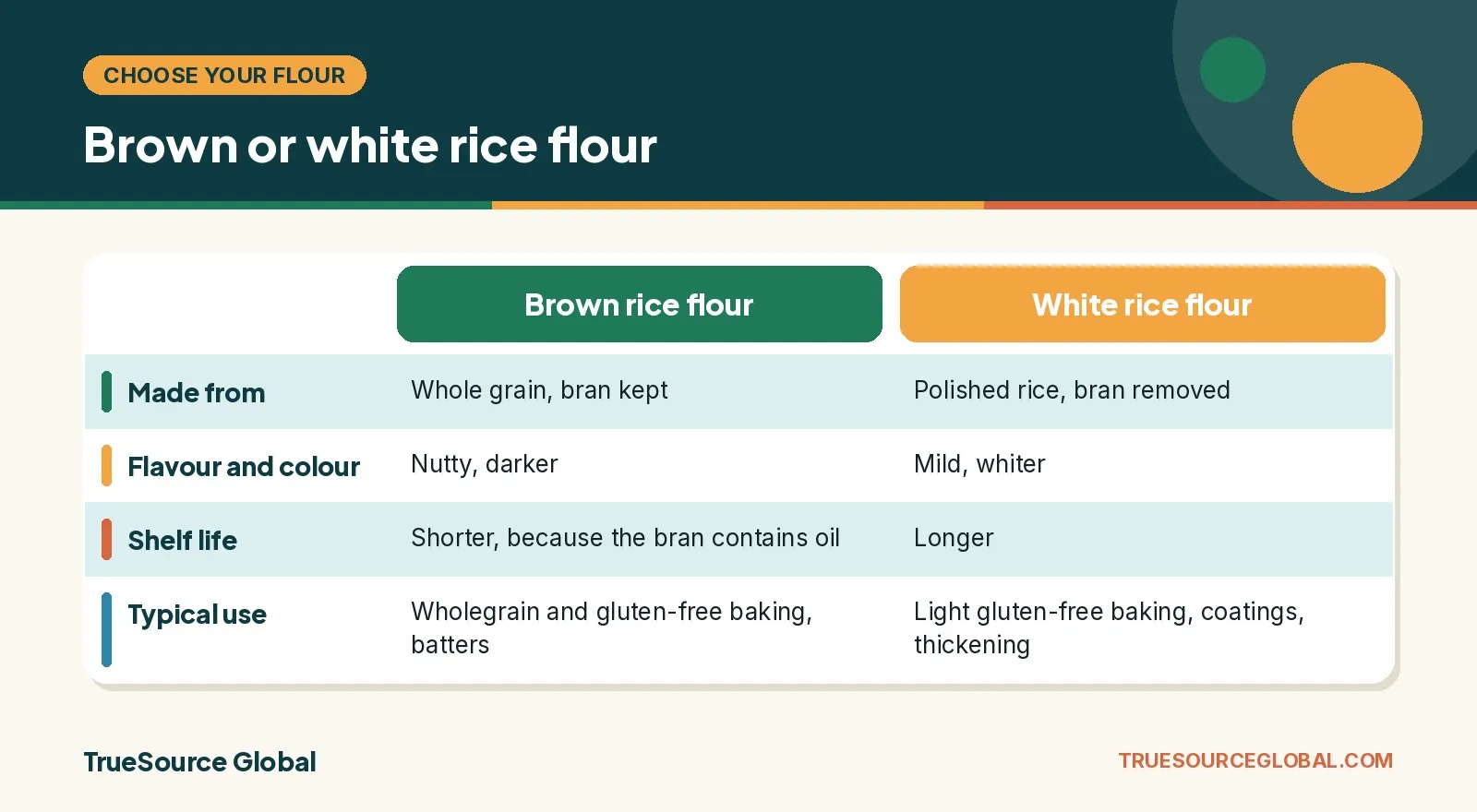
| Point | Brown rice flour | White rice flour |
|---|---|---|
| Made from | Whole grain, bran kept | Polished rice, bran removed |
| Flavour and colour | Nutty, darker | Mild, whiter |
| Shelf life | Shorter, because the bran contains oil | Longer |
| Typical use | Wholegrain and gluten-free baking, batters | Light gluten-free baking, coatings, thickening |
How do you protect shelf life?
Because brown rice flour keeps the bran, ask the supplier three things in writing: the shelf life they assign, the storage conditions it depends on, and the pack it was set for. Agree a pack with a good moisture barrier and a seal you can check. On arrival, store stock cool and dry, rotate it first in, first out, and smell-test retained samples against the approved sample.
What should make you cautious about a supplier?
- A quote with no specification, or one that only says “rice flour”.
- A “gluten-free” statement with no test result or method.
- A heavy metals result that leaves out arsenic.
- CoA results that read “complies” with no figure, method or limit, or the same CoA for every order.
- No answer on how the mill keeps rice separate from wheat.
What are the MOQ, sample and packaging terms?
We work with partner producers and do not own factories. For most products the minimum is 500 units per SKU. Pilot runs of 100 to 250 units are available at a slightly higher unit cost. Samples dispatch in 5 to 7 working days. Production takes 7 to 14 business days after order and artwork approval. We reply to quote requests within 12 hours. Packaging options include kraft pouches, glass bottles, PET jars and tin boxes, and bulk formats are agreed per quote.
What are the market rules in the US, EU and UK?
- United States: food facilities must be registered with the FDA, and importers have Foreign Supplier Verification Program duties. A “gluten-free” label must meet 21 CFR 101.91, which sets a limit of less than 20 parts per million of gluten.
- European Union: “gluten-free” claims follow Regulation (EU) No 828/2014, with the same 20 mg per kg limit. Contaminant limits, including inorganic arsenic in rice products, are in Regulation (EU) 2023/915.
- United Kingdom: gluten-free rules retained from the EU regulation apply. Check current Food Standards Agency guidance before you print claims.
Brown rice flour buyer checklist
- A written specification: raw material, milling, mesh, moisture, gluten limit.
- A sample approved against it before the first order.
- A batch CoA with figures, methods and limits, including gluten and inorganic arsenic.
- Your own lab check on the first batch.
- Shelf life, storage and pack agreed in writing.
- Labelling rules checked for every claim.
Next steps
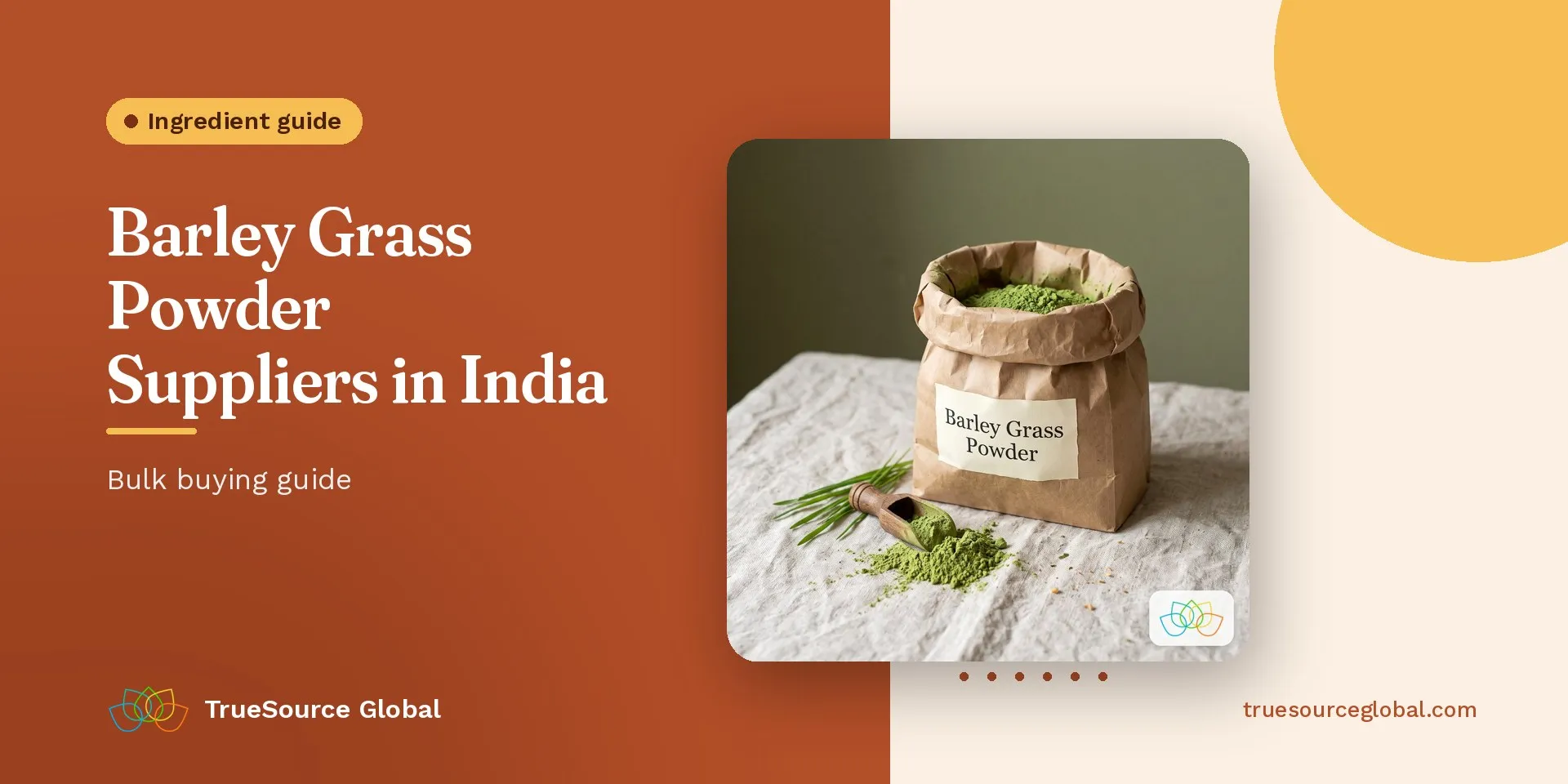
See our Brown Rice Flour page and the wider superfoods and flours range. If you also buy green or root powders, our barley grass powder guide follows the same method. For your own brand, read about private label. When you have a volume in mind, request a quote or book a call.
Frequently asked questions
Is brown rice flour gluten-free?
Rice contains no gluten, but flour can pick up gluten from shared mills, storage and transport. If you will sell it as gluten-free, you need test evidence for each batch against your market's limit. In the US and the EU that limit is 20 parts per million. Ask the supplier how the mill keeps rice separate from wheat and which gluten test it uses.
Why should I test brown rice flour for arsenic?
Rice plants take up arsenic from soil and water more than many other crops, and some of it stays in the grain. Ask for a heavy metals result that includes inorganic arsenic, and check the maximum levels for rice products in your market, such as Regulation (EU) 2023/915 in the EU.
How long does brown rice flour keep?
Brown rice flour keeps the bran, which contains oil, so it does not keep as long as white rice flour. Ask the supplier for the shelf life they assign, the storage conditions it depends on and the pack it was set for, and keep stock cool and dry.
What is the minimum order for brown rice flour from TrueSource Global?
Most products run at 500 units per SKU, with pilot runs of 100 to 250 units at a slightly higher unit cost. Bulk pack formats are agreed per quote. Samples dispatch in 5 to 7 working days, and we reply to quote requests within 12 hours.
Sources
- eCFR: 21 CFR 101.91, gluten-free labeling of food
- EUR-Lex: Regulation (EU) No 828/2014 on information about the absence or reduced presence of gluten in food
- EUR-Lex: Regulation (EU) 2023/915 on maximum levels for contaminants in food
- FDA: Registration of food facilities, guidance for industry
- FDA: FSMA final rule on Foreign Supplier Verification Programs
Ready to source this from India?
Tell us the product, volume and market. We'll reply within 12 hours with a quote, MOQ and sample plan, with no obligation.